

Blog

Explain the importance of using data at Company X to accurately determine problems and issues.
Data should be an indispensable component of the problem-discovery process at Company X because it forms the foundation on which the firm delivers value to its clients. This is because a reliance on superficial symptoms or assumptions can result in a misallocation...

Explain what evidence-based practice is and provide two examples of how Company X could apply it.
Evidence-based practice (EBP) is an organized method that human resource professionals (people professionals) use to guide and justify their decisions or recommendations (Gill, 2018). It involves the deliberate integration of the best available evidence from various sources (such as organisational data, academic...

Turning HR Models into Real Workplace Action
The modern corporate landscape often suffers from a disconnect between boardroom frameworks and the daily experience of employees. Human Resources (HR) models, while theoretically robust, frequently remain abstract concepts that fail to drive tangible change. To bridge this gap, organizations must focus...

Linking CIPD Principles to Organisational Strategy
In the contemporary business landscape, the role of the human resources function has undergone a profound transformation. No longer confined to the periphery of administrative tasks and compliance monitoring, the modern people profession is increasingly positioned at the very heart of organisational...
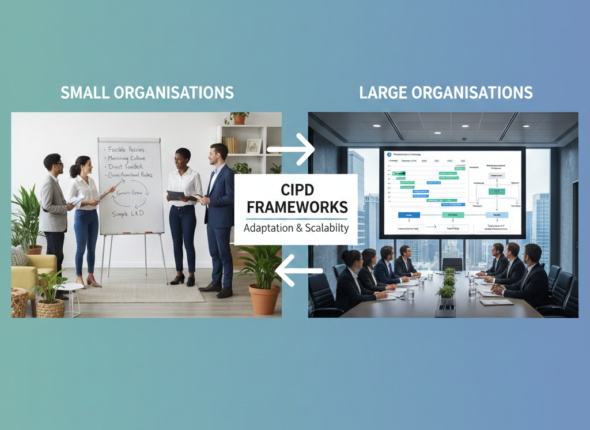
Case studies: Applying CIPD Frameworks in Small vs Large Organisations
The Chartered Institute of Personnel and Development (CIPD) has long served as the global standard-bearer for the HR and People Development profession. Its frameworks, particularly the CIPD Profession Map, provide a comprehensive blueprint for ethical, evidence-based, and impactful people management. However, the...

Navigating CIPD qualifications: choosing between Level 3, 5, or 7
The field of Human Resources (HR) and Learning & Development (L&D) is constantly evolving, demanding a high level of professional competence and strategic insight. For professionals seeking to formalize their expertise, advance their careers, and gain industry-wide recognition, the qualifications offered by...

How CIPD Membership Can boost your Career Opportunities
In today’s competitive job market, continuous professional development is no longer a luxury but a necessity, especially in a dynamic field like Human Resources. For HR and people development professionals in the UK and beyond, the Chartered Institute of Personnel and Development...

Building a Reflective Practice as a CIPD Student
For any aspiring HR professional, the journey through the Chartered Institute of Personnel and Development (CIPD) qualifications is a significant step towards a successful career. While the curriculum provides a robust foundation of knowledge and skills, one of the most crucial competencies...

Continuing Professional Development (CPD) Strategies for HR Practitioners
In the dynamic world of Human Resources, change is the only constant. From evolving labor laws and technological disruptions to shifting employee expectations, the HR landscape is in a perpetual state of transformation. For HR practitioners, standing still is not an option....

How to demonstrate professional credibility as a CIPD member
In the dynamic and ever-evolving world of human resources, professional credibility is not just a valuable asset—it is the very foundation upon which successful careers are built. For members of the Chartered Institute of Personnel and Development (CIPD), the world’s leading professional...