

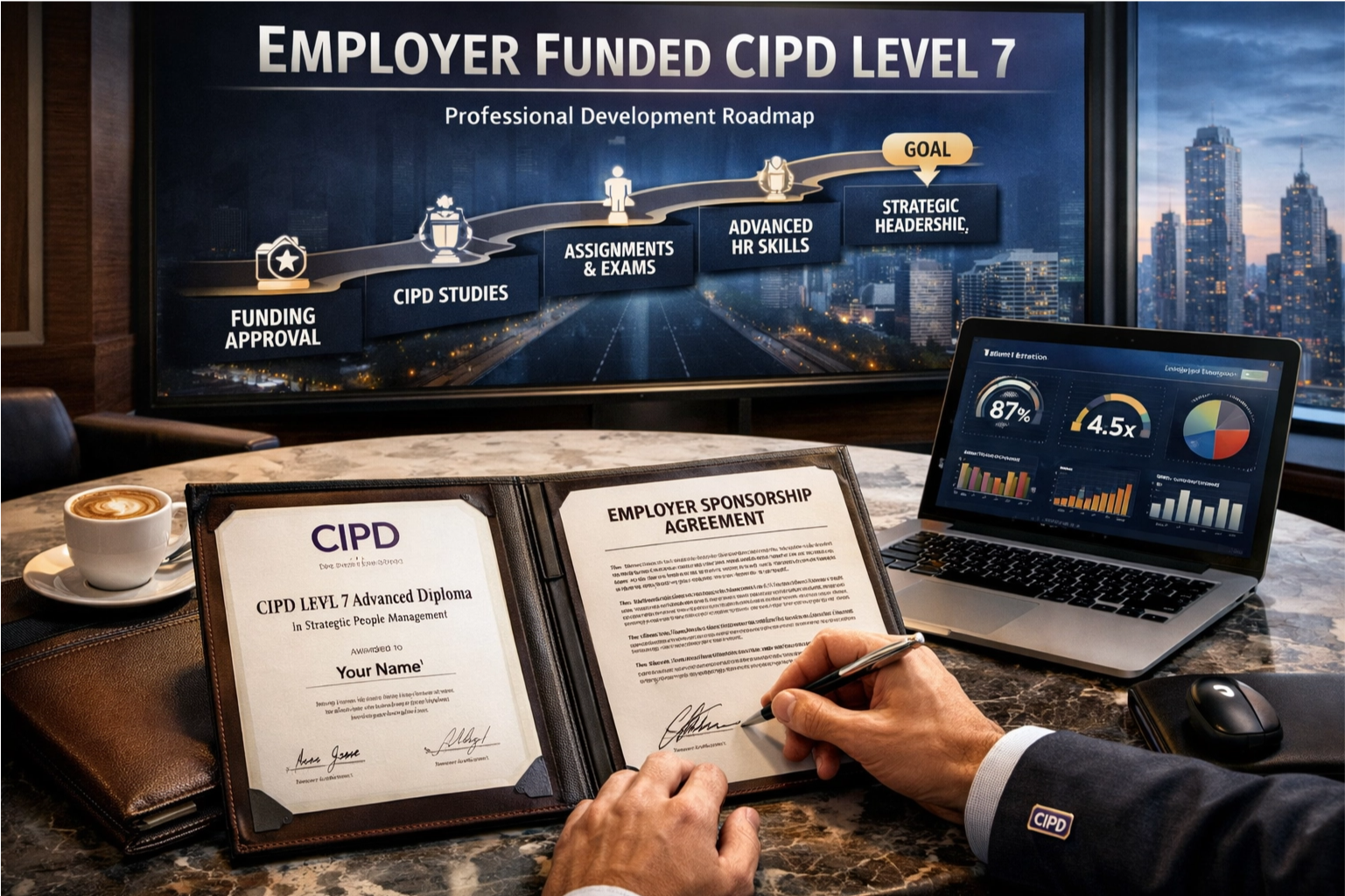
Why Your Company Must Fund the CIPD Level 7 Qualification: A Strategic Investment in People Leadership
In today’s volatile and complex business environment, the role of the People function has fundamentally shifted from administrative support to strategic leadership. For organizations to thrive, their HR and L&D leaders must possess the highest level of strategic acumen. The CIPD Level 7 Advanced Diploma, equivalent to a Master’s degree, is the qualification that delivers this capability, transforming experienced practitioners into strategic partners . For a company, funding this qualification is not an expense, but a critical investment in future-proofing its human capital strategy.
The CIPD Level 7: A Master’s-Level Strategic Asset
The CIPD Level 7 is the most senior qualification offered by the Chartered Institute of Personnel and Development, leading to the prestigious Chartered Member (MCIPD) or Chartered Fellow (FCIPD) status . It is designed for those already operating at a senior level or aspiring to roles like Head of HR, HR Director, or VP of People.
The curriculum is built around the CIPD Profession Map, ensuring that graduates are equipped to drive organizational performance through evidence-based practice. The core focus is on strategic thinking, business acumen, and ethical leadership .
Core Module Focus |
Strategic Business Value for the Company |
|
Equips the leader to anticipate and design strategies for macro-level trends (e.g., AI integration, global talent mobility, future of work models), ensuring the company remains competitive.
|
|
|
People Management and Development Strategies for Performance
|
Provides the expertise to design and implement people strategies that directly align with and enhance organizational performance, productivity, and profitability.
|
|
Personal Effectiveness, Ethics and Business Acumen
|
Develops the commercial and ethical grounding necessary for HR leaders to influence executive-level decision-making and manage complex organizational risk.
|
|
The most direct ROI component: mandates a rigorous, evidence-based research project to solve a specific, high-value organizational problem.
|
The Corporate ROI: Measurable Returns on Investment
The decision to fund a CIPD Level 7 qualification is a direct financial transaction that must be justified by a clear return on investment (ROI). The returns are both immediate and long-term, impacting the bottom line and the strategic capability of the organization.
1. Immediate Business Impact: The “Free Consultancy” Project
The most compelling argument for corporate funding lies in the mandatory Business Research in People Practice unit. This unit requires the employee to conduct a substantial, evidence-based research project focused on a genuine organizational challenge. In essence, the company receives a high-level, Master’s-equivalent consultancy project, paid for through the training budget.
This project can be strategically directed to address critical issues such as high employee turnover, low engagement scores, or the need for a new talent acquisition model. The resulting recommendations are not theoretical; they are grounded in academic rigor and tailored to the company’s specific context, leading to measurable outcomes like:
- Cost Reduction: Implementing evidence-based retention strategies to reduce the significant costs associated with recruitment and onboarding.
- Efficiency Gains: Redesigning organizational structures or processes based on research to improve departmental productivity.
- Performance Improvement: Developing targeted leadership or L&D interventions that directly address skill gaps impacting business goals.
2. Financial and Human Capital Gains
While CIPD-qualified professionals often see a salary increase, which reflects their increased market value, the company benefits from retaining this high-value talent . The investment in the Level 7 qualification acts as a powerful retention mechanism, significantly reducing the costly churn of experienced senior staff. The cost of replacing a senior HR professional far outweighs the cost of the qualification.
Furthermore, a Level 7 qualified leader is equipped to utilize advanced human capital metrics and analytics . They can move beyond simple reporting to provide predictive insights, ensuring that people decisions are data-driven and directly contribute to financial objectives. This strategic shift transforms the HR function from a cost center into a value-generating engine.
Fortifying the HR Function and Employer Brand
Funding the CIPD Level 7 is a strategic move that elevates the entire HR function and enhances the company’s external reputation.
Elevating Strategic Capability: The qualification ensures that the company’s People leadership can effectively Influence the Board by speaking the language of business, finance, and strategy. They are better equipped to Manage Risk by developing robust employment relations and compliance frameworks, mitigating legal and reputational exposure. They become the internal experts capable of leading complex organizational change programs, ensuring successful implementation and employee buy-in .
Talent Retention and Employer Branding: In the competitive market for senior HR talent, offering to fund the CIPD Level 7 is a significant differentiator. It signals to both current and prospective employees that the company is committed to world-class professional development and views its people leaders as future executives. This commitment fosters loyalty, boosts employee engagement, and strengthens the company’s position as an employer of choice .
Securing the Investment: A Framework for the Business Case
To successfully secure funding, the internal business case must be compelling and actionable. It should focus on the corporate benefits, not just the individual’s career aspirations.
Business Case Component |
Focus for the Company |
|
Problem Statement
|
Clearly articulate the current business challenge that the newly qualified leader will solve (e.g., “Our current talent strategy is not aligned with our 5-year growth plan”).
|
|
Proposed Solution
|
CIPD Level 7 qualification, specifically detailing the strategic modules and the mandatory research project’s topic (e.g., “Researching the impact of hybrid work on productivity and developing a new policy”).
|
|
Expected ROI (Quantitative)
|
Provide projected financial benefits, such as estimated cost savings from the research project’s findings or a target reduction in staff turnover.
|
|
Risk Mitigation
|
Include a formal training agreement requiring the employee to remain with the company for a specified period post-qualification, protecting the investment.
|
The CIPD Level 7 Advanced Diploma is a strategic asset that no forward-thinking company can afford to overlook. While the UK funding landscape has shifted away from public levy support, the case for direct employer funding remains a powerful strategic imperative. By investing in this qualification, organizations are not merely paying for a course; they are securing a Master’s-level strategic partner, gaining a high-value consultancy project, and fortifying their leadership pipeline against the complexities of the modern world of work. This investment is the clearest signal a company can send that it is serious about its people, its strategy, and its future success.