

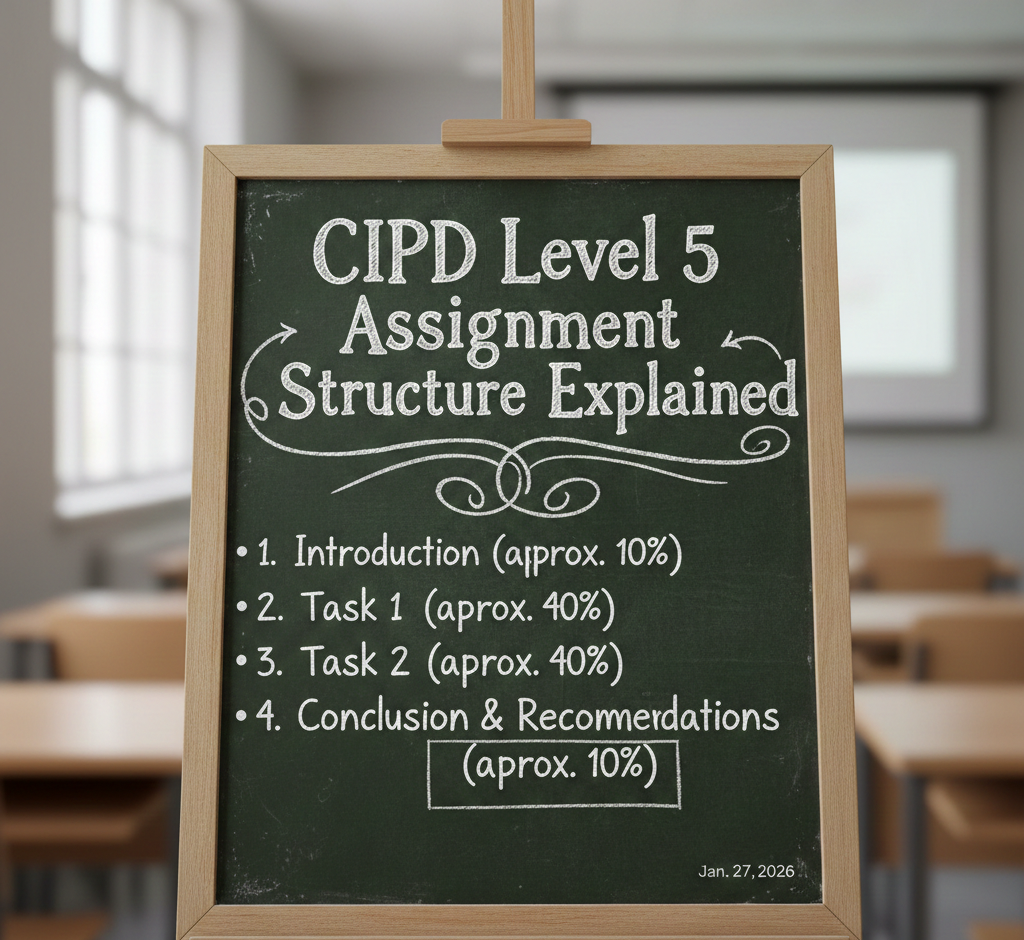
The Chartered Institute of Personnel and Development (CIPD) Level 5 Associate Diploma is a pivotal qualification for those looking to advance their careers in Human Resources (HR) or Learning and Development (L&D). As an intermediate-level certification, it bridges the gap between foundational knowledge and strategic expertise. However, for many students, the most daunting aspect of the course is not the content itself, but the assignment structure.
Navigating the requirements of units like 5CO01, 5CO02, and 5CO03 requires more than just subject knowledge; it demands a disciplined approach to academic writing, a deep understanding of assessment criteria, and the ability to link theory to practice. This blog post provides an exhaustive guide to mastering the CIPD Level 5 assignment structure, ensuring you can approach your assessments with confidence and achieve a “Pass” on your first attempt.
1. The Importance of Structure in CIPD Level 5
At Level 5, the CIPD expects a higher degree of critical analysis compared to Level 3. You are no longer just describing concepts; you are evaluating, analyzing, and justifying. A well-organized structure is the “skeleton” that supports your academic arguments. Without it, even the most insightful content can become lost in a sea of disjointed paragraphs.
Why Structure Matters:
- Clarity of Thought: A logical flow helps the marker follow your reasoning.
- Meeting Assessment Criteria (ACs): CIPD assignments are graded based on specific criteria. A structured approach ensures every AC is addressed.
- Word Count Management: With strict limits (typically +/- 10%), a planned structure prevents you from over-explaining minor points at the expense of critical ones.
- Professionalism: As a people professional, the ability to produce structured reports is a core competency.
2. The Standard Assignment Blueprint
While each unit may have specific requirements (e.g., a report, a presentation, or a portfolio), most CIPD Level 5 written assignments follow a standard blueprint. Adhering to this format ensures your work meets professional standards.
Section |
Purpose |
Key Components |
|
Title Page
|
Identifies the submission.
|
Unit code, title, student name/ID, word count, and date.
|
|
Table of Contents
|
Navigational aid for the marker.
|
Clear headings corresponding to Assessment Criteria (ACs).
|
|
Introduction
|
Sets the scene and defines the scope.
|
Brief background of the organization and the purpose of the report.
|
|
Main Body
|
The “meat” of the assignment.
|
Divided into sections by ACs; includes theory and examples.
|
|
Conclusion
|
Summarizes key findings.
|
A synthesis of the main points without introducing new info.
|
|
Recommendations
|
Practical applications (if required).
|
Actionable steps based on the findings in the main body.
|
|
Reference List
|
Credits the sources used.
|
Full list of all cited works in Harvard style.
|
|
Appendices
|
Supplementary data.
|
Charts, raw data, or templates (not included in word count).
|
3. Decoding the Assessment Criteria (ACs)
The most critical element of the CIPD Level 5 assignment structure is the Assessment Criteria. Each unit is broken down into Learning Outcomes (LOs), which are further divided into ACs.
How to Address ACs:
- Use ACs as Headings: This is the simplest way to ensure you don’t miss anything. For example, if AC 1.1 asks you to “Evaluate the relationship between the whole-organisation and the people function,” use that as your heading.
- Analyze the Command Verbs: Pay close attention to verbs like Evaluate, Analyze, Critically Appraise, or Summarize.
- Evaluate: Look at both sides (pros and cons) and provide a judgment.
- Analyze: Break a complex topic into smaller parts to understand its structure.
- Explain: Provide clear reasons or justifications for a concept.
3. The “Golden Thread”: Ensure there is a logical link between the ACs. Your answer to AC 1.1 should naturally lead into AC1.2.
4. Deep Dive: Core Unit Structures
To provide a more practical guide, let’s look at the specific structures for the three core units of the Associate Diploma.
5CO01: Organisational Performance and Culture in Practice
This unit is the foundation of the Associate Diploma, focusing on how HR and L&D functions operate within the broader business ecosystem. When structuring this assignment, you must demonstrate an understanding of how external pressures translate into internal people strategies.
- Section 1: The External Business Environment: This section often requires a PESTLE analysis (Political, Economic, Social, Technological, Legal, and Environmental). However, simply listing factors is not enough for Level 5. You must evaluate how these factors specifically impact your organization’s people strategy. For instance, how does a change in employment law (Legal) necessitate a shift in recruitment practices or contract management?
- Section 2: Organisational Strategy and the People Function: Here, you should structure your response around the “Value Chain.” Explain how HR activities—such as talent management or employee relations—directly contribute to achieving the organization’s strategic goals. Use models like Porter’s Value Chain to illustrate this connection.
- Section 3: Organisational Culture and Theoretical Perspectives: This is where you dive into the “invisible” side of the business. You might use Handy’s Model of Culture (Power, Role, Task, Person) or Johnson and Scholes’ Cultural Web to analyze your current organizational culture. The structure should focus on how this culture supports or hinders performance and what the people professional’s role is in shaping it.
- Section 4: Technology and the People Function: A modern CIPD assignment must address the digital landscape. Structure this by discussing how HR Information Systems (HRIS) or AI-driven recruitment tools are changing the way people services are delivered.
5CO02: Evidence-Based Practice
This is often considered the most technical unit, requiring a shift from “gut feeling” to data-driven decision-making. The structure is typically split into two distinct tasks.
- Task 1: Principles of Evidence-Based Practice (EBP): This section should define EBP using the four pillars: practitioner expertise, organizational data, stakeholder perspectives, and external evidence (academic research). Your structure should evaluate the benefits and challenges of using EBP in a people management context.
- Task 2: Quantitative and Qualitative Data Analysis: You will likely be presented with a scenario or a dataset. The structure here is paramount:
- Introduction to the Data: What are you looking at? (e.g., employee turnover rates or training evaluation scores).
-
- Data Presentation: Use tables and charts to visualize the findings. Ensure they are clearly labeled and referenced in the text.
-
- Interpretation: What does the data tell us? For example, “The 15% increase in turnover in the IT department correlates with the implementation of the new remote-working policy.”
-
- Recommendations: Propose at least two or three evidence-based solutions. Each recommendation should be justified by the data you analyzed.
5CO03: Professional Behaviours and Valuing People
This unit is deeply personal and focuses on your identity as a professional. The structure is often more reflective than the other units.
- Section 1: The CIPD Profession Map: You must structure your response around the core purpose, values, and behaviors of the map. Focus on Ethical Practice and Professional Courage. Provide a scenario where you had to demonstrate these behaviors, perhaps by challenging a decision that didn’t align with organizational values.
- Section 2: Inclusivity and Diversity: This is not just about compliance; it’s about the business case for diversity. Structure this by evaluating how an inclusive culture drives innovation and employee engagement.
- Section 3: The Reflective Journal and PDP: This is a mandatory part of the structure. You should use a reflective model like Gibbs’ Reflective Cycle (Description, Feelings, Evaluation, Analysis, Conclusion, Action Plan) to analyze a recent professional experience. This is followed by a Personal Development Plan (PDP) table that outlines your learning needs for the next 12 months.
5. Integrating Theory and Practice
A common mistake in CIPD Level 5 assignments is being too descriptive or too theoretical. The secret to a high-quality structure is the Theory-Practice Integration.
“Academic theories are the ‘why’, while organizational examples are the ‘how’. A successful assignment marries the two seamlessly.”
The PEEL Method for Paragraph Structure:
To maintain a professional and academic tone, use the PEEL method for every paragraph in your main body:
- Point: State the main point of the paragraph (related to the AC).
- Evidence: Support your point with academic theory (e.g., Maslow, Herzberg, or CIPD reports).
- Example: Provide a real-world example from your organization or a case study.
- Link: Connect the paragraph back to the AC or the next section.
6. Word Count Strategy
Managing a 4,000 to 5,000-word assignment requires a strategic breakdown. If you have 10 ACs to cover in 4,000 words, you have roughly 400 words per AC.
Word Count Allocation Table:
Section |
Percentage |
Approx. Words (for 4,000 total) |
|
Introduction
|
10%
|
400
|
|
Main Body (ACs)
|
75%
|
3,000
|
|
Conclusion
|
10%
|
400
|
|
Recommendations
|
5%
|
200
|
Note: The Reference List and Appendices are NOT included in the word count.
7. Referencing and Academic Integrity
CIPD assignments must be supported by credible evidence. This means you must cite your sources using the Harvard Referencing System.
What to Cite:
- Books and Academic Journals.
- CIPD Factsheets and Reports.
- Industry News (e.g., People Management magazine).
- Internal Organizational Documents (ensure they are anonymized).
Avoid Common Pitfalls:
- Over-quoting: Use your own words to explain theories. Only use direct quotes if the specific wording is essential.
- Secondary Referencing: Try to find the original source rather than citing “Smith (2020) as cited in Jones (2022).”
- Plagiarism: Always run your work through a plagiarism checker before submission.
8. Advanced Structuring: The Art of Critical Analysis
To move from a basic “Pass” to a high-quality submission, you must master Critical Analysis. At Level 5, the CIPD markers are looking for your ability to question assumptions and look at multiple perspectives.
How to Structure a Critical Argument:
- The “However” Factor: Whenever you present a theory or a benefit, follow it up with a counter-argument. For example: “While Maslow’s Hierarchy of Needs provides a useful framework for understanding motivation, it has been criticized for its cultural bias and the fact that humans do not always follow a linear path of needs (However…).
- Contextualization: Structure your arguments around the specific context of your industry. A structure that works for a tech startup might not work for a public sector hospital. Always explain why a particular model is relevant to your specific environment.
- Synthesis: This is the highest level of structuring. It involves bringing together different theories to form a new conclusion. For instance, combining Herzberg’s Two-Factor Theory with Modern Total Reward Models to propose a new retention strategy.
9. Managing Stakeholder Perspectives in Your Assignment
A unique requirement of the CIPD Level 5 structure is the inclusion of Stakeholder Perspectives. People professionals do not work in a vacuum; their decisions affect employees, managers, shareholders, and the wider community.
Structuring Stakeholder Analysis:
- Identify: Who are the key stakeholders for this specific AC?
- Impact: How does the proposed people practice affect them?
- Conflict: Are there competing interests? (e.g., shareholders wanting cost-cutting vs. employees wanting higher bonuses).
- Mitigation: How can the people function balance these interests?
By weaving these perspectives into your assignment structure, you demonstrate the “Commercial Acumen” that is so highly valued by the CIPD.
10. Practical Tips for Formatting and Submission
While content is king, presentation is the queen that keeps the king in check. A poorly formatted assignment can frustrate a marker and obscure your hard work.
- Headings and Sub-headings: Use a consistent numbering system (e.g., 1.0, 1.1, 1.2). This makes the document easy to navigate and ensures you have covered every part of the brief.
- White Space: Don’t be afraid of it. Use bullet points for lists and keep paragraphs to a reasonable length (150-200 words). This makes the report “breathable” and easier to read.
- Anonymization: This is a strict CIPD requirement. Use “Company X” or “The Organisation” instead of real names. If you include internal documents in the appendices, ensure all sensitive data is redacted.
- File Naming: Follow your center’s guidelines. Usually, this involves your name, student ID, and the unit code (e.g., J_Doe_12345_5CO01_Submission.docx).
Your Pathway to Success
The CIPD Level 5 Associate Diploma is more than just a certificate; it is a transformative journey that reshapes how you think about people and organizations. While the assignment structure may seem rigid at first, it is designed to instill the discipline and analytical rigor required of a modern HR or L&D professional.
By viewing each assignment as a professional business report rather than just an academic exercise, you align yourself with the expectations of the industry. Use the blueprints provided in this guide, stay disciplined with your word count, and never lose sight of the “Golden Thread” that connects theory, evidence, and practice.
The road to becoming a CIPD Associate Member is paved with well-structured assignments. Start building yours today.