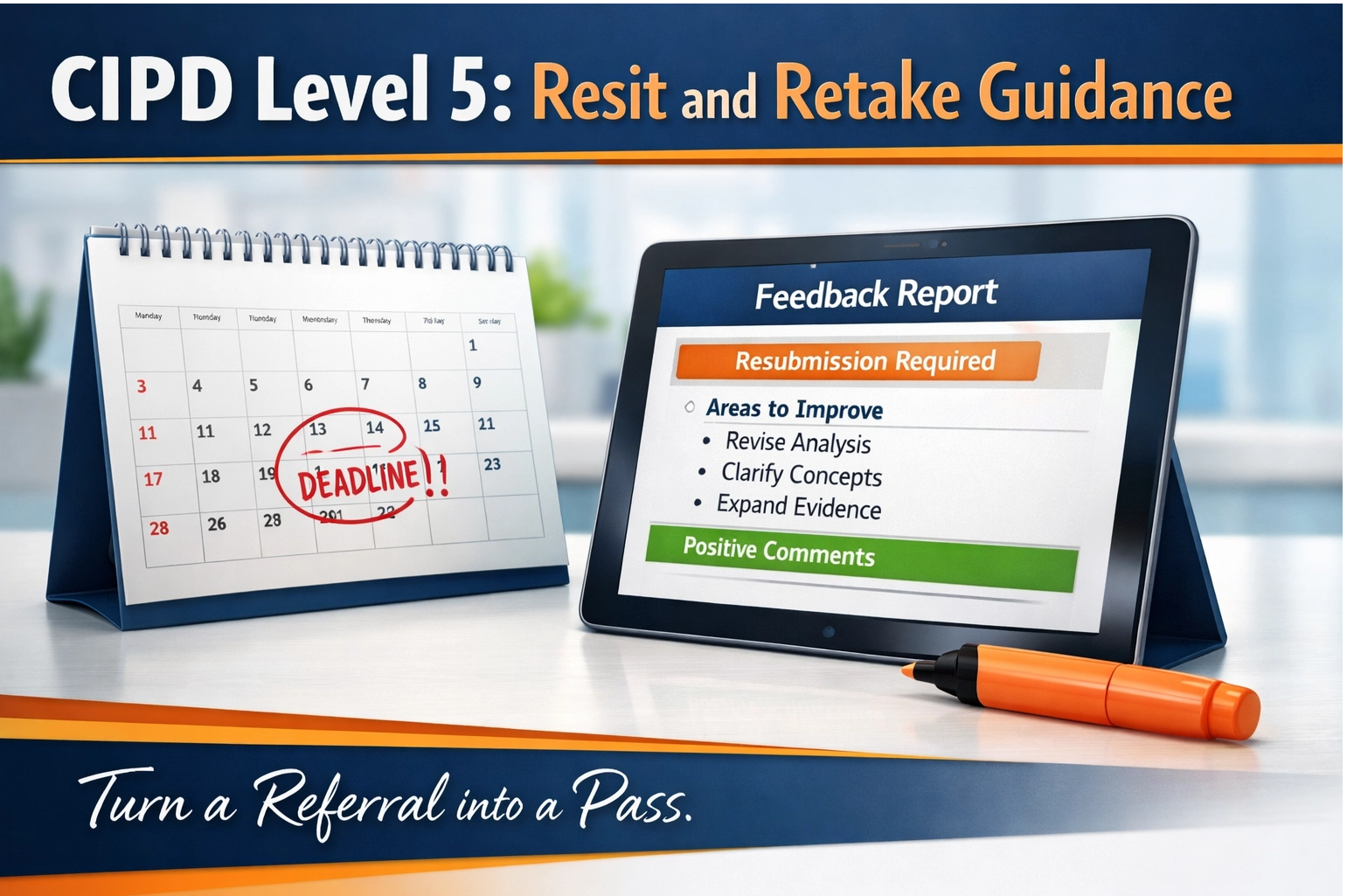
Receiving a “Referral” on a CIPD Level 5 assignment can be a disheartening experience, particularly given the time and effort required for the Associate Diploma. However, it is essential to understand that a referral is not a final failure; rather, it is a “First Attempt In Learning” (FAIL). In the professional world of Human Resources and Learning and Development, setbacks are viewed as opportunities for refinement and growth.
This article explores the formal procedures, consequences, and practical steps to take if your CIPD Level 5 assignment does not meet the required standards on the first attempt.
Understanding the “Referral”
In CIPD terminology, failing an assignment is formally referred to as a Referral. This means the assessor has determined that your work has not yet demonstrated all the required learning outcomes or assessment criteria specified in the unit brief.
Upon receiving a referral, you will be provided with a feedback sheet. This document is the most critical tool for your success, as it highlights the specific areas where your work fell short—whether it was a lack of critical analysis, insufficient referencing, or a failure to address a particular part of the rubric.
The Resubmission Process and Capping
Most CIPD providers follow a standardized process for resubmissions, though specific timelines and fees may vary by institution.
|
Feature
|
Standard Policy
|
|
Number of Attempts
|
Typically three attempts (the original submission plus two resubmissions).
|
|
Grade Capping
|
Resubmitted assignments are usually capped at a “Pass”. Even if the revised work is of Distinction quality, the final grade will be recorded as a Pass.
|
|
Resubmission Fees
|
Many providers offer the first resubmission for free, but subsequent attempts or a full “retake” often incur administrative or marking fees.
|
|
Timeline
|
Students are usually given a window (often 2–4 weeks) to address feedback and resubmit.
|
Resit vs. Retake: What is the Difference?
It is important to distinguish between a resit and a retake, as they have different implications for your progress and finances:
1.Resit: This involves revising and re-submitting your existing assignment based on tutor feedback. You do not need to attend the classes or lectures for that module again.
2.Retake: If you fail all allowed resubmission attempts (usually three), you must “retake” the entire unit. This involves re-enrolling in the module, attending the learning sessions again, and paying the full unit fee.
What Happens if You Fail Three Times?
If you are unsuccessful after three attempts, the consequences become more significant. You will typically be required to wait until the next cohort reaches that specific module to re-enroll. This can delay your overall qualification date by several months. Furthermore, failing to complete a unit within the maximum registration period (usually two to three years for Level 5) could result in having to restart the entire diploma under a newer specification.
Practical Steps to Move Forward
If you have received a referral, follow these structured steps to ensure your next submission is successful:
“The key to passing a CIPD assignment is not just knowing the HR theory, but demonstrating how that theory applies to organizational practice while meeting every single learning outcome.”
1. Deconstruct the Feedback
Do not skim the feedback. Map every comment back to the specific assessment criteria. If the tutor says “more critical analysis required,” ensure you move beyond simply describing a model (like Maslow or Herzberg) and instead evaluate its effectiveness in a modern workplace.
2. Check Your Referencing
Referencing errors are one of the most common reasons for referrals at Level 5. Ensure you are using the Harvard Referencing System accurately. Every citation in your text must have a corresponding entry in your bibliography.
3. Use the PEEL Method
To ensure your writing is academic and structured, use the PEEL method for every paragraph:
- Point: State the main idea.
- Evidence: Support it with a citation or organizational example.
- Explanation: Explain how the evidence supports your point.
- Link: Connect it back to the assignment question or the next paragraph.
4. Engage with Your Tutor
Most providers (such as ICS Learn, Avado, or DPG) offer tutor support. If you do not understand why you were referred, schedule a call or send a specific query. Tutors are there to help you bridge the gap between your current work and the required standard.
Failing a CIPD Level 5 assignment is a common hurdle on the path to becoming a Chartered Member. While the “Pass” cap on resubmissions might seem restrictive, the primary goal of the Associate Diploma is to demonstrate professional competence. By treating the referral as a constructive feedback loop rather than a final judgment, you can refine your academic writing and deepen your HR expertise, ultimately making you a more effective practitioner.
How CIPD Assignment Help Company Can Help in This Context
CIPD Assignment Help Company provides structured academic support to help learners avoid failure and achieve higher grades with confidence.
We help by:
-
Providing expert guidance from CIPD-qualified professionals who understand assessment criteria and learning outcomes.
-
Clarifying complex concepts such as people practice strategies, organisational behaviour, employment law, and evidence-based decision-making.
-
Supporting resubmissions by identifying gaps in feedback and improving structure, analysis, and alignment with CIPD standards.
-
Improving academic writing skills, including critical evaluation, reflective practice, and correct referencing.
-
Offering personalised support tailored to your unit, workplace context, and specific challenges.
-
Ensuring timely delivery, helping learners meet deadlines without compromising quality.
Our support reduces the risk of failure, saves time, and helps learners build the confidence and competence needed to successfully complete CIPD Level 5 and progress in their HR or L&D careers.