

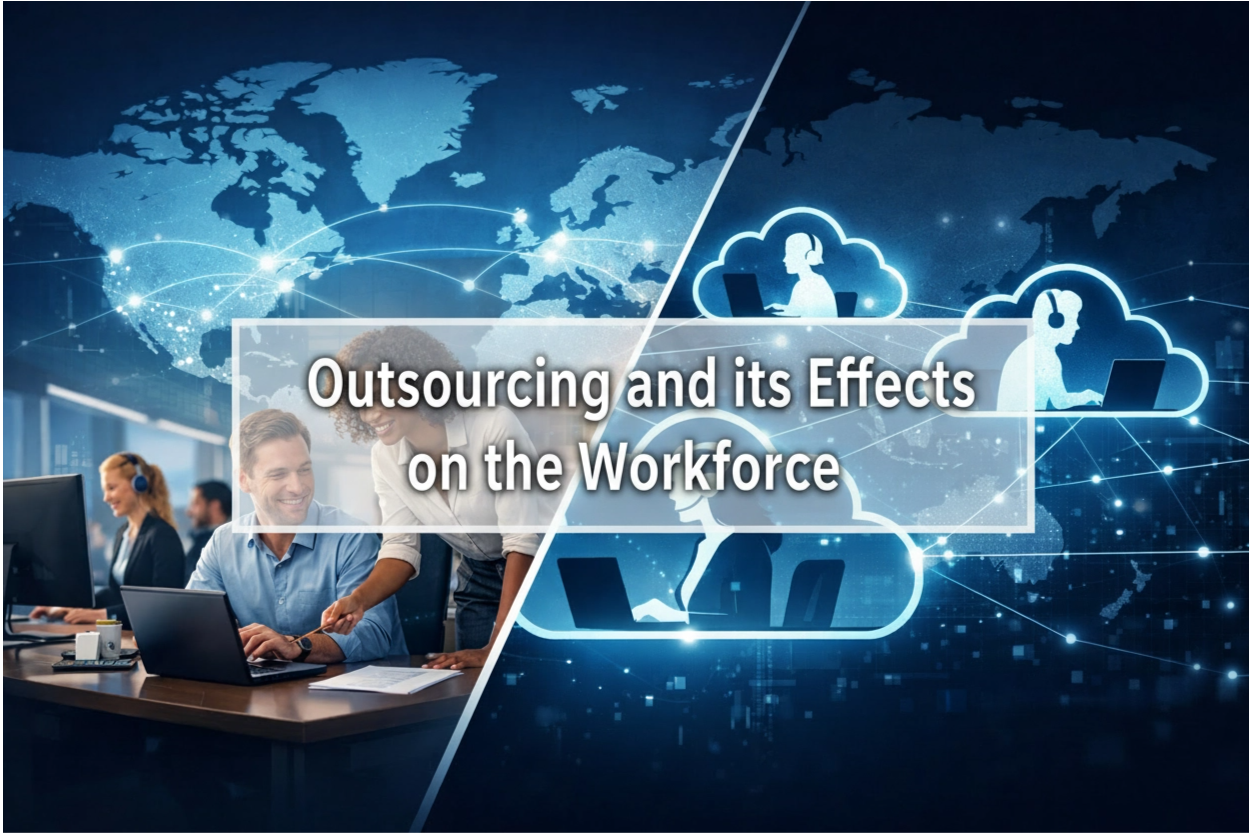
The landscape of global labor has undergone a seismic shift over the last few decades, evolving from a simple pursuit of lower manufacturing costs into a complex, multi-dimensional strategy that touches every facet of the modern enterprise. In 2026, outsourcing is no longer merely a “back-office” function; it is a fundamental architectural component of the global economy. As businesses strive for agility in an era of rapid technological disruption, the practice of delegating tasks to external providers—whether across the street or across an ocean—has created a ripple effect that is reshaping the very nature of work. This article explores the dual impact of outsourcing on both domestic and international workforces, examining the legislative, economic, and technological forces at play.
The Domestic Workforce: Displacement, Adaptation, and the HIRE Act
For the domestic workforce in developed economies like the United States, the narrative of outsourcing has historically been one of loss. The displacement of manufacturing jobs in the late 20th century has transitioned into the offshoring of service-sector roles, including customer support, accounting, and entry-level software development. This trend has created a persistent tension between corporate profitability and local employment stability. However, the reality in 2026 is more nuanced than a simple zero-sum game. While certain roles have undoubtedly vanished, others have evolved, requiring a higher degree of specialization and a shift toward “human-centric” capabilities.
The legislative response to these pressures has reached a boiling point with the introduction of the Halting International Relocation of Employment (HIRE) Act of 2025. This landmark legislation, which gained significant traction in early 2026, proposes a 25% excise tax on “outsourcing payments” made by domestic firms to foreign entities for labor and services . The goal is clear: to disincentivize the flight of jobs and encourage “reshoring.” Yet, economists argue that such punitive measures may be a blunt instrument in a globalized world . For many companies, outsourcing is not just about saving pennies on the dollar; it is about accessing a global talent pool that is often more specialized and scalable than what is available locally.
Aspect |
Impact on Domestic Workforce |
Strategic Corporate Response |
Job Security |
Increased volatility in entry-level and routine roles.
|
Shift toward high-value, strategic domestic hiring.
|
Wage Pressure |
Stagnation in roles that are easily offshored.
|
Premium pay for specialized, non-automatable skills.
|
Skill Requirements |
Rapidly shifting toward leadership, strategy, and AI oversight.
|
Investment in internal reskilling and upskilling programs.
|
Legislative Environment |
New protections and incentives (e.g., HIRE Act).
|
Restructuring supply chains to balance cost and compliance.
|
The domestic worker of 2026 is forced to participate in a “skills pivot.” As routine tasks are offshored or automated, the value of human labor has shifted toward roles that require emotional intelligence, complex problem-solving, and cross-functional leadership. In this sense, outsourcing has acted as a catalyst for professional evolution, albeit a painful one for those caught in the transition. The domestic workforce is increasingly becoming a hub for strategy and innovation, while execution and operational maintenance are distributed globally.
The Offshore Workforce: From Economic Engine to Digital Frontier
On the other side of the equation, the impact of outsourcing on developing nations has been nothing short of transformative. Countries like the Philippines, India, and Vietnam have leveraged the Business Process Outsourcing (BPO) industry to build robust middle classes and modernize their infrastructure. In the Philippines, the BPO sector is projected to reach a staggering $42 billion in revenue by the end of 2026, providing millions of high-quality jobs that offer significantly higher wages than traditional local industries . These roles have become a gateway to the global economy, fostering a generation of professionals with world-class skills in IT, finance, and healthcare.
“Outsourcing has fundamentally altered the socio-economic fabric of the Global South. It is not just about job creation; it is about the transfer of knowledge, the standardization of professional ethics, and the integration of local talent into the global value chain.” — Global Labor Trends Report 2025
However, this rapid growth has not been without its challenges. The offshore workforce often faces high-stress environments, graveyard shifts to accommodate Western time zones, and a phenomenon known as “talent poaching,” where global firms compete aggressively for the same pool of skilled workers . Furthermore, the rise of “data labor”—the human workers who label data to train artificial intelligence—has introduced a new layer of ethical complexity. These workers often operate in a regulatory gray area, performing repetitive, high-stakes tasks for relatively low pay, leading to calls for international labor standards that specifically address the “digital sweatshop” conditions in some emerging tech hubs .
The AI Revolution: The New Frontier of Outsourcing
As we move deeper into 2026, the traditional definition of outsourcing is being challenged by the rise of Generative AI. For years, outsourcing meant moving work from a high-cost human to a low-cost human. Today, it increasingly means moving work from a human to an algorithm. This “algorithmic outsourcing” is disrupting the BPO industry itself. Tasks that were once the bread and butter of offshore hubs—such as basic customer service, data entry, and routine coding—are now being handled by AI agents. This shift has created a paradox: while AI reduces the need for traditional outsourced labor, it simultaneously creates a massive demand for a new kind of human worker.
This new class of outsourced labor is focused on “AI Orchestration.” Companies are now outsourcing the training, fine-tuning, and oversight of their AI models to specialized firms in regions with high STEM literacy. Instead of “body shopping”—the practice of hiring large numbers of low-skilled workers—the market is shifting toward “solution shopping.” Businesses are looking for partners who can provide integrated AI-human teams that deliver higher productivity and accuracy than either could achieve alone. This transition is forcing offshore hubs to rapidly upskill their workforces to remain relevant in a landscape where “cheap labor” is no longer a sufficient competitive advantage.
Category |
Traditional Outsourcing (Pre-2024) |
AI-Integrated Outsourcing (2026+) |
Primary Goal |
Labor cost reduction.
|
Speed, scalability, and AI-enhanced precision.
|
Worker Profile |
Generalist, process-oriented.
|
Specialist, AI-literate, problem-solver.
|
Engagement Model |
Hourly rate or FTE (Full-Time Equivalent).
|
Outcome-based or “AI-as-a-Service” models.
|
Technology Role |
Tool for the worker.
|
The primary engine, overseen by the worker.
|
Strategic Shifts: Nearshoring and the Global Race for Talent
Another significant trend in 2026 is the rise of “nearshoring”—the practice of moving outsourced operations to countries that are geographically and culturally closer to the home office. For U.S. companies, this has meant a surge in investment in Latin American tech hubs like Guadalajara, Mexico, and Medellín, Colombia. Nearshoring offers several advantages over traditional offshoring, including similar time zones, reduced cultural friction, and shorter travel times for management. This shift is driven by a growing recognition that “hidden costs”—such as communication delays and management overhead—can often outweigh the raw savings of a lower hourly wage in a distant country.
Simultaneously, the global workforce is experiencing a “race for talent” that transcends national borders. As specialized skills in fields like cybersecurity, renewable energy engineering, and advanced data science become increasingly scarce, the traditional power dynamic between employer and employee is shifting . Highly skilled workers in developing nations are no longer content with being “back-office” support; they are increasingly being recruited directly by global firms as remote, full-time employees. This “brain drain” from traditional outsourcing providers to direct global employment is forcing BPO firms to rethink their value proposition, shifting from being labor providers to becoming talent incubators.
A Symbiotic but Strained Future
The effects of outsourcing on the workforce in 2026 are profound, permanent, and deeply interconnected. For the domestic worker, it is a force that demands constant adaptation and a commitment to lifelong learning. For the offshore worker, it is a ladder to economic prosperity, albeit one with precarious rungs. And for the global corporation, it is a strategic necessity that must be balanced against increasing legislative scrutiny and the disruptive power of artificial intelligence.
Ultimately, the success of the global workforce in this environment will depend on agility. The boundaries between “domestic” and “foreign” labor are blurring as digital platforms and AI tools create a more seamless global marketplace. However, this integration must be managed with a keen eye toward ethics and equity. Whether through legislative frameworks like the HIRE Act or through industry-led standards for AI labor, the goal must be to ensure that the benefits of a globalized workforce are shared more broadly, and that the “human” in human resources remains the central focus of our economic progress. As we look toward the remainder of the decade, the question is no longer whether to outsource, but how to do so in a way that builds a more resilient, skilled, and inclusive global workforce.