

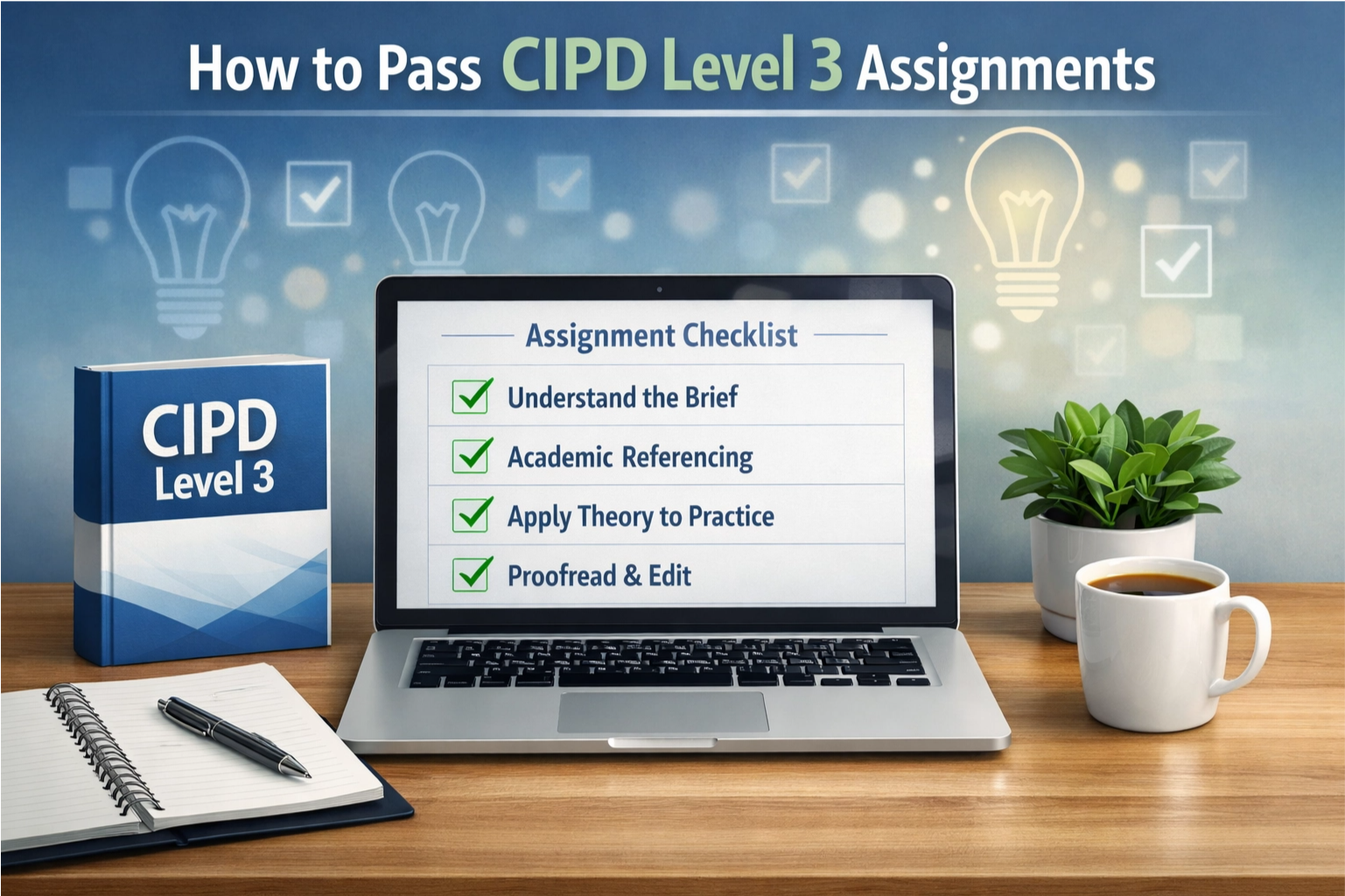
The CIPD Level 3 Foundation Certificate in People Practice is a crucial step for anyone starting their career in HR or L&D. It provides the foundational knowledge required to become a successful people professional. However, for many students, the assignment-based assessment can feel daunting. Unlike traditional exams, CIPD assignments require a specific blend of academic theory, critical analysis, and practical application. This detailed guide will break down the CIPD Level 3 assessment process and provide a clear, step-by-step strategy to ensure you achieve a Pass on your first submission.
1. Understanding the CIPD Level 3 Assessment Landscape
The CIPD Level 3 qualification is composed of four core units, each designed to build a comprehensive understanding of the people profession :
Unit Code |
Unit Title |
Focus Area |
3CO01 |
Business, culture and change in context
|
External factors, business strategy, and organizational culture.
|
3CO02 |
Using data and evidence to inform decision-making.
|
|
3CO03 |
Core behaviours for people professionals
|
Ethical practice, professional values, and personal development.
|
3CO04 |
Essentials of people practice
|
The employee lifecycle, from recruitment to exit.
|
It is vital to understand that CIPD Level 3 assignments are criterion-referenced, meaning they are assessed purely on whether you have met all the specified Assessment Criteria (ACs) for that unit . There is no grading system at this level—it is simply a Pass or Fail. Your focus must therefore be on comprehensively addressing every single AC.
The CIPD expects you to demonstrate four key capabilities in your written work :
- Factual, procedural and theoretical knowledge of people practice.
- Interpretation and evaluation of relevant information and ideas.
- Awareness of different perspectives within HR and L&D.
- Application of appropriate methods to address well-defined problems.
2. Decoding the Assignment Brief and Command Words
The single most common reason for assignment referral (failing and needing to resubmit) is failing to address the question as asked. This often comes down to misinterpreting the command words used in the Assessment Criteria.
Before you write a single word, you must break down the brief and identify the specific action required by each command word. A simple description will not suffice if the question asks for an evaluation.
Command Word |
What the Assessor Expects |
Example Action |
Define |
Provide a clear, concise, and accurate meaning of a term or concept.
|
State the definition of ’employee engagement’ and its source.
|
Explain |
Describe a concept and provide reasons for how or why it works.
|
Describe the steps of a disciplinary process and explain the legal rationale for each step.
|
Discuss |
Examine a topic from various angles, presenting different viewpoints and arguments.
|
Discuss the pros and cons of remote working for organizational culture.
|
Review |
Assess the strengths, weaknesses, and effectiveness of a model or approach.
|
Review the effectiveness of a specific recruitment method used in an organization.
|
Evaluate |
Judge the worth, significance, or success of something, supported by evidence and a reasoned conclusion.
|
Evaluate the impact of a recent change management initiative on employee morale.
|
Pro Tip: Use the command word as a guide for the depth of your research. A ‘Define’ requires a simple, cited fact, while an ‘Evaluate’ requires theory, evidence, analysis, and a justified conclusion.
3. The Winning Writing Strategy: Structure and PEEL
A well-structured assignment is easy for the assessor to follow and ensures you hit all the required points.
Overall Assignment Structure
Your assignment should follow a clear, professional structure :
- Introduction: Briefly state the purpose of the assignment and what you will cover. This should be short and to the point.
- Main Body: This is where you address each Assessment Criterion (AC) in turn. Use clear, bold subheadings that directly reference the AC number (e.g., AC 1.1: Explain the purpose of a job description). This makes it easy for the assessor to tick off each requirement.
- Conclusion: Summarise the key findings and arguments you have made. Do not introduce new information here.
- References: A full list of all sources cited in your work, formatted using the Harvard style.
Mastering the PEEL Paragraph Technique
To ensure your arguments are robust and meet the academic standard, adopt the PEEL method for structuring your paragraphs :
Element |
Description |
Purpose |
Point |
Start with a clear, focused statement that directly addresses the AC.
|
Sets the theme for the paragraph.
|
Evidence |
Support your point with credible sources, theories, models, or data.
|
Grounds your argument in fact and theory.
|
Explanation |
Explain how and why the evidence supports your point, showing critical analysis.
|
Demonstrates your understanding and critical thinking.
|
Link |
Conclude by linking the point back to the overall assignment question or the next paragraph.
|
Ensures logical flow and relevance.
|
Example of PEEL in Practice:
(P) Effective leadership is crucial for fostering employee engagement and driving organizational success. (E) According to the CIPD, leaders who demonstrate empathy and strong communication skills are more likely to create a positive work environment, resulting in higher levels of employee motivation and retention . (E) This is because empathetic leaders understand and address the needs of their employees, building trust and commitment within teams. Clear communication ensures that employees are aligned with organizational goals, which further enhances their sense of purpose and productivity. (L) Therefore, developing leadership competencies such as empathy and communication is essential for any organisation aiming to achieve sustainable success.
The Importance of Practical Application
CIPD qualifications are employer-driven. Your assignments must not just be theoretical; they must link theory to practice. Wherever possible, use real-world examples from your own organization or a hypothetical case study to illustrate your points. This demonstrates your ability to apply HR principles in a professional context.
4. Technical Requirements and Final Checks
Success in CIPD assignments also depends on adhering to the technical requirements.
Referencing and Sources
- Style: CIPD typically requires the Harvard referencing style. Be meticulous with in-text citations (Author, Year) and your final reference list .
- Credibility: Use credible sources to support your evidence. Prioritize CIPD Factsheets, academic textbooks (e.g., Armstrong’s Handbook), and reputable academic journals. Avoid over-relying on non-academic websites.
Word Count Adherence
While the total word count for Level 3 assignments is often around 3,000 words across the written tasks, pay close attention to the specific word count guidance provided for each task. Most providers allow a small tolerance (e.g., 10% over or under). Going significantly over suggests you have been too descriptive, while going significantly under suggests you have not provided enough depth or evidence to meet the ACs .
Final Proofreading
Before submission, you must proofread your work thoroughly. Errors in spelling, grammar, and punctuation can distract the assessor and undermine the professionalism of your work. Read your work aloud to catch awkward phrasing and ensure a smooth, logical flow between paragraphs and sections.
By following this structured approach—understanding the assessment criteria, decoding the command words, using the PEEL method, and adhering to technical standards—you will be well-equipped to produce high-quality, professional assignments and successfully pass your CIPD Level 3 qualification.