

Table of Contents
Executive Summary
In an era defined by rapid technological advancement and unprecedented data availability, the ability of an organisation to make sound, reliable decisions is its most critical competitive advantage. Evidence-Based Practice (EBP) has emerged as a transformative framework that shifts the paradigm of management from one based on intuition and “gut feeling” to one grounded in empirical evidence and systematic analysis. This report explores how EBP enhances the quality of organisational decision-making by integrating four key sources of evidence: scientific research, internal data, professional expertise, and stakeholder values. By following a structured six-step process—Ask, Acquire, Appraise, Aggregate, Apply, and Assess—organisations can mitigate cognitive biases, improve transparency, and achieve superior performance outcomes. While challenges such as cultural resistance and skill gaps persist, the transition toward an evidence-based culture is essential for long-term sustainability and strategic excellence in the modern business landscape.
Introduction
The landscape of modern management is increasingly complex, volatile, and uncertain. Leaders are frequently required to make high-stakes decisions under pressure, often relying on their personal experience, industry trends, or the advice of popular management gurus. However, research consistently demonstrates that human judgment is prone to significant flaws, including overconfidence and various cognitive biases that can lead to costly strategic failures. The traditional reliance on “best practices”—which are often neither “best” nor “practices” in a rigorous sense—is no longer sufficient for organisations seeking to thrive in a globalised economy.
Evidence-Based Practice (EBP) offers a robust alternative. Originally developed in the field of medicine to ensure that patient care was based on the best available clinical research, EBP has been adapted for management and organisational leadership. It is not about replacing human judgment with data; rather, it is about informing judgment with the most reliable information available. This report argues that EBP improves organisational decision-making by providing a systematic, transparent, and objective framework that reduces uncertainty and aligns organisational actions with empirical reality. By examining the core components, the systematic process, and the tangible benefits of EBP, we can understand how it serves as a pillar for optimal organisational performance.
Understanding Evidence-Based Practice (EBP)
At its core, Evidence-Based Practice is the conscientious, explicit, and judicious use of the best available evidence from multiple sources to increase the likelihood of a favorable outcome. In the context of an organisation, this means that when a decision is made—whether it concerns a new marketing strategy, a change in HR policy, or a major capital investment—the decision-makers do not rely on a single source of information. Instead, they look for a convergence of evidence across four distinct pillars.
The Four Pillars of Evidence
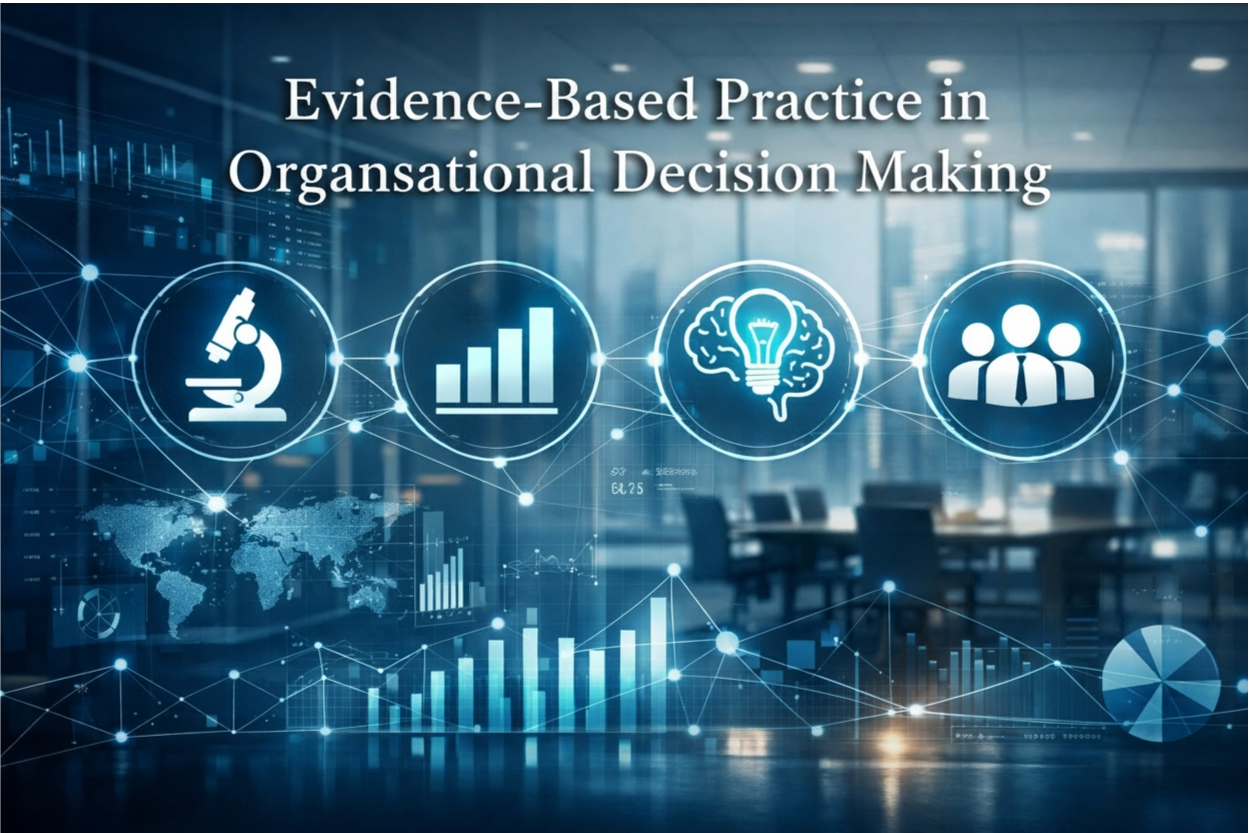
The strength of EBP lies in its holistic approach to information. The Center for Evidence-Based Management (CEBMa) identifies four essential sources of evidence that must be considered in any rigorous decision-making process:
|
Source of Evidence |
Description |
Role in Decision Making |
|
Scientific Literature |
Findings from published, peer-reviewed academic research and empirical studies. |
Provides generalisable principles and identifies “what works” in broader contexts. |
|
Internal Organisational Data |
Metrics, KPIs, financial reports, and internal surveys specific to the organisation. |
Offers context-specific insights into the organisation’s current performance and problems. |
|
Professional Expertise |
The accumulated experience, judgment, and practical skills of managers and practitioners. |
Helps interpret data and apply general principles to specific, nuanced situations. |
|
Stakeholder Values |
The perspectives, expectations, and concerns of those affected by the decision (e.g., employees, customers). |
Ensures that decisions are ethical, acceptable, and aligned with the organisation’s social responsibility. |
By integrating these four sources, EBP ensures that decisions are not only scientifically sound but also practically feasible, contextually relevant, and ethically responsible. For instance, a company considering a four-day workweek would look at academic studies on productivity (Scientific Literature), analyze their own employee performance data (Internal Data), consult with experienced HR managers (Professional Expertise), and survey their staff to understand their preferences (Stakeholder Values). This multi-dimensional view prevents the “tunnel vision” that often plagues traditional decision-making.
The shift toward EBP represents a move away from “management by anecdote” or “management by imitation.” It challenges the notion that because a strategy worked for a competitor or was featured in a popular business magazine, it will necessarily work for every organisation. Instead, EBP demands a level of critical thinking and skepticism that forces leaders to ask: “What is the evidence for this claim, and how reliable is it?” This fundamental shift in mindset is the first step toward improving the quality of every decision made within the organisational hierarchy.
The Systematic Process: The 6 Steps of EBP
One of the most significant ways EBP improves organisational decision-making is by replacing haphazard deliberation with a structured, repeatable process. This process, often referred to as the “6 Steps of Evidence-Based Practice,” ensures that no critical stage of inquiry is overlooked. By following these steps, managers can move from a vague sense of a problem to a well-supported, evaluated solution.
1. Ask: Formulating the Question
The process begins with translating a practical issue or “pain point” into a focused, answerable question. Many organisational failures stem from solving the wrong problem. EBP forces decision-makers to be precise. Instead of asking, “How can we improve morale?” an evidence-based manager might ask, “To what extent do flexible working arrangements impact employee retention in the technology sector?” This precision narrows the scope of the search for evidence and ensures that the subsequent steps are targeted and efficient.
2. Acquire: Searching for Evidence
Once the question is defined, the next step is to systematically search for and retrieve evidence from the four sources mentioned earlier. This involves more than a simple Google search. It requires searching academic databases for scientific research, mining internal databases for relevant organisational metrics, and conducting structured interviews or surveys with stakeholders. The goal is to gather a diverse and comprehensive set of data points that can provide a 360-degree view of the issue.
3. Appraise: Critical Evaluation
Perhaps the most critical step in the EBP process is appraisal. Not all evidence is created equal. A case study of a single successful company is less reliable than a meta-analysis of hundreds of companies. Internal data may be skewed by poor collection methods, and professional expertise may be clouded by personal bias. EBP requires managers to judge the trustworthiness and relevance of the evidence. They must ask: Is the source credible? Was the methodology sound? Is this evidence applicable to our specific organisational context?
4. Aggregate: Weighing the Evidence
After appraising the individual pieces of evidence, the decision-maker must pull them together. This is not a simple matter of counting “pros” and “cons.” It involves weighing the evidence based on its quality and relevance. For example, if scientific research strongly suggests a particular course of action, but internal data shows it would be prohibitively expensive and stakeholders are vehemently opposed, the manager must balance these conflicting signals. Aggregation is where the “art” of management meets the “science” of data.
5. Apply: Implementing the Decision
With a clear understanding of the evidence, the decision is then incorporated into the organisational strategy or policy. This step involves moving from “what we know” to “what we will do.” The evidence-based approach ensures that the implementation plan is grounded in reality, with clear expectations of what the intervention is intended to achieve.
6. Assess: Evaluating the Outcome
The final step is to evaluate the outcome of the decision. Did the intervention work as expected? What were the unintended consequences? This step creates a feedback loop that turns every decision into a learning opportunity. By assessing the results, the organisation builds its own internal body of evidence, making future decisions even more robust.
Improving Decision-Making Quality
The primary benefit of EBP is the dramatic improvement in the quality and reliability of decisions. This improvement is achieved through several key mechanisms that address the inherent weaknesses in human cognition and organisational dynamics.
Mitigating Cognitive Biases
Human beings are naturally “cognitive misers,” meaning we tend to take mental shortcuts to save time and energy. While these shortcuts are useful in daily life, they are disastrous in complex organisational settings. EBP acts as a safeguard against several common biases:
- •Confirmation Bias: The tendency to search for, interpret, and favor information that confirms our pre-existing beliefs. By requiring a systematic search for evidence (Step 2) and critical appraisal (Step 3), EBP forces managers to confront information that may contradict their initial assumptions.
- Availability Heuristic: The tendency to overestimate the importance of information that is most readily available or recent. EBP’s emphasis on scientific literature and historical internal data ensures that decisions are based on a broad evidence base rather than just the latest “hot topic” or a single memorable event.
- Overconfidence Bias: Many leaders believe their intuition is superior to data. EBP humbles the decision-maker by demonstrating the complexity of evidence and the frequency with which “common sense” is proven wrong by empirical research.
Enhancing Transparency and Accountability
In many organisations, decisions are made behind closed doors, based on the preferences of the most powerful person in the room (the “HIPPO” effect—Highest Paid Person’s Opinion). EBP democratises and clarifies the decision-making process. Because the evidence must be acquired, appraised, and aggregated, there is a clear “audit trail” for every major decision. This transparency makes it easier to explain decisions to employees, shareholders, and regulators, thereby increasing trust and buy-in. If a decision leads to a poor outcome, the organisation can look back at the evidence base to determine if the failure was due to poor evidence, poor implementation, or simply an unpredictable external event.
Risk Management and Predictability
Organisational decision-making is essentially an exercise in managing risk. EBP reduces the “noise” in the decision-making environment. By using scientific research to understand general principles and internal data to understand specific trends, managers can make more accurate predictions about the likely outcomes of their actions. This doesn’t eliminate risk entirely, but it moves the organisation from “gambling” to “calculated risk-taking.” For instance, an evidence-based approach to hiring—using validated psychometric tests and structured interviews—significantly increases the probability of a successful hire compared to unstructured “gut-feel” interviews.
Organisational Impact and Performance
The transition to Evidence-Based Practice is not merely an academic exercise; it has profound implications for the bottom line and long-term organisational health. When decisions are consistently based on high-quality evidence, the cumulative effect is a more agile, efficient, and innovative organisation.
Sector-Specific Impact
The benefits of EBP are visible across various industries, each applying the framework to solve unique challenges:
- Healthcare Management: In hospitals, EBP is used not only for clinical care but also for operational decisions. For example, evidence-based staffing models that use historical patient flow data and scientific research on nurse-to-patient ratios have been shown to reduce medical errors and improve patient outcomes while optimizing labor costs.
- Human Resources (Evidence-Based HR): HR departments are increasingly moving away from “trendy” management fads toward evidence-based practices. Research has shown that many popular HR interventions, such as certain types of diversity training or annual performance reviews, often fail to achieve their intended goals. By using EBP, HR leaders can implement interventions that are proven to increase engagement and productivity, such as goal-setting frameworks and objective recruitment processes.
- Finance and Investment: The financial sector has long used quantitative data, but EBP goes further by integrating qualitative stakeholder values and professional judgment with algorithmic models. This holistic approach helps firms navigate market volatility by grounding their strategies in a broader evidence base than just short-term price movements.
The Link to Innovation
A common misconception is that EBP stifles creativity and innovation by tethering managers to “what is already known.” In reality, EBP provides the foundation for successful innovation. By understanding the existing evidence, organisations can identify where the “gaps” are—the areas where current knowledge is insufficient. This allows them to focus their innovative efforts on truly novel solutions rather than reinventing the wheel or repeating past mistakes. Furthermore, the “Assess” step of EBP encourages a culture of experimentation (e.g., A/B testing), which is the engine of modern innovation.
Challenges and Barriers to Implementation
Despite its clear advantages, implementing EBP is not without significant hurdles. Understanding these barriers is essential for any leader attempting to drive this change.
Cultural Resistance
The most formidable barrier is often the existing organisational culture. Many managers take pride in their “intuition” and see EBP as a threat to their authority or professional identity. There is often a deep-seated belief that “we’ve always done it this way,” or that their industry is “too unique” for general scientific principles to apply. Overcoming this requires a fundamental shift in how leadership is defined—from the “heroic leader” who always has the answer to the “evidence-based leader” who knows how to find the answer.
The Skill Gap
EBP requires a specific set of skills that are often lacking in the traditional management workforce. These include data literacy, the ability to search academic databases, and the critical thinking skills necessary for appraisal. Many managers feel overwhelmed by the sheer volume of information available—the “Big Data” trap—and lack the tools to distinguish between high-quality evidence and mere “noise.”
Time and Resource Constraints
The systematic process of EBP takes time. In a fast-paced business environment, there is often immense pressure to make decisions quickly. Leaders may feel they do not have the luxury of conducting a thorough search and appraisal of evidence. However, this is often a “false economy,” as the time saved by making a quick, poorly-informed decision is frequently outweighed by the time and resources spent fixing the resulting mistakes.
Fostering an Evidence-Based Culture
To truly reap the rewards of EBP, it must be woven into the fabric of the organisation. This requires a multi-pronged approach:
- Leadership Commitment: Leaders must model evidence-based behavior. This means asking for evidence when proposals are presented and being willing to change their minds when the data contradicts their views.
- Investment in Training: Organisations should provide managers with training in basic research methods, data analysis, and critical appraisal.
- Rewarding the Process, Not Just the Outcome: In many companies, people are rewarded only for successful outcomes, which can encourage “gambling.” An evidence-based culture rewards people for following a rigorous decision-making process, regardless of the eventual outcome, recognizing that even the best-informed decisions can sometimes fail due to external factors.
- Access to Evidence: Organisations should provide employees with access to the tools they need, such as academic journals, internal data dashboards, and expert networks.
Conclusion
Evidence-Based Practice represents the evolution of management from a craft based on personal experience to a profession grounded in empirical rigor. By integrating scientific research, organisational data, professional expertise, and stakeholder values, EBP provides a powerful framework for improving the quality, transparency, and reliability of organisational decisions. While the path to becoming an evidence-based organisation is challenging and requires a significant shift in culture and skills, the benefits are undeniable. In an increasingly complex world, the organisations that thrive will be those that have the discipline to ask the right questions, the skill to find the best evidence, and the courage to act on what the data truly shows. EBP is not just a methodology; it is a strategic imperative for the 21st-century leader.
References
1.Barends, E., & Rousseau, D. M. (2018). Evidence-Based Management: How to Use Evidence to Make Better Business Decisions. Kogan Page Publishers.
2.Center for Evidence-Based Management (CEBMa). The 6 Steps of Evidence-Based Practice. Retrieved from cebma.org.
3.Pfeffer, J., & Sutton, R. I. (2006). Hard Facts, Dangerous Half-Truths, and Total Nonsense: Profiting from Evidence-Based Management. Harvard Business Review Press.
4.Chartered Institute of Personnel and Development (CIPD). Evidence-based practice for effective decision-making. Factsheet.
5.Rousseau, D. M. (2006). “Is there such a thing as evidence-based management?” Academy of Management Review, 31(2), 256-269.
6.Briner, R. B., Denyer, D., & Rousseau, D. M. (2009). "Evidence-based management: Concept, cleanup and challenges." Organizational Dynamics, 38(1), 19-32.