

If you’re studying a CIPD qualification at Level 3, 5 or 7, the Profession Map is the framework sitting underneath everything you’re being taught. It shapes your unit content, the behaviours you’re assessed against, and the membership grade you’ll hold when you finish.
One thing to clear up first: you’ll still find guides online (including an older version of this one) referring to the “CIPD Profession Map 2020”. There is no 2020 version. CIPD launched the current Profession Map in November 2018 and reviews it every year, so a guide frozen at any single year drifts out of date quickly. This page reflects the map as it stands after the November 2025 review — and we update it after each annual review cycle.
What is the CIPD Profession Map?
The Profession Map is the CIPD’s international standard for the people profession. It was developed through consultation with thousands of practitioners, employers and academics, and it defines what good looks like in HR, L&D and people work — regardless of your job title, sector or seniority.
For students, the practical point is this: the map is not your syllabus, but your syllabus is built from it. CIPD qualifications, membership grades and the professional behaviours you’re assessed on all trace back to this framework. Understanding its structure makes your assignments easier to plan and your career path easier to read.
How the Profession Map is structured
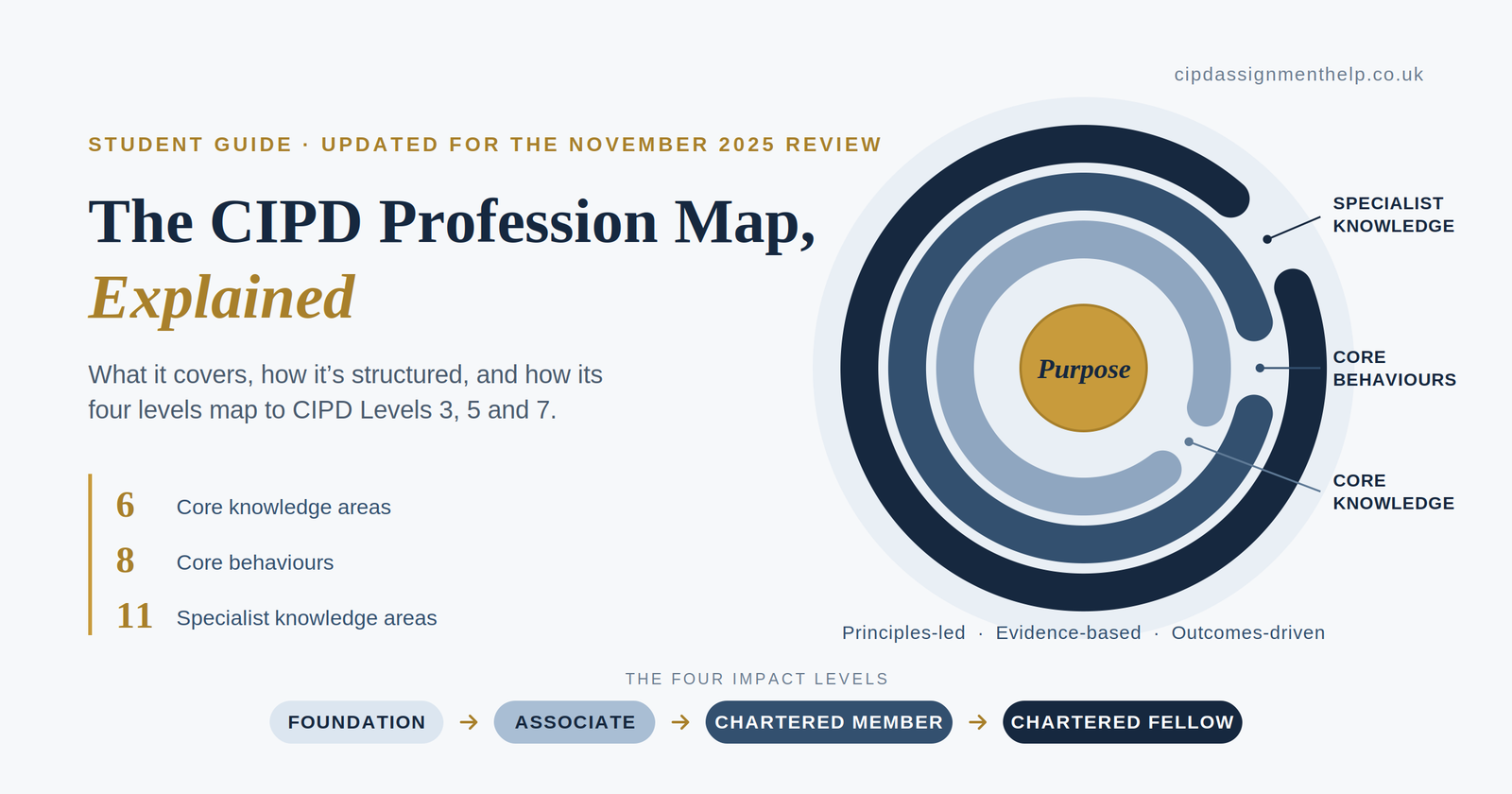
Picture the map as a set of rings around a centre point.
At the very centre sits the purpose of the profession — championing better work and working lives. Around the purpose sit three professional values that are meant to guide every decision a people professional makes:
- Principles-led — doing what’s right, not just what policy allows.
- Evidence-based — grounding decisions in data, research and multiple sources rather than instinct or habit.
- Outcomes-driven — focusing effort on work that genuinely creates value for people and organisations.
Around the values sit three sets of standards: core knowledge (six areas everyone needs), core behaviours (eight ways of working everyone needs), and specialist knowledge (eleven areas you draw on only if your role requires them).
Every standard is written at four impact levels, which we’ll come to shortly — because the levels are where the map connects directly to your qualification.
The six core knowledge areas
Core knowledge applies to every people professional, whatever their role. Here’s what each of the six areas covers, and how recently CIPD has revised it:
| Core knowledge area | What it covers | Recent changes |
|---|---|---|
| People practice | The fundamentals of the employee lifecycle: resourcing, performance, wellbeing, employment law awareness and ways of working | Flexible working standards consolidated into one balanced-risk standard (2025) |
| Culture and behaviour | How organisational culture forms, what behavioural science tells us about people at work, and how learning, teamwork and resilience are built | — |
| Business acumen | Understanding the organisation commercially: strategy, the external environment, basic finance, governance and suppliers | Environmental sustainability standard added (2022); supplier management updated (2023) |
| Evidence-based practice | Using data, research and stakeholder insight to make decisions and solve problems | Fact- and source-checking emphasis strengthened in response to AI-generated content (2025) |
| Technology and people | How technology shapes work and the workforce, including AI | Responsible AI standard added (2023); digital accessibility and literacy added, collaborative technologies standard retired (2025) |
| Change | Building the case for change, planning and delivering it, and embedding continuous improvement | — |
How the core knowledge areas develop across the four levels
The same six areas apply at every career stage — what changes is the nature and reach of the work. The table below is our own summary of that direction of travel; the full standards for each level are on the CIPD website.
| Area | Foundation | Associate | Chartered Member | Chartered Fellow |
|---|---|---|---|---|
| People practice | Carrying out day-to-day people processes and understanding how the employee lifecycle fits together | Advising managers and applying policy to real cases fairly and consistently | Designing people practices that join up with each other and with business plans | Setting the organisation’s overall people approach and preparing it for future workforce needs |
| Culture and behaviour | Recognising what shapes culture and behaviour in your own team | Applying behavioural insight to everyday people work and team dynamics | Diagnosing culture across the organisation and leading interventions to shift it | Owning culture at enterprise level and holding leadership accountable for it |
| Business acumen | Knowing what the organisation does, who it serves and how your work supports that | Connecting people activity to commercial priorities and reading basic financial information | Using commercial and financial insight to shape people plans and evaluate return | Shaping business strategy itself through the people agenda |
| Evidence-based practice | Understanding why decisions should rest on evidence and using simple data confidently | Choosing appropriate tools and sources to analyse problems and inform advice | Interrogating the quality of evidence and turning analysis into organisational decisions | Building organisation-wide capability for evidence-based decision-making |
| Technology and people | Using workplace technology competently and understanding how it changes people’s work | Helping teams adopt technology well and weighing its benefits and risks | Evaluating current and emerging technology — including AI — to improve people practices | Leading digital transformation of the people function and wider workforce |
| Change | Supporting change activity and understanding why a clear case for change matters | Applying change management approaches and helping people through transitions | Leading change programmes and mobilising stakeholders behind them | Building an organisation that can change continuously, not just once |
If your assignment asks about any of these areas, always check the current wording on the CIPD website rather than relying on an older summary — several of these areas have been rewritten since 2021.
The eight core behaviours
The core behaviours describe how people professionals are expected to work, and they apply at every level. This table summarises each behaviour in plain English and shows where you’re most likely to meet it in your course:
| Core behaviour | What it means in practice | Where you’ll meet it as a student |
|---|---|---|
| Ethical practice | Doing the right thing even under pressure, and challenging what isn’t right | Professional behaviour units at every level; ethics-focused questions at Level 7 |
| Professional courage and influence | Speaking up, presenting a case and holding your ground constructively (restructured in 2025 into clearer single-theme standards) | Reflective tasks and stakeholder scenarios, especially at Levels 5 and 7 |
| Valuing people | Treating people with fairness and compassion, and helping them perform at their best | People practice and people management units |
| Working inclusively | Collaborating across boundaries and building environments where people feel safe to contribute (psychological safety added in 2022) | EDI-linked questions across all levels |
| Commercial drive | Focusing effort where it creates genuine value for the organisation and its customers | Business and commercial context units, particularly Levels 5 and 7 |
| Passion for learning | Continuously developing yourself and encouraging development in others | CPD plans and reflective practice tasks |
| Insights focused | Asking sharp questions, weighing evidence and checking sources before concluding (fact-checking emphasis strengthened in 2025) | Research-based assignments at every level |
| Situational decision-making | Reading the context and fitting the response to it, rather than applying a formula | Case-study questions throughout your qualification |
Level 3 and Level 5 students meet these behaviours head-on in their people-professional units — our 3CO03 core behaviours guide walks through how they’re assessed.
The eleven specialist knowledge areas
Specialist knowledge is optional by design. A generalist might use none of these areas; a specialist typically works deeply in one or two. As of the November 2025 review there are eleven:
| Specialist knowledge area | Who typically uses it | Current status |
|---|---|---|
| Employee experience | Engagement, EX and internal communications roles | Amended in 2022 when Wellbeing became its own area |
| Employee relations | ER advisers and practitioners in unionised environments | Broadened in the 2021 review |
| Equality, diversity and inclusion | EDI specialists and leads | Retitled from “Inclusion and diversity” in 2022 |
| Learning and development | L&D professionals — core reading for L&D pathway students | — |
| Organisation development and design | OD&D practitioners and consultants | Revised in 2022 |
| People analytics | Data and analytics roles within people teams | Fully revised in 2023 |
| Resourcing | Recruitment and resourcing specialists | Fully revised in 2024; new standards on AI in recruitment and candidate experience |
| Reward | Reward, benefits and compensation specialists | Fully revised in 2024; new standards on job evaluation and pay negotiations |
| Talent management | Talent and succession planning roles | Fully revised in 2024; new standard on career pathways |
| Wellbeing | Wellbeing leads and specialists | Added in 2022 |
| Workforce planning | Workforce planning leads and strategic resourcing roles | Added in the 2025 review — the newest specialist area |
If a source tells you there are nine specialist areas, it predates 2022. Citing that structure in a 2026 submission signals to your assessor that your research is out of date.
The four impact levels — and how they match your qualification
Every standard in the map is written at four levels of impact. The levels describe the nature of the work, not years of service:
- Foundation — hands-on, tactical delivery that supports your immediate team and customers.
- Associate — operational work: advising managers, handling more complex casework, creating short-term value.
- Chartered Member — strategic work: shaping practices, interpreting data, influencing stakeholders across the organisation.
- Chartered Fellow — leading strategy, driving large-scale change and shaping the profession itself.
Here’s how the levels line up with CIPD qualifications and membership grades:
| Profession Map level | Typical nature of work | CIPD qualification | Membership grade on completion |
|---|---|---|---|
| Foundation | Tactical, hands-on delivery | Level 3 Foundation Certificate | Foundation Member |
| Associate | Operational, advisory | Level 5 Associate Diploma | Associate Member (Assoc CIPD) |
| Chartered Member | Strategic, influencing | Level 7 Advanced Diploma | Eligible to apply for Chartered Member (Chartered MCIPD) |
| Chartered Fellow | Leading strategy at scale | Experience-based route | Chartered Fellow (Chartered FCIPD) |
Note the wording in the Level 7 row: completing the Advanced Diploma satisfies the knowledge requirement for Chartered Membership, but chartered status also involves demonstrating the impact of your work in practice.
What’s changed? The Profession Map update timeline
CIPD reviews the map annually and publishes every change. The short history:
- November 2018 — the current Profession Map launches, replacing the 2013 version.
- 2021 — greater focus on flexible and hybrid working; “Digital working” becomes “Technology and people”; “Analytics and creating value” becomes “Evidence-based practice”.
- 2022 — Wellbeing added as a specialist knowledge area; “Inclusion and diversity” retitled “Equality, diversity and inclusion”; psychological safety added to Working inclusively; environmental sustainability added to Business acumen; OD&D revised.
- 2023 — AI enters the standards: a new standard on responsible use of AI in Technology and people; People analytics fully revised.
- 2024 — Resourcing, Reward and Talent management fully revised, adding standards on AI in recruitment, candidate experience, job evaluation, pay negotiations and career pathways.
- 2025 — Workforce planning added as a new specialist knowledge area; Technology and people updated (digital accessibility and literacy in, collaborative technologies out); flexible working standards consolidated in People practice; Professional courage and influence restructured; fact- and source-checking strengthened across Evidence-based practice and Insights focused.
We add each new review cycle to this timeline, so this section always shows the current state of the map.
How to use the Profession Map in your CIPD assignments
Know which units draw on it directly. At Level 3, the core units on business culture and professional behaviours are built straight from the map’s core knowledge and behaviours. At Level 5, the professional behaviours and valuing people unit asks you to apply the behaviours to your own practice. At Level 7, the map’s Chartered Member-level standards underpin the expectations across your core modules.
Cite the current version. Referencing “the nine specialist areas”, “Inclusion and Diversity” or “Digital working” tells your assessor you’ve relied on outdated secondary sources. Reference the map as it stands on cipd.org, and where a recent change is relevant — AI in recruitment, workforce planning, psychological safety — naming it shows genuinely current research.
Use the self-assessment tool for reflective tasks. CIPD provides a self-assessment tool built on the map. For CPD plans and reflective assignments, assessing yourself against the standards at your level gives you authentic, specific evidence rather than generic reflection.
Anchor your career sections. Assignments that ask where you’re heading professionally become much easier when you frame your answer in terms of moving from one impact level to the next — it’s the language your assessor already thinks in.
Frequently Asked Questions
Is there a “CIPD Profession Map 2026”?
Not as a separate edition. CIPD doesn’t release numbered versions — it reviews the single, current map once a year. The most recent changes were made in the November 2025 review, and that’s the version in force in 2026.
How many specialist knowledge areas are there?
Eleven, following the addition of Wellbeing in 2022 and Workforce planning in 2025. Sources citing nine areas are out of date.
What sits at the centre of the Profession Map?
The purpose of the profession — championing better work and working lives — surrounded by the three values: principles-led, evidence-based and outcomes-driven.
Is the Profession Map the same as CIPD membership levels?
They’re aligned but not identical. The map’s four levels are standards describing types of work and impact; membership grades (Foundation Member, Associate Member, Chartered Member, Chartered Fellow) are the credentials you hold, awarded through qualifications and experience assessed against those standards.
Do I need to learn the whole map for my course?
No. Focus on the six core knowledge areas and eight core behaviours at the level matching your qualification. Specialist knowledge areas only matter where your units or your role touch them — an L&D student, for example, should know the Learning and development specialist standards well.
Studying a unit built on the Profession Map?
If you’re working on an assignment that draws on the map — professional behaviours, evidence-based practice, or any core unit — our tutors can help you interpret the standards at your level, structure your answer and strengthen your referencing. Get in touch through our Level 3, Level 5 or Level 7 pages, or request a free quote.
Sources: CIPD, Explore the Profession Map and The Profession Map update history, cipd.org (accessed 2026). Always verify the current standards against the CIPD website, as the map is reviewed annually.

Becoming an Effective L&D Practitioner 3BEP Example
[…] What do you still need to learn? Update your CPD plan with these new development needs and include dates for their intended completion. This should […]
5HR02 Assignment Example | Talent Management and Workforce Planning
[…] is one of the fundamental people practice functions that mitigate numerous organisational risks. CIPD (2020) defines succession planning as a process of identifying and developing potential future […]