

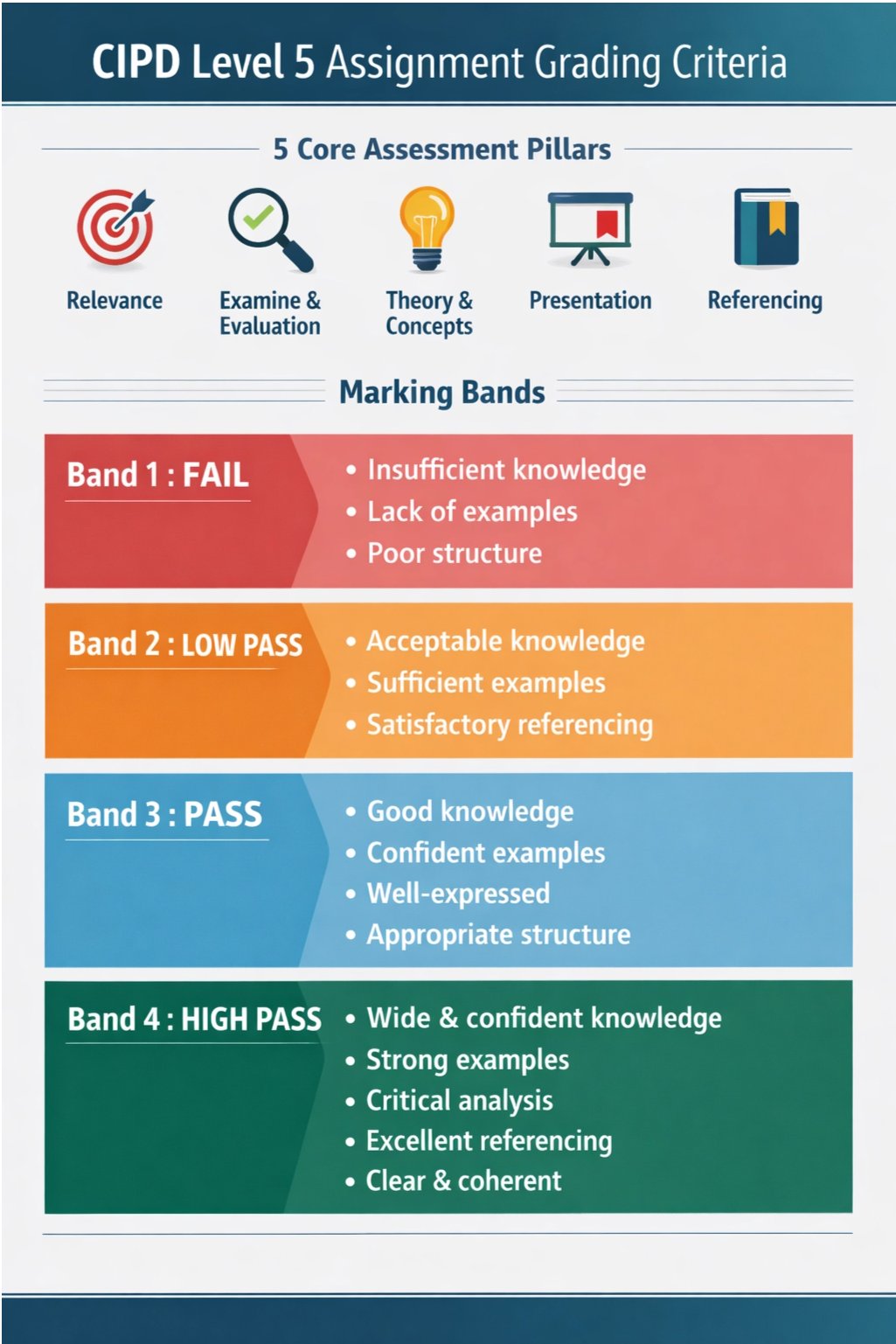
The CIPD Level 5 Associate Diploma in People Management or Organisational Learning and Development marks a significant step in a professional’s career. It moves beyond foundational knowledge, demanding a sophisticated level of analysis and application. For many learners, the grading process can seem opaque, but in reality, it is governed by a clear, structured framework. Understanding this framework is not just about passing; it is the essential blueprint for achieving a Merit or, more importantly, a Distinction.
This post will demystify the CIPD Level 5 grading criteria, explaining the 1-4 marking scale, the philosophy behind the assessment, and the practical strategies you can employ to elevate your assignments from a Pass to a top-tier grade.
The Foundation: Assessment Criteria and the 1-4 Scale
CIPD assignments are not graded on a single percentage score. Instead, each unit is broken down into several Assessment Criteria (ACs), and each AC is marked individually using a four-point scale. To successfully pass a unit, a learner must achieve a minimum of a ‘Pass’ (a score of 2) in every single Assessment Criterion within that unit. Failing even one AC will result in a ‘Refer’ for the entire unit, regardless of the high scores achieved in the others.
The four-point scale is designed to differentiate between levels of achievement, moving from basic compliance to exceptional critical insight.
|
Score
|
Grade Descriptor
|
Achievement Level
|
Key Focus
|
|
4
|
Distinction
|
Exceptional
|
Deep critical analysis, synthesis of complex ideas, and innovative application to real-world scenarios.
|
|
3
|
Merit
|
High Standard
|
Clear, well-structured analysis, good application of theory, and strong evidence of understanding.
|
|
2
|
Pass
|
Satisfactory
|
Meets the minimum requirements of the AC. Demonstrates a basic understanding and correct application of concepts.
|
|
1
|
Fail/Refer
|
Insufficient
|
Evidence is missing, irrelevant, or demonstrates a fundamental misunderstanding of the required concept.
|
Beyond the Pass: The Path to Merit and Distinction
The difference between a Pass (2), a Merit (3), and a Distinction (4) lies in the depth of engagement with the material. A Pass confirms that you have met the requirement; a Distinction proves you have mastered it.
1. Mastering the Command Verbs
At Level 5, the CIPD is looking for more than just description. You must pay close attention to the command verbs used in each Assessment Criterion, as they dictate the required level of cognitive skill.
|
Command Verb
|
Required Action for Distinction (Score 4)
|
Avoid (Score 2 or less)
|
|
Analyse
|
Systematically break down the subject into its constituent parts, showing the relationship between them and providing a reasoned judgment.
|
Simply describing the parts without showing how they interrelate.
|
|
Evaluate
|
Appraise the strengths, weaknesses, implications, and practical usefulness of a theory or approach, offering a balanced and evidence-based conclusion.
|
Stating opinions or merely listing pros and cons without justification.
|
|
Critically Review
|
Examine and judge the subject’s validity and relevance in a specific context, challenging assumptions and presenting alternative perspectives.
|
Summarising existing literature without offering a critical perspective.
|
|
Appraise
|
Assess the value or quality of something, considering its significance and potential impact on organisational performance.
|
Providing a superficial overview or definition.
|
2. Critical Analysis and Application
To achieve a Merit or Distinction, your work must demonstrate critical analysis and practical application.
- Critical Analysis: This involves moving beyond what a theory is to why it is relevant, how it works in practice, and what its limitations are. For example, instead of just describing Maslow’s Hierarchy of Needs, a Distinction-level response would evaluate its relevance in a modern, diverse workplace, perhaps critiquing its cultural bias or comparing it to more contemporary motivation theories.
- Practical Application: CIPD is a professional qualification, and your assignments must reflect this. You should consistently link theoretical concepts to real-world scenarios, ideally drawing on your own professional experience or well-researched case studies. This shows the assessor that you can translate academic knowledge into actionable HR or L&D practice.
Calculating the Final Unit Grade
Once all ACs have been marked, the individual scores are aggregated to determine the final unit grade. While the exact point boundaries can vary slightly between units and centres, the principle remains the same: the higher the total score, the higher the grade.
For a unit with, for example, eight Assessment Criteria (ACs), the total possible score is 32 (8 ACs x 4 points each). The typical boundaries for an 8-AC unit are:
|
Final Unit Grade
|
Aggregate Score Range (Example: 8 ACs)
|
Requirement
|
|
Distinction
|
28 – 32 points
|
All ACs must be a 3 or 4, with a majority of 4s.
|
|
Merit
|
22 – 27 points
|
All ACs must be a 2 or higher, with a significant number of 3s.
|
|
Pass
|
16 – 21 points
|
All ACs must be a 2 or higher.
|
|
Refer
|
Below 16 points
|
Any single AC scores a 1.
|
Note: These ranges are indicative and serve as a guide. Always consult your specific centre’s marking scheme for definitive boundaries.
Best Practices for Success
To ensure your assignment is positioned for the highest possible grade, follow these best practices:
- Deconstruct the Brief: Before writing, break the assignment brief down into its constituent ACs. Use a checklist to ensure every single point is addressed.
- Structure for Clarity: Use clear headings and subheadings that directly correspond to the ACs. This makes it easy for the assessor to follow your argument and confirm that all criteria have been met.
- Reference Rigorously: Use the Harvard referencing system (or your centre’s specified style) consistently. High-quality sources, such as CIPD factsheets, academic journals, and reputable industry reports, lend credibility to your analysis.
- Proofread and Refine: Errors in grammar, spelling, and punctuation detract from the professional quality of your work. Ensure your language is precise and your arguments are coherent.
By understanding the CIPD’s structured grading system—from the mandatory Pass for every AC to the critical analysis required for a Distinction—you can approach your Level 5 assignments with confidence and a clear strategy for achieving your desired outcome.