

Table of Contents
The landscape of the modern workforce has undergone a seismic shift over the last decade. With the rise of the gig economy, the proliferation of freelance platforms, and the normalization of remote work, the traditional “9-to-5” full-time role is no longer the only path to a successful career. However, despite these emerging alternatives, full-time employment remains the cornerstone of the global economy. For many, it represents the ultimate goal—a badge of stability and professional maturity. For others, it is a restrictive structure that stifles creativity and personal freedom. To navigate today’s job market effectively, one must move beyond the surface-level perceptions and conduct a rigorous analysis of the advantages and disadvantages inherent in a full-time commitment.
At its core, full-time employment is defined by a consistent commitment to a single employer, typically involving 35 to 40 hours of work per week in exchange for a salary and benefits. This arrangement creates a symbiotic relationship: the employer gains a dedicated resource for long-term projects, while the employee gains a level of security that is difficult to replicate in the world of independent contracting. As we delve into the nuances of this professional structure, we will explore why millions of workers continue to choose this path, while an increasing number are beginning to question its long-term viability in an era of rapid digital transformation.
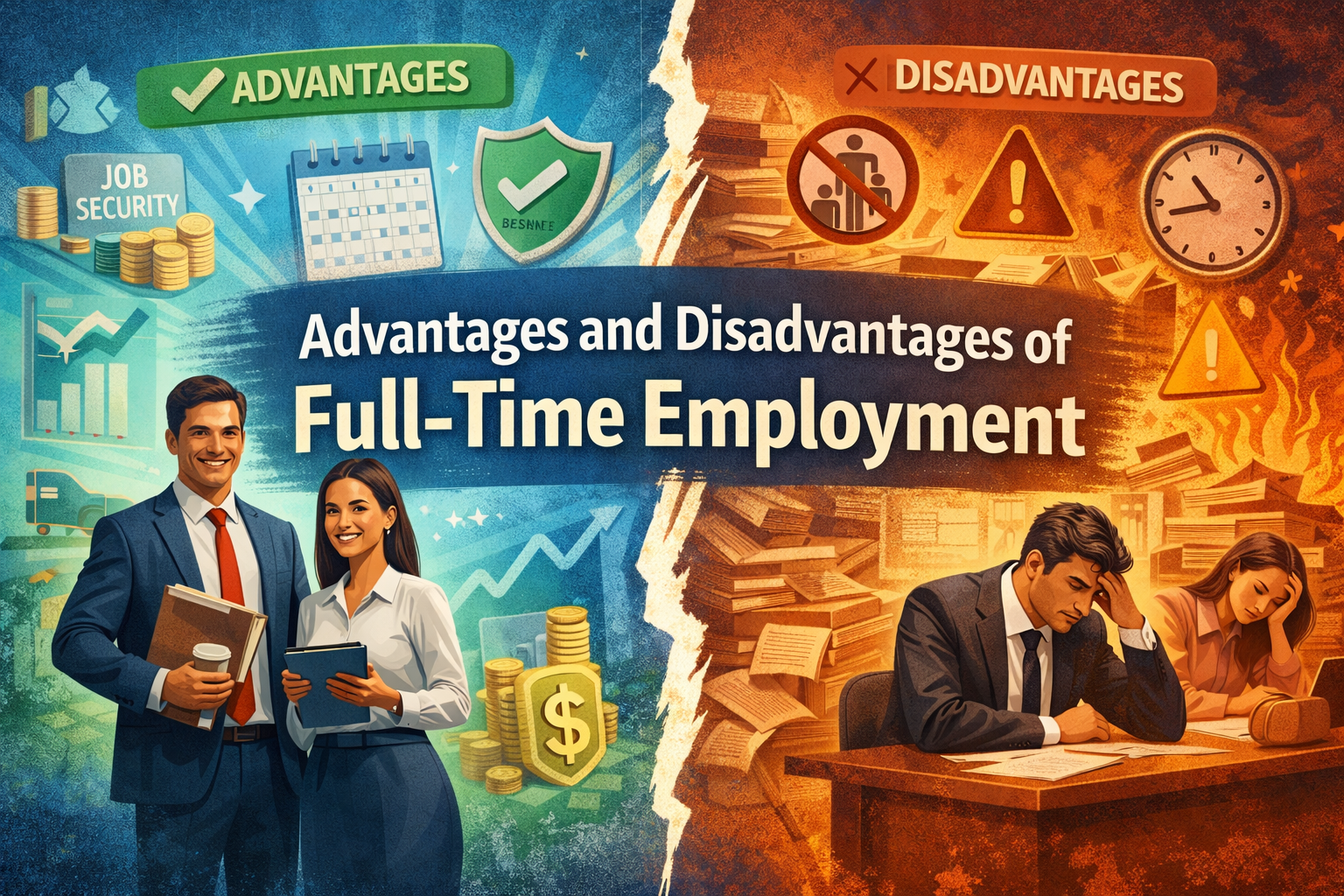
The Pillars of Stability: Advantages of Full-Time Employment
The most immediate and frequently cited benefit of full-time employment is financial predictability. Unlike freelancers or seasonal workers who often face “feast or famine” cycles, full-time employees can rely on a guaranteed paycheck arriving at regular intervals. This predictability is the foundation upon which individuals build their lives; it allows for accurate budgeting, the securing of mortgages, and long-term financial planning. Furthermore, many full-time roles include structured compensation increases, such as annual cost-of-living adjustments, performance-based bonuses, and commissions, which provide a clear trajectory for income growth over time .
Beyond the base salary, the comprehensive benefits package is perhaps the strongest argument for traditional employment. In many regions, particularly the United States, the cost of private health insurance can be prohibitive for individuals. Full-time employers often subsidize health, dental, and vision insurance, significantly reducing the financial burden on the worker. Additionally, retirement benefits such as 401(k) matching or pension plans serve as a forced savings mechanism, often with the added benefit of “free money” from employer contributions. When combined with paid time off (PTO), sick leave, and parental leave, these benefits create a robust safety net that protects the employee’s well-being and future .
Benefit Category |
Description |
Impact on Employee |
Health Insurance |
Employer-sponsored medical, dental, and vision plans. |
Reduces out-of-pocket costs and ensures access to care. |
Retirement Plans |
401(k) matching, pensions, or superannuation contributions. |
Facilitates long-term wealth accumulation and security. |
Paid Leave |
Vacation days, sick time, and public holidays. |
Allows for rest and recovery without loss of income. |
Professional Development |
Tuition reimbursement, workshops, and internal training. |
Enhances skill sets and increases long-term marketability. |
Another critical advantage is the structured environment for career progression. Full-time roles are typically part of a larger organizational hierarchy, which provides a clear “ladder” for advancement. Employees often have access to internal mentorship, formal training programs, and a variety of projects that allow them to develop specialized skills. This environment fosters a sense of purpose and direction; knowing that a junior analyst can eventually become a senior manager or director provides a powerful incentive for high performance. Moreover, being part of a company often grants access to proprietary tools, data, and resources that would be far too expensive for an independent professional to acquire .
Finally, the social and professional community found in a workplace cannot be overlooked. Humans are inherently social creatures, and the workplace serves as a primary hub for interaction. Full-time employment offers the opportunity to collaborate with a consistent team, fostering deep professional relationships and a shared sense of culture. This community provides emotional support during challenging projects and a network of contacts that can be invaluable throughout one’s career. For many, the workplace is not just where they earn a living, but where they find a sense of belonging and collective achievement .
The Hidden Costs: Disadvantages of Full-Time Employment
While the benefits of a full-time role are substantial, they are often purchased at the cost of personal flexibility and autonomy. The traditional 9-to-5 schedule, while providing structure, can also act as a cage. Full-time employees are typically required to be present—physically or digitally—during specific hours, regardless of their natural productivity cycles or personal needs. This rigidity makes it difficult to manage the complexities of modern life, such as attending a child’s school event, running errands during business hours, or pursuing spontaneous travel. For individuals who value freedom above all else, the requirement to “ask permission” for time off can be a significant psychological burden .
Furthermore, the environment of a large organization often brings with it the complexities of office politics and bureaucracy. Unlike the independent contractor who can focus almost exclusively on the quality of their output, the full-time employee must navigate a web of interpersonal dynamics, hierarchy, and corporate “red tape.” Countless hours are often lost to unproductive meetings, administrative tasks, and the pursuit of consensus. In some cultures, “face time”—the act of being seen at one’s desk—is valued more than actual results, leading to a performative work style that can be both exhausting and demoralizing .
Disadvantage |
Root Cause |
Consequence |
Rigid Scheduling |
Fixed working hours and location requirements. |
Difficulty in achieving a true work-life balance . |
Corporate Politics |
Organizational hierarchy and competing interests. |
Increased stress and potential for unfair treatment . |
Skill Stagnation |
Repetitive tasks within a single specialized role. |
Reduced marketability in a changing job market . |
Single-Source Risk |
Dependency on one employer for all income. |
High vulnerability during economic downturns or layoffs . |
The risk of burnout and professional stagnation is another significant drawback. The repetitive nature of many full-time roles can lead to a “plateau” where the employee is no longer learning or growing. When an individual spends years performing the same functions for the same company, their skill set may become overly specialized to that specific environment, making them less adaptable to the broader market . Additionally, the “always-on” culture prevalent in many modern industries—where employees are expected to respond to emails and messages long after official hours—has blurred the boundaries between work and home life, leading to chronic stress and physical exhaustion .
There is also the matter of financial dependency. While a salary is predictable, it is also concentrated. A full-time employee is entirely dependent on the health and whims of a single organization. If that company faces a downturn, undergoes a merger, or decides to restructure, the employee’s entire income stream can vanish overnight. In contrast, a freelancer with multiple clients has a diversified income; losing one client is a setback, but losing one’s only employer is a catastrophe . Furthermore, full-time employees often have fewer opportunities for tax deductions compared to business owners or independent contractors, who can write off expenses such as home offices, equipment, and travel .
Full-Time Employment in the Digital Age
The definition of full-time work is currently in a state of flux. The rise of remote and hybrid models has addressed some of the traditional disadvantages, particularly the time and stress associated with commuting. Today, many full-time employees enjoy the stability of a salary while working from the comfort of their homes, allowing for a better integration of professional and personal life. However, this shift has introduced new challenges, such as digital isolation and the difficulty of “switching off” when one’s office is also their living room.
We are also seeing the emergence of the “fractional” or “portfolio” career, where professionals hold multiple part-time or contract roles that collectively equate to a full-time commitment. This trend suggests that the future of work may not be a binary choice between full-time employment and freelancing, but rather a spectrum of arrangements that prioritize different values at different stages of life.
Decision Framework: Is Full-Time Right for You?
Choosing between full-time employment and other models is a deeply personal decision that should be based on an honest assessment of one’s priorities. If you value security, community, and a clear path for advancement, the traditional full-time route is likely the best fit. This is especially true for those in life stages that require high financial predictability, such as when raising a family or paying off significant debt.
Conversely, if your primary drivers are autonomy, variety, and the ability to control your own schedule, you may find the constraints of full-time work to be stifling. In such cases, the trade-off of less security for more freedom may be well worth it. It is also important to consider your personality; some thrive under the structure of a manager and a team, while others are most productive when they are the masters of their own domain.
Full-time employment is neither a relic of the past nor a perfect solution for the future; it is a professional tool that offers specific advantages at a specific price. By providing financial stability, essential benefits, and a sense of community, it remains a vital path for millions of workers. Yet, the inherent lack of flexibility and the risks of organizational dependency cannot be ignored. As the world of work continues to evolve, the most successful professionals will be those who understand these trade-offs and consciously choose the path that aligns with their personal values and long-term aspirations. Whether you choose the safety of the harbor or the freedom of the open sea, the key is to navigate with intent.