

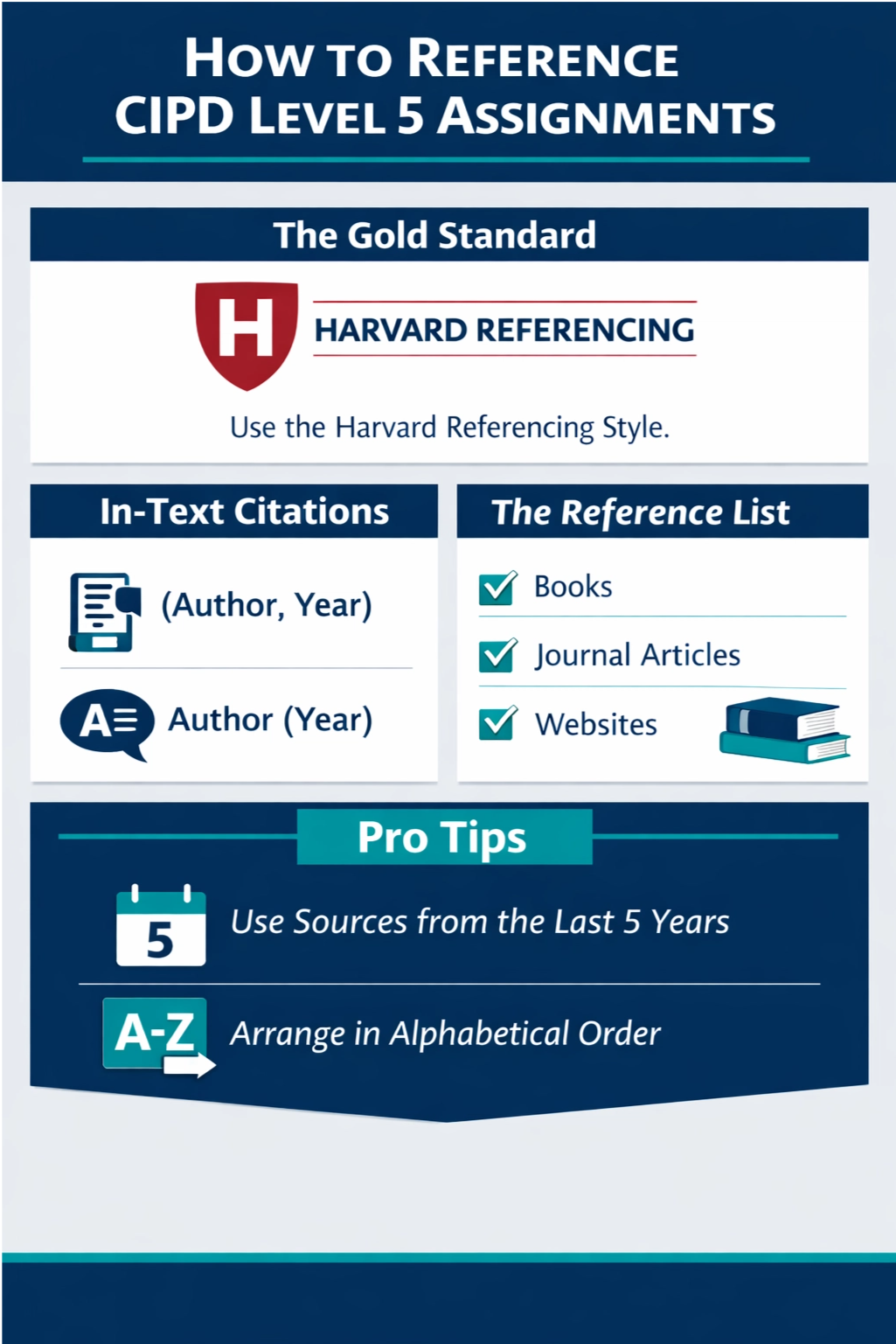
The Chartered Institute of Personnel and Development (CIPD) Level 5 Associate Diploma in People Management or Learning and Development marks a significant step in your professional journey. It requires not only a deep understanding of HR and L&D principles but also the ability to demonstrate academic rigor in your assignments. Central to this is impeccable referencing. For CIPD Level 5, the universally accepted standard is the Harvard referencing system . Mastering this system is not merely a technical requirement; it is a fundamental skill that validates your research, strengthens your arguments, and ensures you avoid the academic pitfall of plagiarism.
This guide provides a comprehensive breakdown of the Harvard system as applied to CIPD Level 5 assignments, focusing on the specific types of sources you will encounter, from seminal textbooks to contemporary CIPD reports and crucial legislation.
The Dual Pillars of Harvard Referencing
The Harvard system is an Author-Date style, meaning it relies on two interconnected components to function effectively: the in-text citation and the Reference List.
1. In-Text Citation Mastery
The in-text citation is a brief marker placed within the body of your assignment, immediately following the information you have drawn from a source. Its primary function is to direct the reader to the full source details in your Reference List.
The basic format is simple: the author’s surname and the year of publication, enclosed in parentheses.
Example: Effective people management is crucial for organizational success (Armstrong, 2020).
When citing a source with two authors, both surnames are included. For three or more authors, the convention is to use the first author’s surname followed by et al. (Latin for “and others”).
|
Number of Authors
|
In-Text Citation Format
|
Example
|
|
One Author
|
(Surname, Year)
|
(Mullins, 2019)
|
|
Two Authors
|
(Surname and Surname, Year)
|
(Taylor and Woodhams, 2022)
|
|
Three or More
|
(Surname et al., Year)
|
(Green et al., 2023)
|
|
Corporate Author
|
(Organisation Name, Year)
|
(CIPD, 2024)
|
A critical point for Level 5 is the use of direct quotes. If you reproduce a source’s exact words, you must include the page number to allow for precise location of the text. Failure to do so, even with the author and year, can be considered poor academic practice.
Example of a direct quote: The process of job analysis is defined as “the systematic investigation of the tasks, duties, and responsibilities of a job” (CIPD, 2023, p. 15).
2. The Comprehensive Reference List
The Reference List, placed at the end of your assignment, provides the full bibliographic details for every source you have cited in the text. It must be arranged alphabetically by the author’s surname (or the corporate author’s name).
For CIPD Level 5, you will be expected to cite a variety of sources. Consistency in formatting is paramount. Below are the required formats for the most common and essential source types:
Books (The Foundational Text)
Books, particularly core textbooks like Armstrong’s Handbook, are essential for establishing theoretical foundations.
Format:
SURNAME, Initial. (Year) Title of Book. Edition (if not the first). Place of Publication: Publisher.
Example: ARMSTRONG, M. and TAYLOR, S. (2020) Armstrong’s Handbook of Human Resource Management Practice. 15th ed. London: Kogan Page .
Journal Articles (The Academic Standard)
Academic journals demonstrate that your research is current and based on peer-reviewed scholarship. They are highly valued in Level 5 assignments.
Format:
SURNAME, Initial. (Year) Title of article. Title of Journal. Volume number (Issue number), pp. page numbers.
SURNAME, Initial. (Year) Title of article. Title of Journal. Volume number (Issue number), pp. page numbers.
Example: SAMMER, J. (2012) Financial education – stress = improved productivity. HR Magazine. Vol 57 (6), pp. 71–76 .
CIPD Reports and Online Publications (The Professional Edge)
CIPD reports, surveys, and factsheets are arguably the most important sources for Level 5, as they provide the latest professional insights and data. Since these are almost always accessed online, the format requires an ‘Available at’ URL and an ‘Accessed’ date.
Format:
CORPORATE AUTHOR. (Year) Title of Report [online]. Place of Publication: Publisher. Available at: URL (Accessed Date).
CORPORATE AUTHOR. (Year) Title of Report [online]. Place of Publication: Publisher. Available at: URL (Accessed Date).
Example: CHARTERED INSTITUTE OF PERSONNEL AND DEVELOPMENT. (2024) Health and wellbeing at work 2024 [online]. London: CIPD. Available at: https://www.cipd.org/report-link (Accessed 27 January 2026 ) .
Legislation and Official Publications (The Legal Context)
CIPD assignments often require you to reference legal frameworks, such as the Equality Act or the Employment Rights Act. These are treated as official publications.
Format:
Title of Act Year. (Year) [online]. Place of Publication: Publisher. Available at: URL (Accessed Date).
Title of Act Year. (Year) [online]. Place of Publication: Publisher. Available at: URL (Accessed Date).
Example: Equality Act 2010. (2010) [online] London: The Stationery Office. Available at: http://www.legislation.gov.uk/ukpga/2010/15/contents (Accessed 27 January 2026 ) .
CIPD Level 5: Beyond the Basics
For Level 5, your assessors are looking for evidence of critical thinking and the use of credible, authoritative sources. Simply having a reference list is not enough; the quality of your sources is a key differentiator.
The Importance of Source Quality and Recency
CIPD assignments require you to bridge academic theory with professional practice. This means prioritizing sources that meet a high standard of authority:
- Academic Literature: Peer-reviewed journal articles and established textbooks.
- Professional Bodies: Reports and factsheets from the CIPD, ACAS, and other reputable HR/L&D organizations.
- Government and Official Sources: Legislation, government white papers, and statistics from the Office for National Statistics (ONS).
A common piece of advice for Level 5 students is the Recency Rule: aim for sources published within the last five to ten years. While classic theories (e.g., Maslow’s Hierarchy of Needs) are timeless and must be cited, your application of these theories should be supported by contemporary research and data .
Common Referencing Pitfalls to Avoid
Even experienced students make simple errors that can cost marks. Be vigilant against these common mistakes:
- Inconsistency: Switching between different referencing styles (e.g., mixing Harvard and APA) or varying the punctuation and capitalization within your Harvard entries.
- Missing Access Dates: Forgetting to include the date you accessed an online source. This is crucial because web content can change or be removed.
- The “Wikipedia Trap”: Relying on non-academic sources like Wikipedia, general business blogs, or marketing materials. While these can be starting points, they should never be the final source cited in your Reference List.
- The Mismatch: Ensuring that every in-text citation has a corresponding full entry in the Reference List, and vice versa.
By treating your Reference List as an integral part of your assignment—a demonstration of your rigorous research process—you will not only satisfy the CIPD’s academic requirements but also significantly enhance the credibility and persuasive power of your arguments.