

Case study
PrimeReach Care is a government funded, acute health care service to around 500,000 people in its local region. Located across multiple, geographically dispersed sites, it employs over 15,000 people in a wide variety of professional and ancillary roles and maintains a variety of important partnerships with dozens of other organisations.
PrimeReach Care has faced very substantial challenges in recent years. Some, like the covid pandemic were exceptional, but thankfully quite short-lived. Others, such as a fast-aging population and the emergence of some chronic skills shortages in key areas, are longer term in nature, but equally concerning in terms of their potential impact on PrimeReach Care’s capacity to provide the highest standards of healthcare. Skills shortages in some specialist areas are becoming increasingly
severe. PrimeReach Care has plugged gaps by recruiting overseas but is finding it hard to retain these recruits for longer periods of time.
During 2024, employee voice activities highlighted that groups of staff were dissatisfied about pay and conditions within the organisation. This has now abated due to significant government-funded pay rises, but discontent among staff in respect of terms and conditions continues to simmer. Staff retention is a particular current challenge, as is absence. A higher percentage of PrimeReach Care’s employees are currently taking extended periods of sick leave than has ever been the case before, and in over 50% of these cases poor mental health comprises at least one of the causes. Senior managers at PrimeReach Care have recently attended a briefing given by ministers and officials, at which some very clear messages were communicated regarding the next five years. The most important concerned funding. Put simply, health care services like PrimeReach Care should plan for very tight, ongoing financial settlements in the next five years. They should not expect above- inflation increases in their regular operating budgets, which include pay for staff. Any additional funds that become available will be focused specifically on priorities such as bringing waiting lists and waiting times down. Capital budgets will also be very constrained, reducing the availability of funds for new buildings and equipment. Repair bills will have to be met out of current expenditure. Substantial efficiency improvements and increased productivity are both needed and expected.
Senior Managers have asked the People Department to provide recommendations about appropriate future actions at PrimeReach Care in some key areas. You work in a generalist, mid-level People management role on PrimeReach Care’s main site but are considered to be someone who is appropriate for promotion into a more senior role on completion of your studies. The People Director has asked you to provide answers to the following questions that will provide insight into some of the major challenges facing PrimeReach Care and help to inform the recommendations.
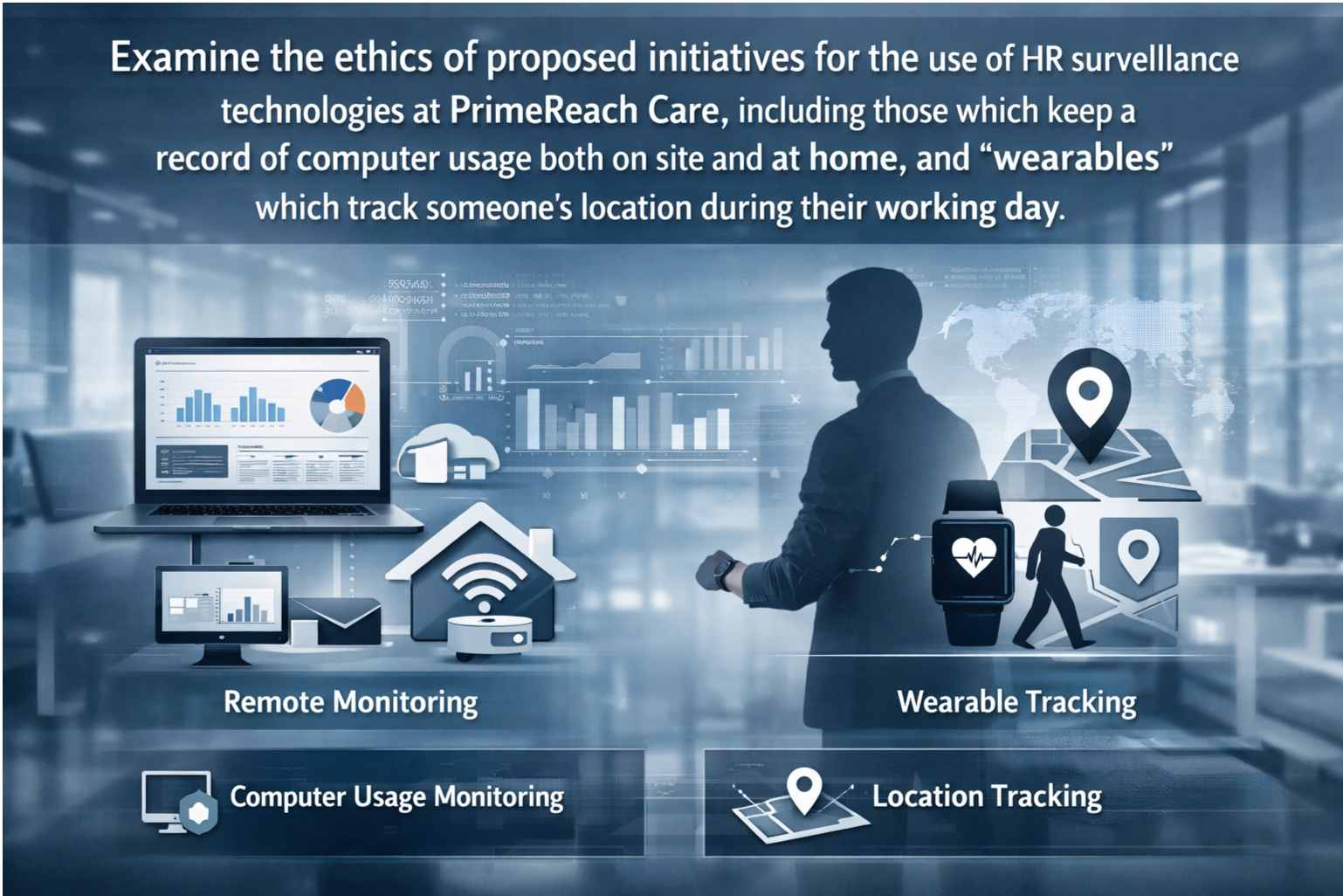
PrimeReach Care is a large government-funded healthcare provider which is currently facing pressure to improve efficiency and accountability. In response, the management of the company is exploring the use of HR surveillance technologies that monitor staff activity and performance. This is important to ensure that the employees are acting in accordance with the set rules and achieve productivity. To achieve this goal, some of the tools that the company can use is digital tools that record computer usage both on site and remotely, as well as wearable devices that track employee location during shifts. The use of these tools is gaining traction because there is a growing demand for employees to work remotely so that they can balance work and personal or family lives.
The said tools or technologies promise better productivity oversight, but they raise serious ethical, legal, and cultural concerns because they include spying on employees and how they are handling their work (Department for Digital, Culture, Media and Sport, 2018).
- Nature of the Proposed Surveillance Technologies
Computer Usage Monitoring
This tool involves software collecting data on logs log-in and log-out times and tracking time spent on applications, such as word documents. It measures typing activity, and monitors internet browsing including the sites that users are visiting. When the tools are used in hybrid or remote working arrangements, they can provide data on employee output and IT security compliance. The managers can determine if the employees are working or they are spending time on sites that do not add value to their current work.
Wearable Tracking Devices
These devices, as the name suggests, involves users wearing the devices on their wrists and collecting key information or data. Therefore, they are often integrated with staff ID badges or wristbands, record an employee’s physical location throughout the working day.
In a healthcare setting, wearables are very important and their importance is gaining tracking in the industry. This is because they can be used for safety purposes, such as locating staff in emergencies, managing movement across large sites, or verifying attendance in specific wards.
When taken together, these technologies form part of a growing global trend toward digital monitoring in workplaces. According to a research by the Chartered Institute of Personnel and Development (CIPD, 2023), which shows that over 40% of employers in the UK now use some form of electronic monitoring to track performance or attendance. While the tools may enhance operational control, their use in sensitive environments such as healthcare requires strict ethical safeguards.
- Ethical Frameworks for Assessment
Several ethical theories provide guidance for assessing HR surveillance: the ethical theories which are relevant in this case are Deontological Ethics, Utilitarian Ethics (Outcome-based), and Virtue Ethics.
Deontological Ethics (Duty-based) Focuses on respect for individual rights and fairness. In this case, the use of surveillance technologies is unethical because they intrude on privacy without consent violates employees’ moral autonomy. Utilitarian Ethics (Outcome-based) Considers whether the benefits outweigh the harms. Technologies should improve safety or efficiency without creating disproportionate psychological or social harm (Department for Digital, Culture, Media and Sport, 2018). Virtue Ethics Emphasises trust, respect, and integrity. Ethical surveillance should promote an organisational culture of accountability rather than suspicion.
- Potential Ethical Benefits
The use of surveillance technologies enhances the safety of patients and staff. Therefore, location-tracking wearables can help locate staff quickly during medical emergencies, violence incidents, or security alerts. In large hospitals, real-time positioning can shorten response times and improve patient outcomes.
The second benefit is that the technologies for surveillance, when used in the healthcare setting, they improve Accurate Workforce Planning. Data on working patterns and system usage can help identify inefficiencies, staff shortages, or areas where additional support is needed. This can support fairer workload distribution and reduce burnout (Department for Digital, Culture, Media and Sport, 2018).
The third benefit is Compliance and Accountability. This is especially the case because the technologies make it easier for employees to comply with set guidelines as well as improve overall accountability. In sectors handling sensitive patient data, monitoring ensures staff comply with data protection policies and prevents unauthorized access. This protects both patients and the organisation from legal risk.
The fourth benefit is Remote Work Transparency. This is true because hybrid work is growing in importance. As hybrid work grows, some digital tracking can maintain productivity standards and ensure equitable treatment between on-site and remote employees.
- Ethical Risks and Concerns
Despite the clear benefit of the use of digital tools for surveillance, they introduce ethical risks and concerns as discussed as follows.
- Violation of Privacy and Autonomy
- Lack of Informed Consent
- Psychological Harm and Distrust
- Function Creep
- Equality and Discrimination Risks
- Erosion of Professional Trust
- Legal and Regulatory Context
PrimeReach Care must comply with multiple UK and EU-derived legal standards. The relevant law is UK GDPR and Data Protection Act (2018). This law requires transparency, lawful basis, and proportionality in personal data processing. Employees must be informed about what is collected, why, and how long it will be stored.
Human Rights Act (1998). This law is under Article 8 and it protects the right to privacy, which extends to the workplace.
Equality Act (2010) is a law that Prevents discriminatory impacts from technology use.
Employment Rights Act (1996). This law Mandates fair treatment and consultation on workplace changes affecting staff conditions.
Failure to observe these laws exposes PrimeReach Care to legal challenges and reputational damage.
- Ethical Guidelines for Implementation
- Proportionality and Necessity
- Transparency and Consultation
Before implementation, PrimeReach Care must engage staff, unions, and professional associations in open consultation. Staff should understand:
- What data will be collected
- How it will be used
- Who will access it
- How long it will be stored
- Their rights to review or challenge data
- Consent and Choice
- Data Security and Retention
- Purpose Limitation
- Human Oversight
- Wellbeing Safeguards
- Specific Recommendations
Conduct a Data Protection Impact Assessment (DPIA). This legal and ethical step identifies privacy risks before deployment. It ensures that surveillance remains proportionate and that safeguards are in place.
Pilot Programs Before Rollout. Start with limited pilots in departments where monitoring serves a clear safety or operational purpose. Evaluate employee feedback and stress indicators before wider use.
Establish a Joint Oversight Committee. Include HR, IT, clinical leaders, and trade union representatives to oversee technology governance, approve new systems, and audit compliance.
Develop a Clear Employee Monitoring Policy. Outline permissible tools, data handling rules, and rights of access. Make this policy publicly accessible on the intranet and part of new employee induction.
Provide Regular Communication and Training. Train managers to interpret data ethically and avoid misuse. Conduct annual refreshers on privacy obligations and ethical conduct.
Introduce Employee Opt-Out Options Where Feasible. For roles where continuous monitoring is not essential, offer alternatives or partial tracking options.
Publish Transparency Reports. Annually disclose the type of surveillance systems in use, reasons for use, and any incidents of misuse. This demonstrates accountability and builds trust.
Focus on Culture, Not Control. Reinforce that technology supports safety and efficiency, not punishment. Combine monitoring with wellbeing initiatives to preserve morale.