

CIPD Level 5 vs. Level 7: A Detailed Comparison for HR Professionals
The Chartered Institute of Personnel and Development (CIPD) qualifications are the gold standard for Human Resources (HR) and Learning & Development (L&D) professionals globally. For those looking to advance their careers, the choice between the CIPD Level 5 Associate Diploma in People Management and the CIPD Level 7 Advanced Diploma in Strategic People Management is a critical decision. While both qualifications lead to CIPD professional membership, they are designed for different career stages, offer distinct levels of academic rigour, and prepare professionals for fundamentally different roles within an organisation.
This detailed post provides a comprehensive comparison to help aspiring and current HR professionals determine which qualification aligns best with their experience, career goals, and desired level of strategic influence.
Overview of Key Differences
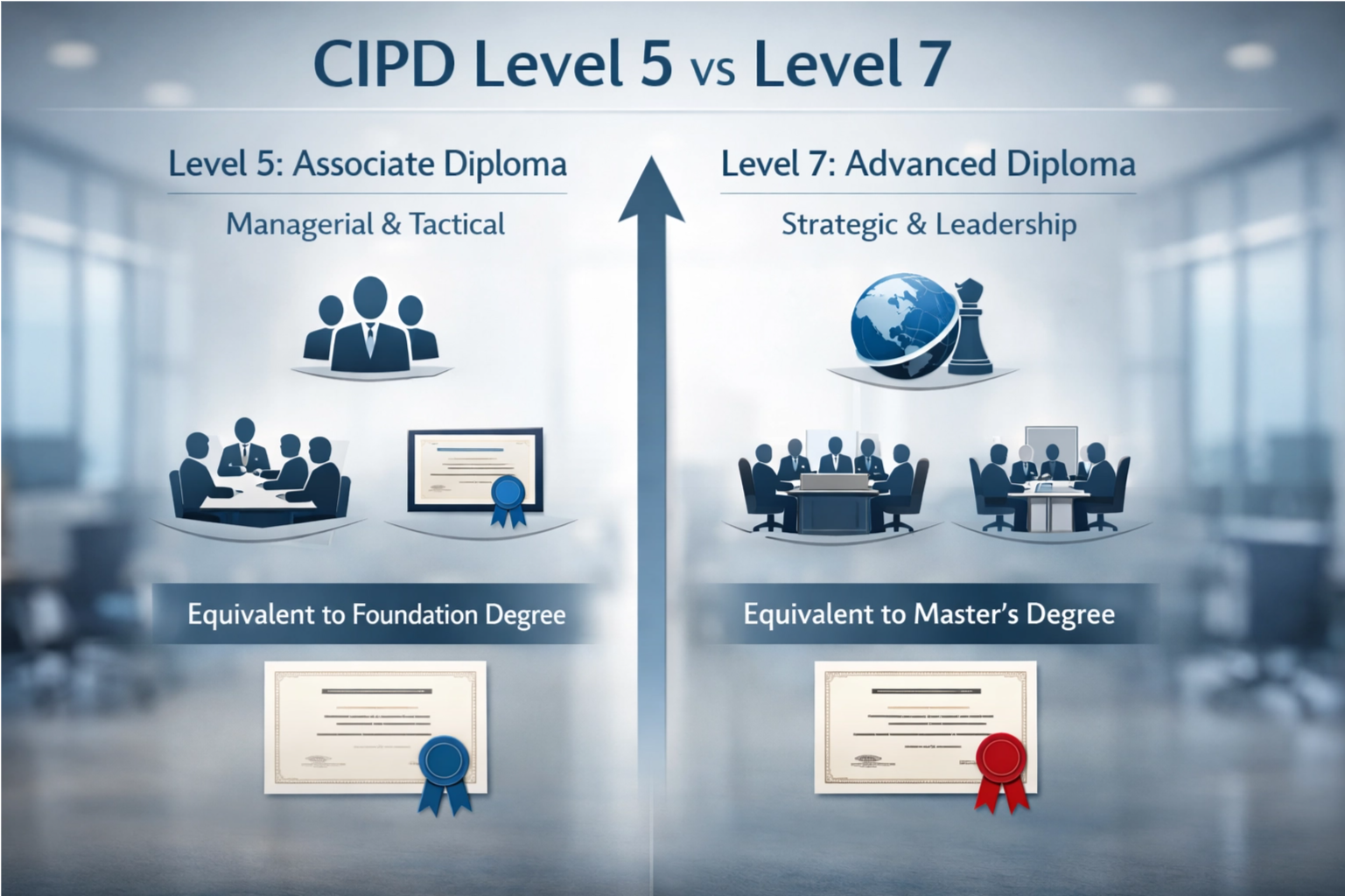
The most significant distinction between the two levels lies in their scope and academic equivalence. Level 5 focuses on the operational and tactical execution of HR policies, whereas Level 7 is dedicated to strategic leadership, critical analysis, and shaping the future direction of the people profession .
Feature |
CIPD Level 5 Associate Diploma in People Management |
CIPD Level 7 Advanced Diploma in Strategic People Management |
|
RQF Equivalence
|
UK Regulated Qualifications Framework (RQF) Level 5
|
UK Regulated Qualifications Framework (RQF) Level 7
|
|
Academic Equivalent
|
Foundation Degree, HND
|
Postgraduate/Master’s Degree
|
|
Focus
|
Operational, Tactical, and Applied HR Management
|
Strategic, Theoretical, and Critical HR Leadership
|
|
Target Audience
|
HR Officers, Advisors, Junior HR Managers
|
Senior HR Managers, Heads of HR, HR Directors
|
|
CIPD Membership
|
Associate Member (Assoc CIPD)
|
Associate Member (Assoc CIPD), with eligibility for Chartered Member (MCIPD) or Chartered Fellow (FCIPD) based on experience
|
|
Typical Units
|
Evidence-Based Practice, Professional Behaviours, Organisational Performance and Culture
|
Work and Working Lives in a Changing Business Environment, Strategic People Management, Strategic Reward Management
|
|
Estimated Study Hours
|
Approximately 420 hours
|
Approximately 1200 hours
|
|
Typical Salary Range (UK)
|
£30,000 to £50,000
|
£65,000 to £120,000+
|
Depth and Academic Rigour
The difference in level directly corresponds to the depth of study and the complexity of the material.
CIPD Level 5: The Operational Expert
The Level 5 qualification is equivalent to a Foundation Degree or Higher National Diploma (HND) . It is designed to develop the core knowledge and practical skills required to manage people effectively on a day-to-day basis. The focus is on applied thinking and developing the judgement necessary to implement and manage HR policies and processes. Students learn how to execute HR functions, such as managing employee relations, resourcing, and reward, in line with organisational objectives.
CIPD Level 7: The Strategic Leader
The Level 7 qualification is the highest CIPD award and is equivalent to a Postgraduate or Master’s degree . This level shifts the focus from doing HR to leading and shaping the HR function. The curriculum demands a high level of critical analysis, research, and strategic thinking. Professionals at this level are expected to evaluate complex organisational issues, challenge existing practices, and develop evidence-based people strategies that drive business performance and influence stakeholders at the highest level.
Target Audience and Career Progression
The appropriate qualification is largely determined by a professional’s current role and their desired career trajectory.
Career Path with Level 5
The Level 5 Associate Diploma is the ideal next step for individuals who have some experience in an HR role (e.g., HR Administrator or Coordinator) and are looking to move into a management or advisory position. Typical roles for Level 5 graduates include HR Business Partner, HR Manager, People Analyst, or Employee Relations Manager . This qualification is often considered the minimum standard for a mid-level HR professional in the UK and is frequently cited in job specifications for these roles.
Career Path with Level 7
The Level 7 Advanced Diploma is tailored for experienced HR professionals who are already operating at a senior level or aspire to move into executive and strategic leadership roles. This qualification is essential for those aiming for positions such as Head of HR, HR Director, or Director of People . It provides the necessary strategic grounding to lead the entire people function and contribute to the organisation’s overall strategy. The higher salary potential associated with Level 7 roles reflects the increased responsibility and strategic impact expected of these leaders .
Curriculum and Core Themes
The content of the two diplomas reflects their respective operational and strategic focuses.
Level 5 Core Units
The Level 5 diploma typically consists of seven units, including three core units that establish the foundation of modern HR practice :
- Organisational Performance and Culture in Practice: Understanding the link between people practices and business success.
- Professional Behaviours and Valuing People: Developing ethical and professional conduct.
- Evidence-Based Practice: Learning to use data and research to inform HR decisions.
Level 7 Core Units
The Level 7 diploma is more extensive, often comprising eight modules, with a strong emphasis on strategic planning and critical evaluation :
- Work and Working Lives in a Changing Business Environment: Critically assessing the impact of external factors on work.
- People Management and Development Strategies for Performance: Developing and implementing strategic approaches to talent and performance.
- Strategic Employment Relations: Analysing complex employment relations issues from a strategic perspective.
- Resourcing and Talent Management to Sustain Success: Focusing on long-term, strategic talent acquisition and retention.
Membership and Chartered Status
Both qualifications lead to Associate Membership (Assoc CIPD) upon completion. However, the Level 7 qualification is the academic prerequisite for achieving Chartered Member (MCIPD) or Chartered Fellow (FCIPD) status.
To achieve Chartered status, a professional must complete the Level 7 qualification and demonstrate a significant level of strategic experience and impact in their role. While the Level 7 diploma provides the academic knowledge, the professional experience is assessed separately. For those whose ultimate goal is to become a Chartered HR professional, the Level 7 is the most direct and respected academic pathway .
The choice between CIPD Level 5 and Level 7 is not about which is “better,” but which is right for your career stage.
- Choose CIPD Level 5 if you are a developing HR professional, aiming for a mid-level management or advisory role, and need a solid, practical foundation in operational HR.
- Choose CIPD Level 7 if you are an experienced HR professional, aiming for a senior leadership or executive role, and need to develop the strategic, critical, and theoretical knowledge required to lead the people function and influence organisational strategy.
In essence, Level 5 teaches you to manage people effectively, while Level 7 teaches you to lead the people strategy that transforms an organisation.