

Reflective practice is the cornerstone of professional development in HR and L&D. For those embarking on the CIPD Level 3 Foundation Certificate in People Practice, reflection is a frequent requirement in assignments and professional development logs. This guide aims to demystify reflective practice, providing a clear roadmap for Level 3 learners to master this essential skill.
At its core, reflective practice is the structured process of learning through and from experience, analyzing an event to understand why things happened and how to improve in the future. For a CIPD learner, this means applying a critical lens to workplace interactions and issues to identify learning points for professional growth.
Understanding the Core of Reflection
To succeed at Level 3, it is vital to distinguish between description and reflection. Many students fall into the trap of providing a chronological account of an event—what we call “the story.” While a brief description is necessary to provide context, the true value lies in the reflection that follows. Description tells the reader what happened; reflection explains why it matters and how it has changed your perspective or approach.
The “Reflective Practitioner,” a concept popularized by Donald Schön, relies not just on technical knowledge but also on learning from the unique, unpredictable situations encountered in the workplace. For instance, reflecting on a difficult conversation involves analyzing your communication style and the employee’s reaction to determine a more effective approach for next time, moving beyond simply noting that the conversation was “hard.”
|
Feature
|
Descriptive Writing
|
Reflective Writing
|
|
Focus
|
What happened, who was there, and when.
|
Why it happened and what it means for the future.
|
|
Perspective
|
Objective, factual, and chronological.
|
Subjective, analytical, and questioning.
|
|
Outcome
|
A record of an event.
|
New insights, learning, and an action plan.
|
|
Voice
|
Often third-person or passive.
|
First-person (“I”) and active.
|
Why Reflective Practice is Essential for CIPD Level 3
For CIPD qualification, reflective practice is mandatory. The CIPD Profession Map emphasizes the “evidence-based practitioner,” and reflection is a form of internal evidence—using your own experiences as data to drive improvement. This demonstrates ownership of your professional growth, a key trait of a successful people professional.
Secondly, reflection is a core component of Level 3 assessment criteria. Whether completing a Continuous Professional Development (CPD) record or a reflective account, you must prove you can evaluate your own performance. Assessors look for evidence that you can identify strengths and weaknesses and have a clear plan for addressing skill gaps.
Finally, reflection bridges the gap between theory and practice. You will learn about HR models and theories in your CIPD studies. Reflective practice allows you to see how these concepts play out in the real world, making your learning more meaningful and helping you retain information more effectively.
Essential Models of Reflection for Level 3 Learners
Using a structured model is the best way to ensure your reflection is deep enough for a CIPD assessment. These models provide a framework of questions that guide you through the process, preventing you from getting stuck in the descriptive phase.
Gibbs’ Reflective Cycle (1988)
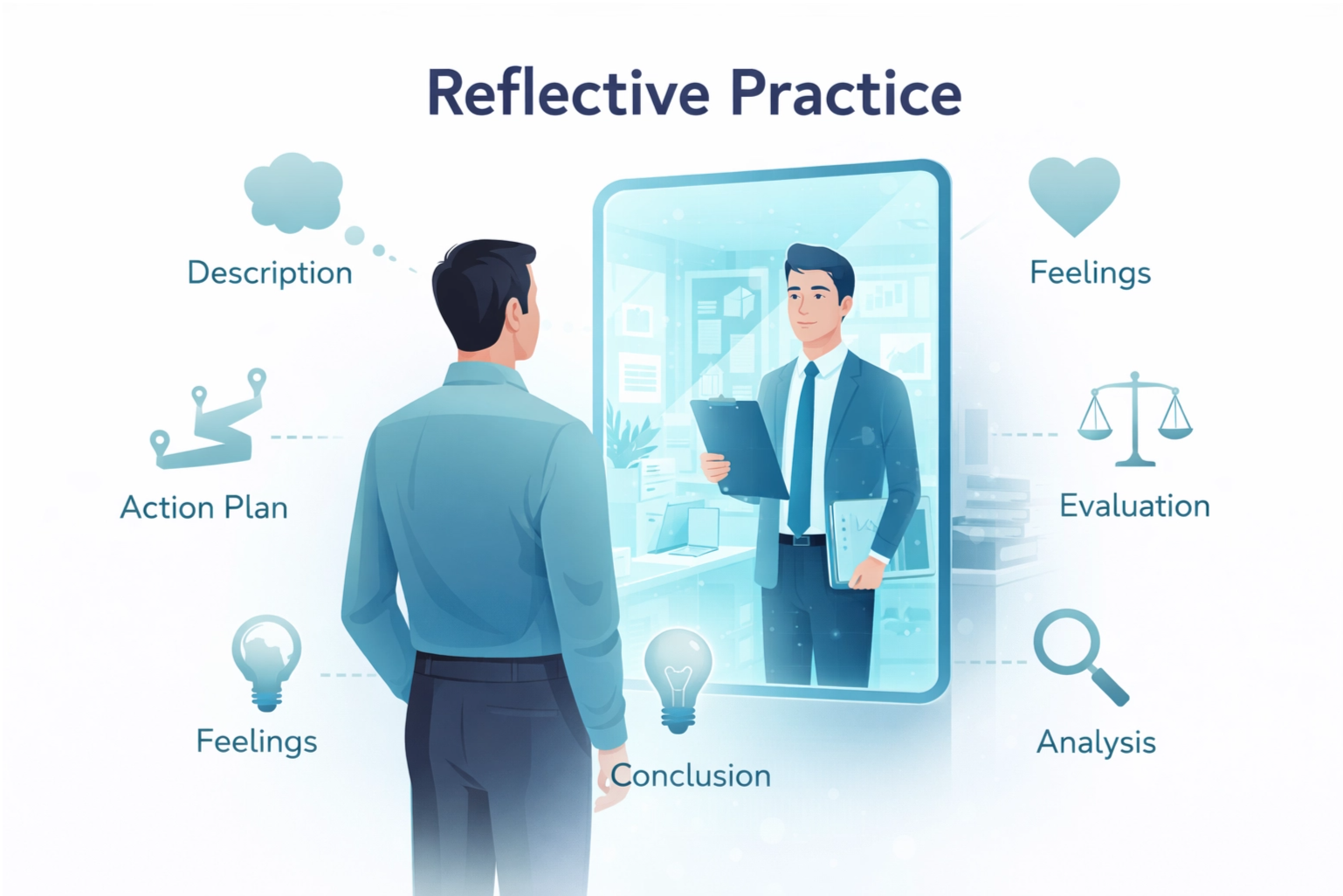
Graham Gibbs’ model is the most popular among CIPD students due to its clear, six-stage structure. It encourages you to look at an event from multiple angles, including your emotional response.
- Description: What happened? Keep this brief and factual.
- Feelings: What were you thinking and feeling at the time?
- Evaluation: What was good and bad about the experience?
- Analysis: What sense can you make of the situation? This is where you link to HR theory.
- Conclusion: What else could you have done?
- Action Plan: If it happened again, what would you do differently?
Kolb’s Experiential Learning Cycle (1984)
David Kolb’s model focuses on the idea that we learn through a recurring cycle of experience and reflection.
- Concrete Experience: Doing or having an experience.
- Reflective Observation: Reviewing and reflecting on the experience.
- Abstract Conceptualization: Learning from the experience and forming new ideas.
- Active Experimentation: Planning and trying out what you have learned.
Driscoll’s Model (1994)
John Driscoll’s “What?” model is a simple, three-question alternative that covers the entire reflective process:
- What? (The description of the event).
- So What? (The analysis and evaluation of the event).
- Now What? (The action plan for the future).
Schön’s Theory: Reflection-in-Action vs. Reflection-on-Action
Donald Schön introduced two concepts: Reflection-in-action (thinking on your feet to adjust your approach in real-time) and Reflection-on-action (looking back after the event with hindsight). Both are valuable, but for your CIPD assignments, you will primarily focus on reflection-on-action.
Practical Tips for Writing Your Reflective Account
Writing reflectively can feel strange at first, but these practical tips will help you produce a high-quality reflective account for your Level 3 assessments.
1. Use the First Person
Unlike most academic writing, reflective writing must use the first person (“I,” “me,” “my”) to take ownership of your experiences and feelings. For example, instead of “The meeting was poorly managed,” write “I felt I did not manage the meeting effectively because I allowed one participant to dominate.” This shift is crucial for demonstrating self-awareness.
2. Select a “Critical Incident”
Choose a “critical incident”—an event that was particularly challenging, surprising, or successful—instead of reflecting on every event. The key is that the incident must have provided a clear learning opportunity, such as a mistake, a difficult interaction, or a successful policy implementation.
3. Balance Description and Analysis
The 20/80 rule is a good guide: 20% description (what happened) and 80% analysis (why it happened, what you learned). If you find yourself writing pages of “he said, she said,” stop and ask: “So what? Why is this important for my development as an HR professional?”
4. The Power of the Action Plan
The action plan is the most important part. Without a clear plan for the future, reflection is incomplete. Your action plan must be specific and actionable. Instead of “I will communicate better next time,” write “In future meetings, I will use a structured agenda and set ground rules for participation to ensure everyone has a chance to speak.”
Common Pitfalls and How to Avoid Them
Here are the common pitfalls to avoid:
- Being Too Descriptive: As mentioned, this is the most common mistake. If your account reads like a diary entry, it isn’t reflective enough. Always bring it back to the “So what?”
- Ignoring Negative Feelings: Many students feel they have to present a perfect image of themselves. However, reflecting on mistakes or negative emotions (like frustration or anxiety) often leads to the most profound learning. Assessors value honesty and the ability to learn from failure.
- Failing to Link to Theory: At Level 3, you are expected to start making connections between your experiences and the HR theories you are studying. If you are reflecting on a team conflict, can you link it to Tuckman’s stages of group development? If you are reflecting on a recruitment task, can you link it to the principles of fair selection?
- Lack of Specificity: Vague reflections lead to vague learning. Be as specific as possible about what you did, what the outcome was, and what you will do differently next time.
A Sample Reflective Snippet (Using Gibbs)
Here is a brief example of a reflective account (using Gibbs) based on a common HR task: conducting an exit interview.
Description: I conducted my first exit interview with a departing employee. I followed the standard company template and asked all the required questions.Feelings: I felt quite nervous and was worried about asking sensitive questions. I think my nervousness made the employee feel slightly uncomfortable, and they gave very brief, “safe” answers.Evaluation: The positive was that I completed the task and gathered the basic data. However, the negative was that I didn’t probe deeper into the reasons for their departure, meaning we missed out on valuable feedback.Analysis: Reflecting on this, I realize that my focus was too much on the “process” and not enough on the “person.” According to active listening theories, building rapport is essential for open communication. My anxiety prevented me from building that rapport.Conclusion: I should have spent more time at the start of the meeting putting the employee at ease and explaining how their feedback would be used to improve the organization.Action Plan: Before my next exit interview, I will practice my opening statement to build confidence. I will also prepare two or three “probing” questions to use if the initial answers are too brief.
Conclusion: The Journey of a Reflective Practitioner
Mastering reflective practice is a journey. As you progress through your CIPD Level 3 qualification, reflection will become more natural. By moving beyond simple description and embracing structured models, you will develop a deeper understanding of yourself and the HR profession.
Remember, the goal of reflection is not to be perfect; it is to be better than you were yesterday. Every challenge is an opportunity to learn, provided you take the time to stop, think, and ask: “What? So what? Now what?” This mindset will help you pass your assessments and lay the foundation for a successful career in people practice.