

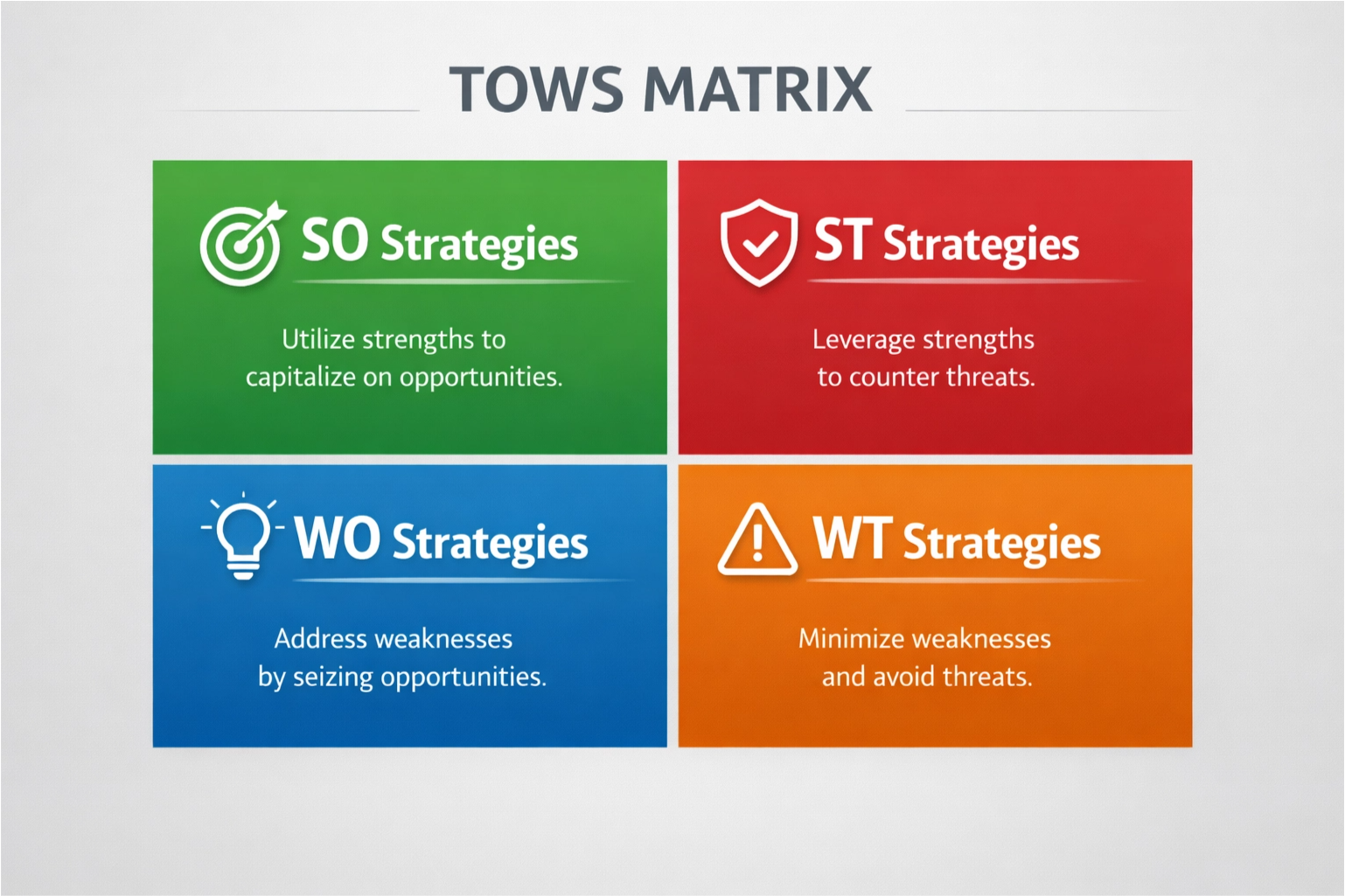
The TOWS Matrix, developed by Dr. Heinz Weihrich in the 1980s, is a strategic planning tool that builds upon the foundational SWOT (Strengths, Weaknesses, Opportunities, Threats) analysis. While SWOT analysis primarily serves as an analytical framework for identifying internal and external factors affecting an organization, the TOWS Matrix takes this a step further by facilitating the generation of strategic options based on the relationships between these factors . It transforms a static assessment into a dynamic framework for strategy formulation, making it an invaluable tool for managers and HR professionals alike.
Conceptual Framework and Origin
The name TOWS is an acronym for Threats, Opportunities, Weaknesses, and Strengths, intentionally reversing the order of SWOT to emphasize its action-oriented nature. Weihrich proposed the TOWS Matrix as a means to systematically match internal organizational factors (Strengths and Weaknesses) with external environmental factors (Opportunities and Threats) to develop actionable strategies .
The core idea behind the TOWS Matrix is that by understanding the interplay between these four elements, an organization can formulate strategies that:
- Leverage strengths to capitalize on opportunities.
- Overcome weaknesses by taking advantage of opportunities.
- Utilize strengths to mitigate or avoid threats.
- Minimize weaknesses and avoid threats.
This systematic approach helps organizations move beyond mere identification of factors to the proactive development of strategic initiatives .
The Four Strategic Quadrants of the TOWS Matrix
The TOWS Matrix generates four distinct categories of strategies, each addressing a specific combination of internal and external factors:
1. SO (Strengths-Opportunities) Strategies: Maxi-Maxi
These strategies aim to maximize both internal strengths and external opportunities. They represent the most desirable strategic position, where an organization can use its core competencies and advantages to fully exploit favorable market conditions or emerging trends. This often involves aggressive growth strategies, innovation, or market expansion .
Example in HR: An HR department with a highly skilled and adaptable workforce (Strength) can capitalize on the opportunity presented by new digital learning platforms (Opportunity) to implement cutting-edge training programs, enhancing employee capabilities and organizational competitiveness.
2. WO (Weaknesses-Opportunities) Strategies: Mini-Maxi
These strategies focus on overcoming internal weaknesses by taking advantage of external opportunities. The goal is to minimize weaknesses while still maximizing the benefits from available opportunities. This often involves developing new capabilities, acquiring resources, or forming strategic partnerships to address internal deficiencies .
Example in HR: An HR department with an outdated performance management system (Weakness) can leverage the opportunity of readily available cloud-based HR software solutions (Opportunity) to implement a modern, efficient, and data-driven performance management system, thereby improving employee engagement and productivity.
3. ST (Strengths-Threats) Strategies: Maxi-Mini
These strategies involve using internal strengths to mitigate or avoid external threats. The objective is to leverage existing advantages to minimize the impact of unfavorable external conditions or competitive pressures. This can include defensive strategies, diversification, or building resilience .
Example in HR: An organization with a strong employer brand and a reputation for employee welfare (Strength) can use this to attract and retain top talent, thereby mitigating the threat of a highly competitive talent market and skill shortages (Threat).
4. WT (Weaknesses-Threats) Strategies: Mini-Mini
These strategies aim to minimize both internal weaknesses and external threats. This is often a defensive or survival-oriented position, where an organization must address its vulnerabilities to avoid significant negative impacts from external challenges. Strategies might include retrenchment, divestment, or strategic alliances to share risks .
Example in HR: An HR department struggling with high employee turnover due to uncompetitive compensation (Weakness) and facing an economic downturn leading to budget cuts (Threat) might implement cost-effective retention strategies, such as enhancing non-monetary benefits, fostering a positive work culture, or focusing on internal mobility to reduce recruitment costs.
TOWS Matrix vs. SWOT Analysis
While closely related, the fundamental distinction between SWOT and TOWS lies in their purpose:
|
Feature
|
SWOT Analysis
|
TOWS Matrix
|
|
Primary Purpose
|
Identification and analysis of internal and external factors.
|
Generation of strategic options and action plans.
|
|
Focus
|
Understanding the current situation.
|
Formulating future strategies.
|
|
Output
|
A list of strengths, weaknesses, opportunities, and threats.
|
Specific strategies derived from combining these factors.
|
|
Nature
|
Analytical, descriptive.
|
Action-oriented, prescriptive.
|
|
Timing
|
Precedes TOWS analysis.
|
Follows SWOT analysis.
|
SWOT provides the raw data, while TOWS provides the strategic interpretation and actionable steps. Therefore, a TOWS analysis is typically conducted after a thorough SWOT analysis has been completed .
Application in HR Management
For HR professionals, the TOWS Matrix is a powerful tool for developing strategic HR initiatives that are directly linked to organizational context and external realities. It enables HR to:
- Develop Targeted HR Strategies: Move beyond generic HR practices to create strategies that specifically address the organization’s unique internal capabilities and external environment.
- Enhance Workforce Planning: Formulate plans for talent acquisition, development, and retention that align with market opportunities and mitigate potential threats.
- Improve Organizational Development Initiatives: Design interventions that leverage organizational strengths to foster growth or address weaknesses to build resilience against external pressures.
- Drive Evidence-Based Decision Making: Provide a structured approach to translate analytical insights from SWOT into concrete, evidence-based HR actions.
- Communicate Strategic Value: Clearly articulate how HR initiatives contribute to overall business success by demonstrating how they utilize strengths, overcome weaknesses, exploit opportunities, and counter threats.
Conclusion
The TOWS Matrix is an essential strategic tool for any organization, particularly within the dynamic field of Human Resources. By systematically connecting internal capabilities with external environmental factors, it empowers HR professionals to develop proactive, relevant, and impactful strategies. It transforms the diagnostic insights of a SWOT analysis into a roadmap for strategic action, ensuring that HR initiatives are not only well-informed but also strategically aligned with the organization’s overarching goals and challenges.