

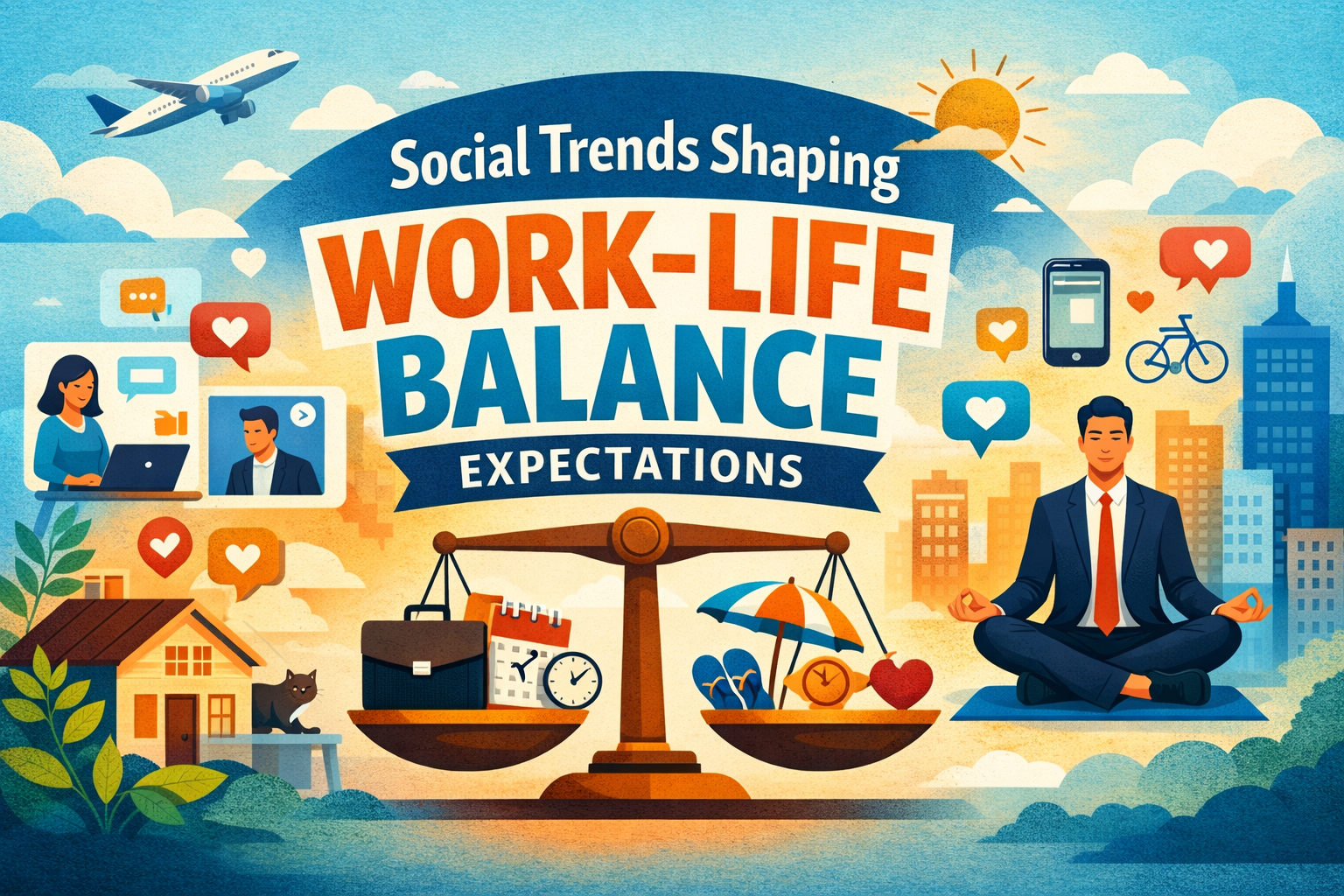
For decades, the concept of “work-life balance” was treated as a personal pursuit—a tightrope walk performed by individual employees trying to juggle professional ambitions with personal sanity. However, as we move through 2026, a profound paradigm shift is underway. The conversation has evolved from a desperate search for “balance” to a strategic demand for “harmony” and “integration.” This transition is being driven by a powerful confluence of legislative action, generational shifts, and technological acceleration. In today’s landscape, work-life balance is no longer viewed as a corporate “perk”; it has become a structural mandate, a legal right, and a core pillar of organizational sustainability.
To understand where we are in 2026, we must look back at the catalyst of this change. The global pandemic of the early 2020s acted as a “Great Reflection,” forcing millions to reconsider the role of work in their lives. By 2026, reactive behaviors like “Quiet Quitting” have matured into proactive expectations. Employees are no longer asking for permission to have a life; they are designing their lives and expecting work to fit within that design. This is the era of the “Human-Centric Workplace,” where the value of a worker is measured by their creative contribution rather than their physical or digital presence.
The Legislative Shield: The Right to Disconnect
One of the most significant social trends shaping expectations today is the formal codification of “unplugging.” For years, the digital tether of smartphones meant that work hours never truly ended. In response, governments worldwide have begun to intervene, recognizing that the “always-on” culture is a public health concern that leads to chronic burnout and strained social structures.
Country/Region |
Legislative Milestone |
Key Impact |
Australia |
Fair Work Amendment (2024/2025)
|
Employees have a legal right to refuse unreasonable out-of-hours contact.
|
United Kingdom |
“Right to Switch Off” Proposal
|
Aimed at preventing employer intrusion into personal time via digital platforms.
|
European Union |
Harmonized EU Directives
|
Ensuring mental rest periods across the bloc, building on the French model.
|
Portugal |
Digital Nomad Protections
|
Laws explicitly forbidding employers from contacting workers outside of hours.
|
Australia’s landmark Fair Work Legislation Amendment, which took full effect for small businesses in August 2025, serves as a global blueprint. It empowers workers to ignore work-related communications outside of their contracted hours without fear of retribution. A critical component of this law is the definition of “unreasonable” contact, which weighs the employee’s role against the impact on their personal life. This legislative shield shifts the psychological burden; when the law recognizes that “unreasonable” contact is a violation, the cultural expectation of constant availability begins to crumble.
For employers, this forces a radical rethink of workflow efficiency. Productivity must now be achieved within the confines of the workday. As we look across the EU and the UK, similar “Right to Switch Off” mandates are becoming the new standard, signaling that the boundary between “the office” and “the home” is being legally reconstructed. The result is a more disciplined approach to communication, where the “always-on” light is finally being switched off.
The Generational Mandate: Gen Z and the Death of Hustle Culture
While legislation provides the framework, the cultural engine driving this change is the rising influence of Gen Z and younger Millennials. By 2026, these cohorts represent a dominant share of the global workforce, and their expectations are fundamentally different. For Gen Z, work-life balance is the primary filter through which they view career success. Recent studies indicate that over 77% of Gen Z workers consider work-life balance the most critical factor when choosing an employer, often ranking it above salary.
“The ‘Soft Life’ is not about laziness; it is about the radical rejection of a system that prioritizes burnout as a badge of honor. It is a demand for a life where work supports existence rather than consuming it.”
This sentiment has manifested in the evolution of social movements. What began as “Quiet Quitting” has matured into the “Soft Life” and “Slow Growth” movements. These are not just trends; they are professional philosophies. Younger workers are seeking “values alignment,” where a company’s commitment to mental health is measured by its actions. They are forcing corporations to move away from the “hustle culture” of the 2010s, replacing it with a model that prioritizes long-term sustainability.
Furthermore, the trend of “Career Cushioning”—maintaining side projects or continuous learning—has reinforced the demand for balance. Because younger workers do not rely on a single employer for their entire identity, they feel more empowered to set boundaries. They view their time as their most valuable asset, and they are unwilling to sell it to an employer that does not respect their personal life.
The Structural Shift: The 4-Day Work Week Becomes Mainstream
Perhaps the most visible structural change in 2026 is the widespread adoption of the four-day work week. What was once a radical experiment has become a mainstream expectation. Global trials conducted between 2024 and 2025 have provided undeniable evidence that shorter weeks do not necessarily lead to lower output.
Benefit Category |
Impact of 4-Day Work Week |
Statistical Observation |
Productivity |
Increased focus and efficiency
|
92% of companies in trials reported stable or improved output.
|
Retention |
Reduced turnover rates
|
57% decrease in staff departures compared to 5-day models.
|
Mental Health |
Lower burnout and stress
|
71% of employees reported reduced levels of burnout.
|
The success of these trials has shifted the burden of proof. It is no longer the employees who must justify why they want a shorter week; it is the employers who must justify why they still require five days. This trend is driving a transition toward output-based evaluation. In a world where AI can automate routine tasks, the “hours spent at a desk” metric is becoming obsolete. Companies that have embraced the four-day week are finding it to be their most potent recruitment tool, creating a competitive advantage that traditional salary increases cannot match.
The AI Paradox: Productivity Enabler vs. Mental Fitness Burden
As we navigate 2026, AI’s role in work-life balance has become a double-edged sword. On one hand, AI “agents” have revolutionized personal time management. Hyper-personalized scheduling tools can analyze an individual’s peak productivity windows, automatically blocking out “deep work” sessions and protecting downtime. These tools act as digital buffers, shielding employees from administrative friction.
However, this increased efficiency has created the challenge of efficiency creep. When AI allows an employee to complete eight hours of work in five, the social expectation often shifts toward doing more work. This has led to the emergence of “Mental Fitness” as a core corporate KPI. Forward-thinking organizations are now using AI not just to drive output, but to monitor cognitive load. In 2026, a manager’s success is increasingly measured by the “mental fitness” of their team—ensuring that the speed of AI does not lead to human burnout.
From Perks to Ecosystems: The Future of Corporate Wellness
The era of fragmented wellness perks—the occasional yoga class or free snacks—is over. In its place, we see the rise of integrated wellness ecosystems. Employees in 2026 expect structural flexibility that acknowledges the complexity of modern life. This includes:
- Work-Life Integration 2.0: The evolution of the “Digital Nomad” into “Workcation” policies that allow employees to work from anywhere without sacrificing career progression.
- Neurodiversity Support: Recognition that different brains work differently, including the right to sensory-safe environments or ADHD-friendly schedules.
- Financial Wellness: Recognizing that financial stress is a barrier to balance, companies are offering integrated financial planning as a core benefit.
- Structural Flexibility: Moving beyond “flex-time” to “flex-place” and “flex-load,” where workloads can be adjusted based on life stages.
The focus has shifted from “helping employees cope with stress” to “designing work so it isn’t inherently stressful.” This is the hallmark of a human-centric workplace.
A New Era of Human-Centric Work
The social trends shaping work-life balance in 2026 represent a victory for the human element in the workforce. We have moved past the era where work-life balance was a myth; it is now a reality to be protected. Through legislative shields, the rejection of hustle culture, and the shift toward the four-day work week, the boundaries of work have been redefined.
As technology accelerates, the most successful organizations will be those that recognize that their greatest asset is the well-being and creativity of their people. The future of work is no longer about how much we can squeeze into a day, but how we can design our days to be worth living. For the individual, the message is clear: the tools, the laws, and the culture are finally on your side. The rebalancing has begun, and it is here to stay.
Ultimately, the trends we see in 2026 are not just temporary reactions to a global crisis, but the beginning of a long-term evolution in the human-work relationship. As we look toward the 2030s, the focus will likely shift even further toward “Universal Basic Balance”—a global standard for human rest and creativity that transcends national borders. In this new era, the most competitive businesses will be those that treat employee well-being as a strategic imperative rather than a compliance requirement. The light is finally being switched off on the “always-on” culture, and in the quiet that follows, we are finding our way back to a more sustainable, meaningful, and human way of working.