

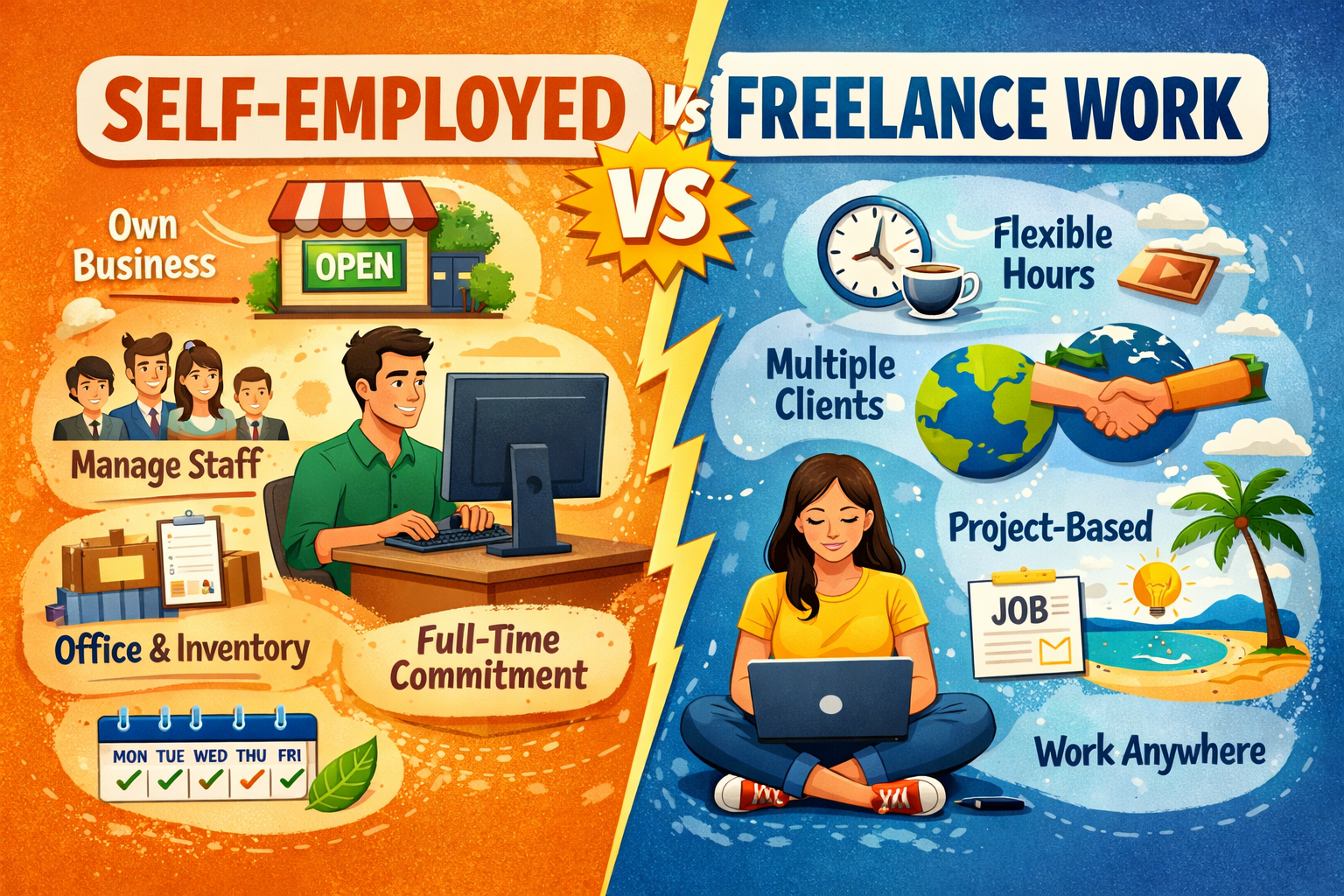
In the evolving landscape of modern employment, the terms “self-employed” and “freelance” are frequently used interchangeably, often leading to confusion. While both describe individuals working outside traditional employer-employee relationships, a closer examination reveals distinct characteristics, motivations, and operational models that differentiate them. Understanding these nuances is crucial for anyone considering or currently navigating the world of independent work, as it impacts everything from career trajectory and financial planning to legal obligations and business growth strategies.
This comprehensive guide will delve into the core definitions, highlight key distinctions, explore the underlying mindsets, and outline the practical implications, including legal and tax considerations, as well as the inherent advantages and disadvantages of each path. By dissecting these aspects, we aim to provide clarity and empower independent professionals to make informed decisions about their career and business development.
Defining the Independent Professional: Freelancer and Self-Employed
To truly understand the comparison, it is essential to establish clear definitions for both terms. While legally, both freelancers and self-employed individuals fall under the umbrella of “independent contractor” for tax purposes , their operational realities and strategic outlooks often diverge significantly.
What is Self-Employment?
Self-employment is a broad legal and economic classification encompassing anyone who works for themselves rather than for an employer. This category is characterized by a high degree of autonomy and responsibility for one’s own business operations. Self-employed individuals are, in essence, their own bosses, making decisions about their work, hours, and methods .
This classification includes a wide array of professionals, from sole proprietors running small businesses like local shops or consultancies, to entrepreneurs building scalable ventures, and even startup founders. A defining characteristic is the focus on establishing and growing a business entity, which may involve hiring employees or engaging other freelancers to assist in operations . The emphasis is often on creating a sustainable business structure that can generate revenue beyond the individual’s direct labor.
What is Freelancing?
Freelancing, while a form of self-employment, typically describes an individual who offers specialized services to multiple clients on a project-by-project, hourly, or contract basis. Freelancers are often seen as the “talent” or “worker” who directly provides a service, such as writing, graphic design, web development, or consulting .
The freelance model is characterized by its flexibility and the ability to work with diverse clients across various industries. While freelancers maintain autonomy over how they perform their work, they generally take direction from clients regarding what needs to be done and the specific requirements of each project . The primary focus for a freelancer is often on perfecting their craft, building a portfolio, and securing a steady stream of client work.
Key Distinctions: A Comparative Overview
Despite their shared status as independent workers, the differences between freelancing and broader self-employment become apparent when examining their primary goals, team structures, income models, branding strategies, and client relationships. The following table summarizes these key distinctions:
Feature |
Freelancer |
Self-Employed (Business Owner) |
Primary Goal |
Perfecting a craft and landing better projects; gaining diverse experience. |
Building a scalable business or asset; long-term growth and expansion. |
Team Structure |
Usually works alone, acting as a “lone wolf” . |
Often hires employees, subcontractors, or other freelancers to support operations . |
Income Model |
Primarily trading time for money (e.g., hourly rates, project fees). |
Focus on scaling through products, systems, recurring revenue, or leveraging others’ time. |
Brand Focus |
Personal brand (e.g., “Jane Doe, Graphic Designer”). |
Business brand (e.g., “Doe Design Studio”). |
Client Control |
High client direction on project scope and deliverables; works for clients . |
More autonomy over product/service delivery; works with clients or customers. |
Scope of Work |
Project-based, often short-term engagements. |
Broader, long-term vision, potentially involving multiple service lines or products. |
Mindset Shifts: From Craftsperson to Entrepreneur
The operational differences between freelancers and self-employed business owners are often rooted in fundamental mindset distinctions. These mental frameworks shape decisions, strategies, and ultimately, the trajectory of their independent careers.
The Freelancer Mindset
The freelancer’s mindset is typically centered on the craft. The core question often revolves around, “How can I do this work better?” . This involves continuous skill development, refining processes, and delivering exceptional results for each client project. The focus is on the immediate task at hand and the satisfaction of a job well done. While freelancers may seek to increase their rates or attract higher-paying clients, the underlying drive is often tied to the quality and execution of their specialized service.
This mindset can lead to a deep expertise in a particular field, but it can also contribute to the notorious “feast or famine” cycle, where income fluctuates based on project availability . The challenge for many freelancers is to move beyond simply trading time for money and to build more predictable income streams.
The Business Owner Mindset
In contrast, the self-employed business owner’s mindset is more entrepreneurial. The guiding question shifts to, “How can I build a system that does this work?” . This involves thinking strategically about scalability, automation, and delegation. The focus moves from individual output to creating a robust business infrastructure that can operate efficiently, even without the owner’s constant direct involvement.
Business owners are concerned with long-term growth, market positioning, and developing assets that generate recurring revenue. They are more likely to invest in marketing, sales funnels, and team building to expand their reach and capacity. This mindset embraces risk and views challenges as opportunities for systemic improvement and innovation.
Legal and Tax Implications
From a legal and tax perspective, the distinction between a freelancer and a self-employed individual often blurs, as both are generally classified as independent contractors by tax authorities . In many jurisdictions, both are responsible for their own taxes, including self-employment taxes, which cover Social Security and Medicare contributions .
Common Legal Structures
Both freelancers and self-employed business owners typically start as sole proprietors due to its simplicity and low setup costs. As their ventures grow, they might consider forming a Limited Liability Company (LLC) to gain personal liability protection. For self-employed individuals with significant income, electing S-Corporation status can offer tax advantages by allowing them to pay themselves a reasonable salary and distribute remaining profits as dividends, which are not subject to self-employment taxes .
Regardless of the chosen structure, both types of independent workers must meticulously track income and expenses, maintain accurate records, and understand their tax obligations to avoid penalties .
Pros and Cons: Navigating the Independent Path
Both freelancing and self-employment offer unique advantages and disadvantages. The choice between these paths often depends on an individual’s personality, career goals, risk tolerance, and desired lifestyle.
Advantages of Freelancing
- Ultimate Flexibility: Freelancers often have significant control over their schedules, work location, and the projects they accept, offering a high degree of work-life balance .
- Low Overhead: Starting a freelance career typically requires minimal initial investment, making it an accessible entry point into independent work .
- Focus on Craft: Freelancers can dedicate their time to their specialized skills, continuously improving and working on projects they are passionate about .
- Diverse Experience: Working with multiple clients exposes freelancers to various industries, challenges, and methodologies, fostering rapid learning and skill diversification.
Disadvantages of Freelancing
- Income Instability: The project-based nature of freelancing can lead to unpredictable income, making financial planning challenging .
- Limited Scalability: It can be difficult for individual freelancers to significantly increase their earning potential beyond trading more of their time for money .
- Isolation: Working alone can sometimes lead to feelings of isolation and a lack of professional community.
- Administrative Burden: Freelancers are responsible for all aspects of their business, including marketing, invoicing, and client management, which can detract from their core work.
Advantages of Self-Employment (Business Ownership)
- Higher Earning Potential: By building scalable systems and leveraging teams, business owners have a greater capacity for revenue generation and wealth creation .
- Asset Creation: A well-structured business can become a valuable asset that can be sold or passed on, providing long-term financial security.
- Stability Through Diversification: Business owners can diversify their offerings, client base, and revenue streams, reducing reliance on any single project or client.
- Impact and Legacy: Building a business allows for a greater impact on the market, job creation, and the potential to leave a lasting legacy.
Disadvantages of Self-Employment (Business Ownership)
- Increased Risk and Responsibility: Business ownership involves higher financial risk and greater responsibility for employees, operations, and strategic direction .
- Management Stress: Managing a team, finances, and growth strategies can be demanding and stressful.
- Higher Overhead: Establishing and growing a business often requires significant investment in infrastructure, marketing, and personnel.
- Less Direct Craft Involvement: As a business scales, the owner often shifts from hands-on work to strategic oversight, which may be less appealing to those who prefer direct involvement in their craft.
Choosing Your Path
The distinction between self-employment and freelancing, while subtle in legal terms, is profound in practice. It represents a spectrum of independent work, ranging from the craft-focused individual service provider to the entrepreneurial builder of a scalable enterprise. Both paths offer immense freedom and the opportunity to pursue one’s passions, but they demand different mindsets, strategies, and tolerances for risk.
Ultimately, the “better” path is subjective and depends on individual aspirations. A freelancer might prioritize flexibility and direct involvement in their craft, while a self-employed business owner might seek to build a lasting enterprise with greater financial leverage and impact. Many professionals begin as freelancers, gradually transitioning into business ownership as their experience grows and their vision expands . Understanding these differences is the first step toward charting a successful and fulfilling course in the dynamic world of independent work.