


Organizational culture, often described as “the way things are done around here,” is a powerful, yet frequently intangible, force that shapes an organization’s identity, guides employee behavior, and ultimately influences its success. In today’s dynamic business landscape, understanding and managing this culture is paramount for leaders and HR professionals alike. One of the most influential frameworks for dissecting and comprehending organizational culture was developed by Edgar Schein, a renowned professor from MIT Sloan School of Management. His model provides a multi-layered perspective, moving beyond superficial observations to uncover the deep-seated beliefs that truly drive an organization.
This blog post will delve into Schein’s three levels of organizational culture: Artifacts, Espoused Values, and Basic Underlying Assumptions. We will explore how these layers manifest in real-world scenarios, offering practical examples to illustrate their impact. Furthermore, we will examine the critical relevance of Schein’s model within the context of the Chartered Institute of Personnel and Development (CIPD) framework, particularly for HR professionals studying units like 5CO01, “Organisational Performance and Culture in Practice.” By the end of this discussion, readers will gain a comprehensive understanding of how to apply Schein’s insights to diagnose, manage, and strategically leverage organizational culture for improved performance.
The Three Layers of Organizational Culture: Edgar Schein’s Model
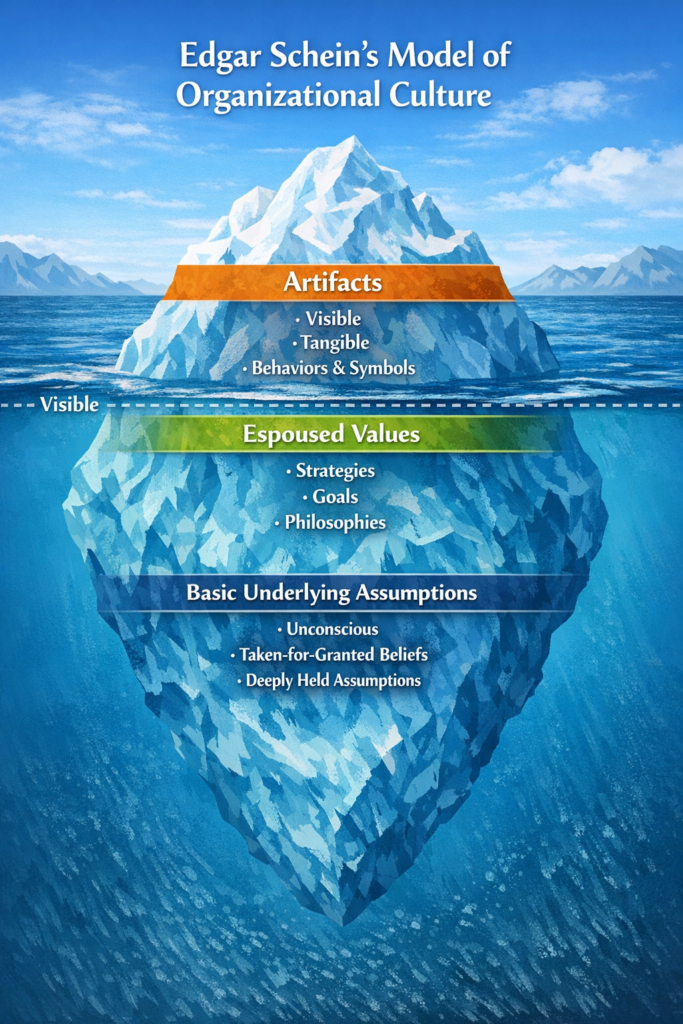
Edgar Schein’s model posits that organizational culture exists on three distinct levels, each offering a deeper understanding than the last. These layers are interconnected, with the deeper levels influencing the more superficial ones. To truly grasp an organization’s culture, one must peel back these layers, much like an onion, to reveal its core.
Layer |
Level of Visibility |
Description |
Examples |
Artifacts |
High (Visible)
|
The surface-level symbols, behaviors, and physical structures of an organization.
|
Office layout, dress code, logos, rituals, language.
|
Espoused Values |
Medium (Stated)
|
The explicitly stated goals, philosophies, and norms that guide organizational behavior.
|
Mission statements, core values, ethical codes, official strategies.
|
Basic Assumptions |
Low (Invisible)
|
The unconscious, taken-for-granted beliefs and feelings that form the core of the culture.
|
Beliefs about human nature, the meaning of work, or how truth is determined.
|
1. Artifacts: The Visible Manifestations
Artifacts represent the most visible and tangible aspects of an organization’s culture. These are the things one can see, hear, and feel when entering an organization. They are the observable symbols of culture, but their meaning is often open to interpretation without understanding the deeper layers. Examples of artifacts include:
- Physical Environment: Office layout (open-plan vs. cubicles), decor, dress code (formal vs. casual), company vehicles, and facilities.
- Language and Communication: Jargon, stories, myths, rituals, ceremonies, and communication patterns (e.g., formal meetings vs. informal chats).
- Technology: The types of technology used and how they are integrated into daily work.
- Behavioral Patterns: How people interact with each other, decision-making processes, and observable routines.
While artifacts are easy to identify, they can be misleading. An organization might have a modern, open-plan office (an artifact) but still operate with a highly hierarchical decision-making process, contradicting the perceived value of collaboration. Therefore, understanding artifacts is merely the first step in cultural analysis.
2. Espoused Values: The Stated Beliefs and Principles
Espoused values are the organization’s stated goals, philosophies, and norms. These are the values that the organization explicitly promotes as important and desirable. They are often found in mission statements, vision statements, company policies, and ethical codes. Espoused values represent what the organization says it believes in and how it wants to be perceived both internally and externally. Examples include:
- Mission and Vision Statements: Declarations of purpose and future aspirations.
- Core Values: Principles like “innovation,” “customer-centricity,” “integrity,” or “teamwork” that the organization claims to uphold.
- Strategies and Goals: The official plans and objectives that guide organizational actions.
- Performance Standards: The criteria by which employees are evaluated and rewarded.
Espoused values serve as a guide for behavior and decision-making. However, there can be a disconnect between espoused values and actual practice. An organization might espouse “work-life balance” but implicitly reward employees who work long hours. This gap highlights the importance of the third, deepest layer.
3. Basic Underlying Assumptions: The Unconscious Core
Basic underlying assumptions are the deepest and most fundamental level of organizational culture. These are the unconscious, taken-for-granted beliefs, perceptions, thoughts, and feelings that members of an organization hold. They are often invisible, even to those within the culture, because they are so deeply ingrained that they are rarely questioned or debated. These assumptions dictate how individuals perceive, think, and feel about various aspects of their work and the organization. They are the ultimate source of values and actions.
Examples of basic underlying assumptions include beliefs about:
- Human Nature: Are people inherently trustworthy or untrustworthy? Motivated by self-interest or collective good?
- Relationships: Is collaboration or competition more effective? Is hierarchy or equality preferred?
- Truth and Reality: How is truth determined? Through data, authority, or experience?
- Time: Is the focus on short-term results or long-term sustainability?
- Environment: Can the environment be controlled, or must the organization adapt to it?
These assumptions are learned responses to group problems and become so deeply embedded that they are no longer consciously debated. They are the “invisible glue” that holds the culture together and are the most difficult to change. Changing basic assumptions often requires significant organizational upheaval or a prolonged period of new experiences that challenge the existing worldview.
Schein’s Model in Practice: Real-World Applications
Applying Schein’s model in practice involves a process of observation, inquiry, and analysis to uncover the layers of culture. It’s about moving beyond what is seen and heard to understand why things are the way they are. Let’s consider a practical example to illustrate this.
Case Study: The Coca-Cola Company
The Coca-Cola Company, a global beverage giant, provides a compelling example of how Schein’s model can be applied to understand its organizational culture.
- Artifacts: The most recognizable artifacts of Coca-Cola include its iconic red-and-white logo, the distinctive contour bottle shape, and its pervasive global presence in retail outlets. Within its corporate offices, one might observe specific layouts, branding elements, and communication styles. These visible elements immediately convey a sense of history, global reach, and brand consistency.
- Espoused Values: Coca-Cola publicly espouses values such as “Refresh the world, make a difference,” and emphasizes sustainability, diversity, and inclusion. Its “Winning Culture” values often highlight being Agile, Curious, Empowered, and Inclusive. These are the principles the company communicates to its employees, shareholders, and the public, aiming to guide behavior and decision-making towards a positive global impact.
- Basic Underlying Assumptions: Beneath these visible artifacts and stated values lie deeper assumptions. A core assumption at Coca-Cola is that high performance and market dominance are essential for its continued success and global leadership. There’s an ingrained belief that “Coke is more than a drink, it’s a global icon,” which fuels a relentless focus on branding, marketing, and maintaining its ubiquitous presence. Furthermore, an assumption about consistency across borders drives standardized processes and product quality worldwide. These assumptions influence everything from product development to marketing campaigns and employee expectations.
For HR professionals at Coca-Cola, understanding these layers is crucial. They might use this model to ensure that new hires not only understand the espoused values but also align with the underlying assumptions of performance and global brand stewardship. During periods of change, such as digital transformation, HR would need to address how these changes might challenge or reinforce existing basic assumptions, rather than just altering visible processes or updating mission statements.
The CIPD Connection: Why Schein’s Model Matters for HR Professionals
For HR professionals, particularly those pursuing qualifications with the Chartered Institute of Personnel and Development (CIPD), Schein’s model is not just an academic concept; it’s a vital diagnostic tool. The CIPD framework emphasizes the strategic role of HR in shaping organizational performance and culture. Understanding Schein’s model is explicitly relevant to several CIPD units, most notably 5CO01: Organisational Performance and Culture in Practice.
CIPD Unit 5CO01: Organisational Performance and Culture in Practice
Within Unit 5CO01, learners are typically required to explain Edgar Schein’s model of organizational culture (Assessment Criteria 2.1) and apply it to real-life organizations. This demonstrates the CIPD’s recognition of the model’s practical utility for HR professionals. The ability to analyze an organization’s culture using Schein’s framework allows HR to:
- Diagnose Cultural Misalignment: HR can identify discrepancies between what an organization says it values (espoused values) and what its members actually do or believe (basic assumptions and artifacts). For instance, if a company espouses “innovation” but its reward systems (artifacts) only recognize adherence to existing processes, HR can pinpoint a cultural gap that hinders true innovation.
- Inform Onboarding and Socialization: By understanding the underlying assumptions, HR can design more effective onboarding programs that help new employees quickly grasp the unwritten rules and expectations, fostering faster integration and cultural fit. This goes beyond simply explaining policies (artifacts) or company values (espoused values) to helping new hires understand the deeper cultural norms.
- Facilitate Change Management: Cultural change is notoriously difficult. Schein’s model highlights that superficial changes to artifacts or espoused values are unlikely to be sustainable if the basic underlying assumptions remain unchallenged. HR professionals can use the model to guide change initiatives, focusing on creating experiences that lead to a re-evaluation of fundamental beliefs, rather than just implementing new policies or rebranding efforts.
- Enhance Employee Engagement and Performance: A clear and coherent culture, where all three layers are aligned, tends to foster higher employee engagement and better performance. HR can leverage Schein’s model to assess cultural health, identify areas for improvement, and develop interventions that strengthen cultural cohesion and support strategic objectives.
- Strategic Workforce Planning: Understanding the existing culture and its underlying assumptions is crucial for strategic workforce planning. It helps HR anticipate how the workforce might respond to new strategies, technologies, or market changes, and plan for necessary cultural shifts to support future organizational goals.
The People Practitioner’s Role
The CIPD Profession Map emphasizes that “People practitioners champion better work and working lives.” This includes fostering healthy and productive organizational cultures. By applying Schein’s model, HR professionals can move beyond a reactive role to become proactive architects of culture. They can:
- Act as Cultural Interpreters: Helping leaders and employees understand the nuances of their culture and the impact of the different layers.
- Design Cultural Interventions: Developing strategies and programs that address cultural challenges at their root, rather than just treating symptoms.
- Advise on Leadership Development: Guiding leaders to understand their role in shaping and reinforcing culture, particularly through their own behaviors and the assumptions they project.
Edgar Schein’s model of organizational culture offers an invaluable lens through which to understand the complex dynamics within any organization. By systematically examining artifacts, espoused values, and basic underlying assumptions, leaders and HR professionals can gain profound insights into what truly drives behavior and decision-making. For CIPD-qualified professionals, this model is more than just theory; it’s a practical tool for diagnosing cultural health, guiding change, and strategically aligning people practices with organizational goals. In an era where culture is increasingly recognized as a key differentiator, mastering Schein’s framework empowers HR to build resilient, high-performing, and adaptable organizations that can thrive in an ever-evolving world.