

Table of Contents
The McKinsey 7-S Framework is a cornerstone of strategic management, offering a holistic approach to organizational effectiveness. Developed in the late 1970s by consultants at McKinsey & Company, the model posits that organizational success depends on the alignment of seven interdependent elements: Strategy, Structure, Systems, Shared Values, Style, Staff, and Skills. This article provides an in-depth exploration of each element, distinguishes between the “hard” and “soft” components, and outlines a practical methodology for implementation. Through a case study of McDonald’s Corporation, the framework’s real-world utility is demonstrated, alongside a critical evaluation of its benefits and limitations in the modern business landscape.
The Genesis of the 7-S Framework
In the late 1970s, the prevailing management theories focused heavily on organizational structure and strategy as the primary drivers of success. However, business leaders and consultants noticed that even the most logically sound strategies often failed due to internal friction. This observation led Tom Peters, Robert Waterman, and Julien Phillips, with contributions from Richard Pascale and Anthony Athos, to develop the McKinsey 7-S Framework.
Formally introduced in 1980 in the article “Structure is Not Organization” and later popularized in the 1982 bestseller In Search of Excellence, the 7-S Framework shifted the focus from a purely mechanical view of organizations to a more organic, interconnected perspective. The core premise is that for an organization to perform well, seven internal elements must be aligned and mutually reinforcing. If one element is out of sync, it creates a ripple effect that can hinder the entire system.
The Core Philosophy: The Power of Alignment
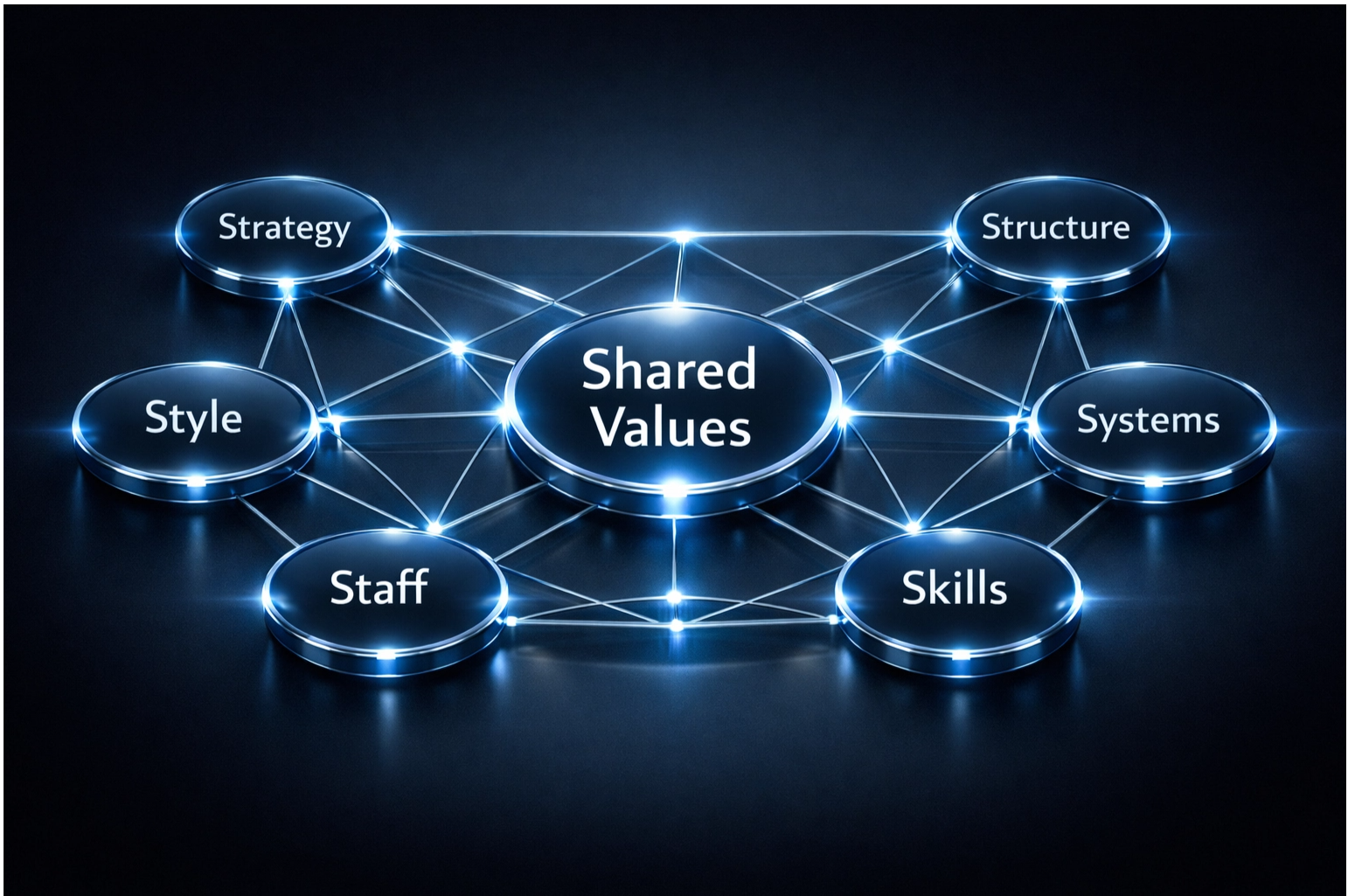
The 7-S Framework is often depicted as a web-like diagram where each element is connected to all others. This visualization emphasizes that no single factor is the “silver bullet” for success. Instead, the framework highlights the importance of alignment.
In this context, alignment means that the organization’s goals (Strategy) are supported by its hierarchy (Structure), facilitated by its processes (Systems), and brought to life by its people (Staff) who possess the right capabilities (Skills) and operate under a consistent leadership approach (Style)—all revolving around a central set of core beliefs (Shared Values).
A Deep Dive into the Seven Elements
The framework divides the seven elements into two categories: the “Hard S’s” and the “Soft S’s.” The hard elements are tangible, easy to identify, and often easier for management to influence directly through reports, memos, and formal plans. The soft elements, however, are more intangible, influenced by culture, and can be significantly more difficult to change.
1. Strategy (Hard)
Strategy represents the organization’s plan for building and maintaining a competitive advantage over its rivals. It answers the question: How do we intend to win? A robust strategy must be clear, communicated effectively, and adaptable to market changes. It provides the direction for the other six elements.
2. Structure (Hard)
Structure refers to the organizational chart and reporting relationships. It defines how tasks are divided, who reports to whom, and how different departments coordinate. Whether an organization is centralized, decentralized, matrixed, or flat, the structure must support the strategy. For instance, a strategy focused on innovation often requires a flatter, more flexible structure than one focused on cost-efficiency.
3. Systems (Hard)
Systems are the formal and informal procedures used to manage the organization daily. This includes financial systems, IT infrastructure, performance appraisal processes, and supply chain management. Systems are the “gears” of the organization; if they are inefficient or outdated, even the best strategy will fail in execution.
4. Shared Values (Soft – The Core)
At the center of the model are Shared Values (originally called “Superordinate Goals”). These are the fundamental beliefs and guiding principles that dictate how employees behave and how the organization perceives itself. Because they are central, they influence every other element. When shared values are strong and clear, they act as a “north star” for the organization.
5. Style (Soft)
Style refers to the leadership approach and the overall “culture” of the organization. It is not just about what leaders say, but what they do. Is the leadership style autocratic or participative? Is the culture risk-averse or entrepreneurial? The style of management sets the tone for employee engagement and organizational agility.
6. Staff (Soft)
Staff relates to the people within the organization—their numbers, backgrounds, and general capabilities. It also encompasses how the organization recruits, trains, motivates, and retains its talent. A critical aspect of the 7-S framework is ensuring that the organization has the right people in the right roles to execute the strategy.
7. Skills (Soft)
Skills are the actual competencies and capabilities of the organization as a whole, as well as its individual employees. During periods of strategic change, organizations often find that their existing skills are no longer sufficient, necessitating a “reskilling” or “upskilling” effort to align with the new direction.
Hard vs. Soft Elements: The Balancing Act
One of the most profound insights of the 7-S Framework is the realization that the “soft” elements are just as important as the “hard” ones. In fact, many organizational failures can be traced back to a preoccupation with strategy and structure while ignoring staff, skills, and style.
Feature |
Hard Elements (Strategy, Structure, Systems) |
Soft Elements (Values, Style, Staff, Skills) |
Visibility |
Highly visible and easy to define. |
Intangible and harder to describe. |
Management |
Controlled through formal documents and plans. |
Influenced by culture and leadership behavior. |
Changeability |
Can be changed relatively quickly. |
Take a long time to change and evolve. |
Impact |
Provide the framework for action. |
Provide the “soul” and energy for execution. |
Management often prefers to focus on the hard elements because they are quantifiable. However, the 7-S model argues that the soft elements are often where the real competitive advantage lies, as they are much harder for competitors to replicate.
Practical Application: A Step-by-Step Guide
The 7-S Framework is a diagnostic tool. It is used to identify why an organization is underperforming or to plan for a major transition, such as a merger or a digital transformation.
Step 1: Identify Misalignments
The first step is to look at the current state of each element and ask: Are they working together? For example, if your strategy is to provide premium customer service, but your “Systems” (incentive programs) only reward speed of transaction, you have a misalignment.
Step 2: Determine the Optimal Design
Based on the organizational goals, what should the 7-S’s look like? This requires envisioning a future state where all elements are perfectly synchronized to support the desired outcome.
Step 3: Create an Action Plan
Decide which elements need to change and in what order. Often, changing a “hard” element like Structure requires a corresponding change in a “soft” element like Skills or Style to be successful.
Step 4: Implement and Monitor
Execution is the most difficult phase. It requires constant communication and leadership commitment. Because the elements are interdependent, managers must monitor how a change in one area affects the others.
Step 5: Continuous Review
The business environment is dynamic. An alignment that works today may be obsolete tomorrow. Regular “health checks” using the 7-S model help organizations stay agile.
Case Study: McDonald’s Organizational Alignment
McDonald’s is a classic example of a company that has historically maintained high levels of alignment across the 7-S’s, which has fueled its global dominance.
- Strategy: A clear focus on cost leadership, consistency, and global expansion.
- Structure: A hierarchical but geographically divisional structure that allows for global standards with local menu adaptations.
- Systems: Highly sophisticated supply chain and standardized food preparation systems (the “Speedee Service System”).
- Shared Values: The “QSC&V” (Quality, Service, Cleanliness, and Value) philosophy instilled by Ray Kroc.
- Style: A culture of discipline and operational excellence, driven by rigorous training.
- Staff: A massive workforce managed through standardized roles and clear career paths.
- Skills: Mastery of high-volume food production and real estate management.
When McDonald’s faced a decline in the early 2000s, it used these elements to pivot. It didn’t just change its “Strategy” (introducing healthier options); it updated its “Systems” (new kitchen layouts), “Skills” (barista training for McCafé), and “Style” (more modern restaurant designs) to ensure the entire organization was realigned with the new consumer demands.
Critical Evaluation: Benefits and Limitations
Benefits
- Holistic View: It prevents managers from focusing solely on “numbers” or “charts” by highlighting the human and cultural side of the business.
- Diagnostic Power: It is an excellent tool for identifying the root causes of organizational inertia.
- Versatility: It can be applied to a whole company, a single department, or even a specific project team.
Limitations
- Internal Focus: The model focuses almost entirely on the internal environment. It does not explicitly account for external factors like market trends, competitors, or regulatory changes (unlike PESTEL or Porter’s Five Forces).
- Complexity: With seven interdependent variables, the model can become overwhelming. It does not provide a specific “starting point” or a hierarchy of importance.
- Static Nature: While it acknowledges change, the model itself is a “snapshot” in time. It can be difficult to use for modeling rapid, continuous evolution.
The Enduring Relevance of the 7-S
Despite being nearly half a century old, the McKinsey 7-S Framework remains one of the most influential tools in the management consultant’s toolkit. In an era of rapid digital disruption, the model’s emphasis on “Soft S’s”—Skills and Shared Values—is more relevant than ever. Technology (Systems) and business models (Strategy) can be copied overnight, but a deeply aligned culture (Style and Values) and a highly capable workforce (Staff and Skills) remain the ultimate barriers to entry.
For leaders today, the lesson of the 7-S is clear: Organizational effectiveness is not the result of a single brilliant decision, but the product of a thousand small alignments across the entire fabric of the enterprise. By treating the organization as a living, breathing system rather than a machine, managers can build more resilient, agile, and successful organizations.