

The Enduring Legacy of Humanistic Psychology
Abraham Maslow’s Hierarchy of Needs, first introduced in his 1943 paper “A Theory of Human Motivation,” represents a watershed moment in the transition from behavioral to humanistic psychology . At a time when psychological research was heavily focused on pathological behavior or mechanical stimulus-response models, Maslow proposed a more optimistic and holistic view of human nature. He argued that individuals are driven by an innate desire for personal growth and fulfillment, rather than merely reacting to external stimuli or repressed conflicts. This shift in perspective has had a profound and lasting impact on the field of organizational management, providing a framework that recognizes employees as complex beings with a multifaceted range of needs.
In the context of the 21st-century workplace, where the nature of work is rapidly evolving due to technological advancements and shifting societal values, Maslow’s hierarchy remains as relevant as ever. It offers a structured approach for leaders to navigate the complexities of employee engagement, retention, and performance. By understanding that motivation is not a one-size-fits-all concept but a progressive journey, organizations can design environments that nurture talent at every stage of their professional development. This blog post will explore the depths of Maslow’s theory, its practical applications in modern business, and how it can be integrated with other motivational models to create a truly high-performing workforce.
The Theoretical Foundation: A Progressive Journey of Needs
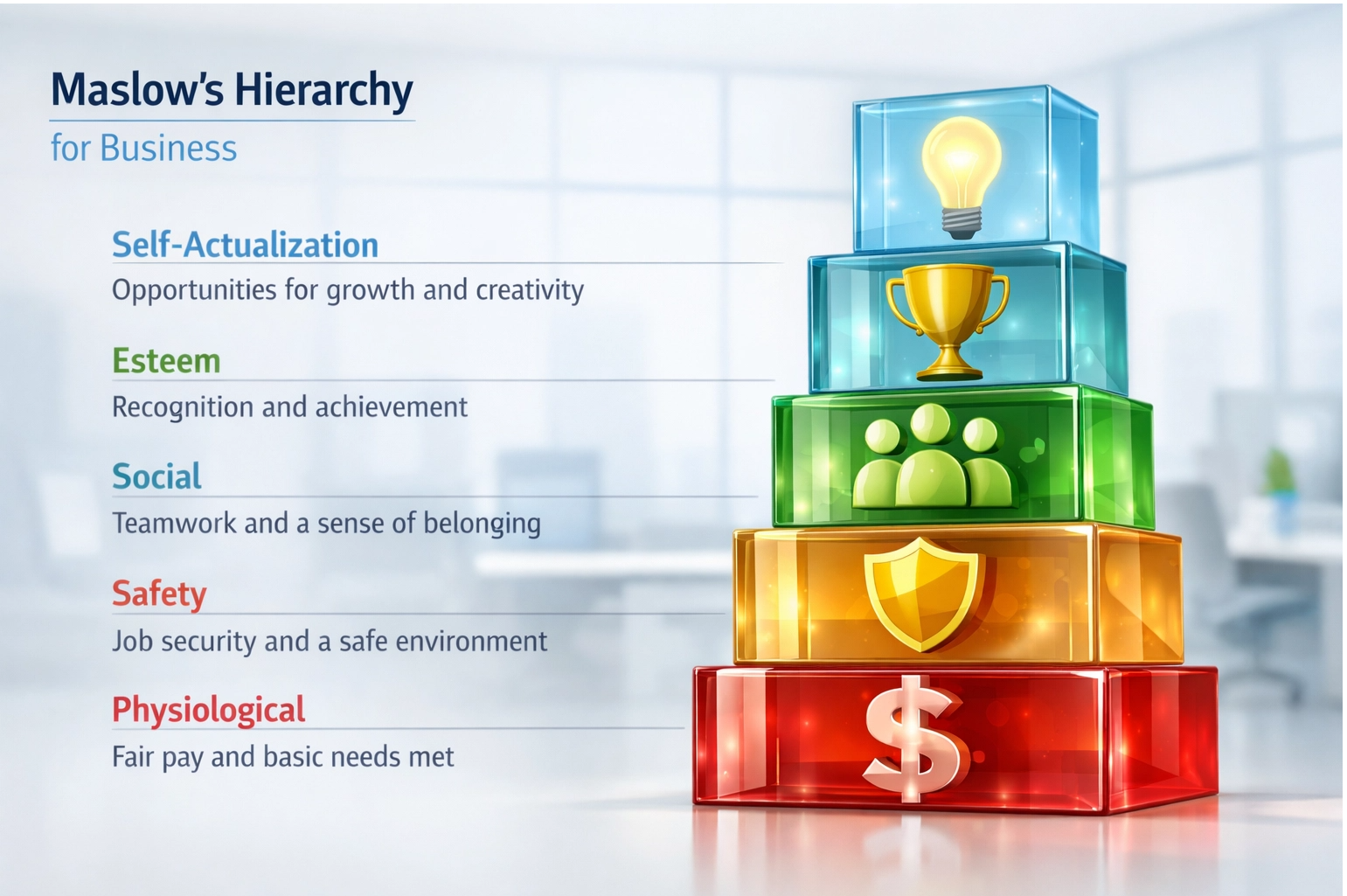
Maslow’s theory is built on the premise that human needs are arranged in a hierarchical structure, typically visualized as a pyramid. The fundamental principle is the concept of “prepotency,” which suggests that lower-level, more basic needs must be satisfied before an individual can be motivated by higher-level aspirations . While this progression is often seen as linear, Maslow himself acknowledged that it is a dynamic and often overlapping process. A satisfied need ceases to be a primary motivator, and the individual’s focus naturally shifts to the next unmet level in the hierarchy.
Level of Need |
Workplace Translation |
Primary Motivational Focus |
Modern Organizational Example |
Physiological |
Base Salary, Environment
|
Survival, Physical Comfort, Basic Life Maintenance
|
Competitive living wages and ergonomic office setups.
|
Safety |
Job Security, Benefits
|
Stability, Predictability, Protection from Harm
|
Robust health insurance and transparent career paths.
|
Social |
Culture, Teamwork
|
Connection, Belonging, Positive Relationships
|
Inclusive team cultures and collaborative digital spaces.
|
Esteem |
Recognition, Status
|
Self-Worth, Achievement, Respect from Peers
|
Peer-to-peer recognition programs and leadership training.
|
Self-Actualization |
Purpose, Autonomy
|
Personal Growth, Mastery, Realizing Potential
|
20% time” for personal projects and mission-driven work.
|
Level 1: Physiological Needs – Beyond the Minimum Wage
The base of Maslow’s pyramid represents the physiological needs essential for human survival. In the workplace, these are often dismissed as mere “hygiene factors,” but they form the critical foundation upon which all other motivation is built. While a competitive base salary is the most obvious translation, the modern interpretation of physiological needs is much broader. It encompasses the entire physical experience of work, from the quality of the air in the office to the availability of healthy food and hydration.
In the era of remote and hybrid work, the responsibility for meeting physiological needs has shifted. Organizations that once focused on on-site cafeterias and ergonomic chairs must now consider how they support their employees’ physical well-being in their home environments. This might involve providing stipends for home office setups, encouraging regular “digital detox” breaks, or offering subscriptions to wellness apps. When an employee is physically uncomfortable, fatigued, or struggling to meet their basic financial obligations, their ability to focus on complex tasks or contribute to team goals is significantly compromised.
Level 2: Safety and Security – The Bedrock of Trust
Once physiological needs are met, the focus shifts to safety and security. In a professional context, this level is about creating an environment of stability and predictability. Job security is a fundamental component, but it also includes financial security through benefits like retirement plans and insurance. However, the most critical aspect of safety in the modern workplace is psychological safety. This concept, popularized by Harvard professor Amy Edmondson, refers to a shared belief that the team is safe for interpersonal risk-taking.
When employees feel psychologically safe, they are more likely to speak up, share innovative ideas, and admit mistakes without fear of retribution. This sense of security is the bedrock of trust within an organization. Without it, employees operate in a state of constant anxiety, focusing their energy on self-preservation rather than contribution. Managers can foster safety by being transparent about organizational changes, setting clear and fair expectations, and modeling vulnerability themselves. A secure employee is a resilient employee, capable of navigating the uncertainties of a rapidly changing business landscape.
Level 3: Social Belonging – The Power of Connection
As social beings, humans have an inherent need to feel connected to others and to belong to a community. In the workplace, this need for social belonging is a powerful driver of engagement and morale. It transcends simple teamwork and encompasses the feeling of being part of an inclusive culture where one’s unique contributions are valued. Positive relationships with colleagues and supervisors provide the emotional support necessary to navigate the challenges of professional life and foster a sense of shared purpose.
The rise of remote work has presented significant challenges to fulfilling social needs. The lack of spontaneous “water cooler” conversations and face-to-face interactions can lead to feelings of isolation and disconnection. Organizations must be intentional about creating opportunities for social interaction in a digital environment. This might include virtual team-building events, dedicated social channels on communication platforms, or regular “check-in” meetings that focus on personal well-being rather than just project updates. When employees feel they belong, they are more committed to the organization and more willing to collaborate effectively with their peers.
Level 4: Esteem and Recognition – Cultivating Self-Worth
Esteem needs represent the desire for achievement, competence, and respect from others. This level of the hierarchy is where employees seek validation for their expertise and contributions. It is important to distinguish between “extrinsic” esteem, which comes from external recognition like job titles and awards, and “intrinsic” esteem, which is a personal sense of self-worth and mastery. A truly motivating environment addresses both facets of esteem.
Recognition programs should be timely, specific, and meaningful. While formal awards have their place, the most powerful form of recognition is often a simple, sincere “thank you” from a supervisor or a peer. Providing opportunities for professional development and career advancement also fulfills esteem needs by demonstrating that the organization values the employee’s growth and potential. When employees feel respected and competent, they are more confident in their abilities and more motivated to take on new challenges and responsibilities.
Level 5: Self-Actualization – The Pinnacle of Achievement
At the top of Maslow’s hierarchy is self-actualization, the desire to reach one’s full potential and find deep meaning in one’s work. This is the level where employees are driven by a sense of purpose and the opportunity to engage in work that aligns with their personal values and aspirations. Self-actualized individuals seek autonomy, creative freedom, and the chance to solve complex problems that challenge their intellect and skills. As Maslow himself articulated:
“A musician must make music, an artist must paint, a poet must write, if he is to be ultimately at peace with himself. What a man can be, he must be. This need we may call self-actualization.”
They are not just working for a paycheck or recognition; they are working to fulfill their own internal drive for excellence.
Supporting self-actualization requires a shift from traditional management to a model of empowerment and inspiration. Leaders must connect individual roles to the organization’s broader mission, providing employees with the “why” behind their work. This involves granting autonomy in decision-making, encouraging innovation, and providing the resources and support necessary for employees to pursue their passions. Companies like Google, with their famous “20% time” policy, have successfully tapped into this level of motivation by allowing employees to spend a portion of their time on projects they are personally passionate about, leading to some of the company’s most successful innovations.
Critical Perspectives: Moving Beyond the Pyramid
While Maslow’s Hierarchy of Needs provides a powerful framework, it is essential to acknowledge its limitations and the criticisms it has faced over the decades. One of the primary critiques is the rigid, linear nature of the hierarchy. Research has shown that human needs are often more fluid and interconnected than Maslow’s pyramid suggests. Individuals can experience multiple needs simultaneously, and the prioritization of these needs can vary significantly based on individual personality, life stage, and cultural background .
Furthermore, the hierarchy has been criticized for its Western-centric focus on individualism and achievement. In more collectivist cultures, the need for social belonging and community may be prioritized above individual esteem or self-actualization. Additionally, the “frustration-regression” principle from Clayton Alderfer’s ERG theory offers a more nuanced view, suggesting that if a higher-level need is not met, an individual may regress and place even more importance on a lower-level need . Understanding these nuances is crucial for leaders who want to apply Maslow’s principles in a diverse and globalized workforce.
Integrating Maslow with Other Motivational Theories
To create a truly comprehensive approach to employee motivation, leaders should look beyond Maslow and integrate his principles with other established theories. For example, Frederick Herzberg’s Two-Factor Theory complements Maslow by distinguishing between “hygiene factors” (which correspond to Maslow’s lower-level needs) and “motivators” (which correspond to higher-level needs). Herzberg argued that while hygiene factors can prevent dissatisfaction, only motivators can truly drive engagement and performance.
Similarly, David McClelland’s Acquired Needs Theory focuses on three primary drivers: the need for achievement, the need for power, and the need for affiliation. By understanding which of these needs is most prominent in an individual employee, a manager can tailor their leadership style and recognition efforts more effectively. Integrating these various models allows for a more personalized and sophisticated approach to motivation that recognizes the unique drivers of every team member.
Practical Implementation: A Roadmap for Leaders
Implementing Maslow’s hierarchy in the workplace requires more than just an understanding of the theory; it requires a commitment to action. The following table provides a strategic roadmap for leaders to address each level of the hierarchy within their teams.
Strategic Area |
Implementation Steps |
Desired Outcome |
Foundation |
Conduct regular salary reviews and ensure ergonomic workspaces.
|
Reduced physical stress and financial anxiety.
|
Security |
Foster psychological safety through transparent communication and vulnerability.
|
Increased trust and willingness to take risks.
|
Community |
Create intentional opportunities for social connection and inclusive culture.
|
Enhanced team cohesion and sense of belonging.
|
Growth |
Implement peer-to-peer recognition and provide clear career development paths.
|
Improved self-confidence and professional competence.
|
Purpose |
Align individual goals with the organizational mission and grant autonomy.
|
High levels of innovation and personal fulfillment.
|
The Future of Motivation
As we look toward the future of work, the principles of Maslow’s Hierarchy of Needs remain a vital guide for leaders. In an increasingly complex and uncertain world, the need for security, belonging, and purpose has never been more acute. Organizations that recognize the whole human being—not just the worker—will be the ones that thrive in the years to come. By consciously working to meet the diverse needs of their employees, from the foundational requirements of survival and safety to the pinnacle of self-actualization, leaders can create a culture of excellence where individuals are empowered to do their best work and reach their full potential. The enduring legacy of Maslow is the reminder that at the heart of every successful organization is a group of individuals striving for something more than just a paycheck; they are striving for a life of meaning and fulfillment.