

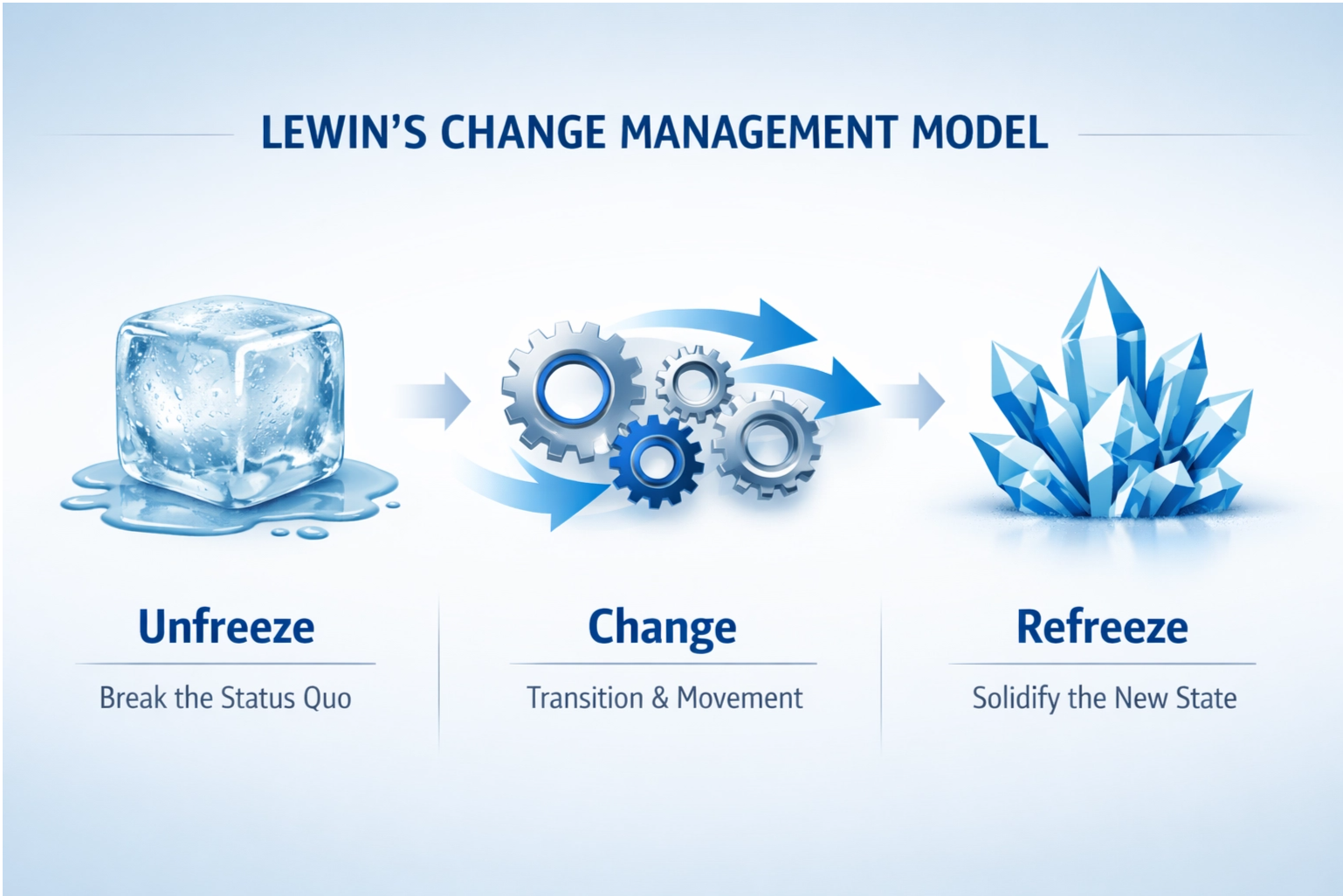
Lewin’s Change Management Model: A Timeless Framework for Navigating Organizational Transformation
In the landscape of organizational psychology and management theory, few concepts have demonstrated the enduring relevance of Kurt Lewin’s Change Management Model. Developed in the 1940s by the German-American psychologist, this model provides a foundational framework for understanding and navigating the complexities of organizational change . Lewin, a pioneer in social, organizational, and applied psychology, introduced a three-stage process—Unfreeze, Change, and Refreeze—that remains a cornerstone of change management practices today. This article explores the depths of Lewin’s model, examining its core components, practical applications, and its continued significance in a world of perpetual transformation.
The Three Stages of Change: A Journey of Transformation
Lewin’s model simplifies the change process into three distinct yet interconnected stages, providing a structured roadmap for leaders and organizations to follow. Each stage represents a critical phase in the journey from a current state to a desired future state.
1. Unfreeze: Preparing the Ground for Change
The initial stage, Unfreeze, is arguably the most critical and challenging phase of the change process. It involves dismantling the existing mindset, behaviors, and organizational structures that maintain the status quo. The primary goal of this stage is to create a sense of urgency and a shared understanding of the need for change. This requires open and transparent communication to help individuals and teams recognize the shortcomings of the current state and the benefits of a new approach .
Key activities in the Unfreeze stage include:
- Challenging existing beliefs and assumptions: Leaders must encourage employees to question the way things are done and to consider alternative possibilities.
- Communicating the vision for change: A clear and compelling vision for the future state helps to motivate and align the organization.
- Building a coalition of support: Gaining the backing of key influencers and stakeholders is crucial for overcoming resistance and driving the change forward.
2. Change: Implementing the New Reality
Once the organization is “unfrozen” and ready for change, the Change stage can begin. This is the implementation phase, where new processes, systems, and behaviors are introduced. This stage is often characterized by a period of uncertainty and adjustment as individuals learn to adapt to new ways of working. Effective communication, training, and support are paramount during this transition to minimize disruption and foster a positive change experience .
Key activities in the Change stage include:
- Providing education and training: Equipping employees with the necessary skills and knowledge is essential for a successful transition.
- Fostering open communication and feedback: Creating channels for dialogue and addressing concerns helps to build trust and engagement.
- Celebrating short-term wins: Recognizing and rewarding progress along the way helps to maintain momentum and motivation.
3. Refreeze: Solidifying the New Norm
The final stage, Refreeze, is about stabilizing the organization after the change has been implemented and ensuring that the new behaviors and processes become embedded in the organizational culture. Without this crucial step, there is a significant risk of employees reverting to their old ways of working. The goal of the Refreeze stage is to make the change the new “business as usual” .
Key activities in the Refreeze stage include:
- Anchoring the change in the culture: Integrating the new ways of working into the organization’s values, norms, and reward systems.
- Providing ongoing support and reinforcement: Continuously monitoring the change and providing support to ensure its long-term sustainability.
- Celebrating the success of the change: Acknowledging the collective effort and the positive outcomes of the change helps to reinforce its value.
Force Field Analysis: Understanding the Dynamics of Change
Integral to Lewin’s model is the concept of Force Field Analysis, a powerful tool for understanding the dynamics of change. This framework posits that any situation is a dynamic equilibrium of driving forces that promote change and restraining forces that resist it. For change to occur, the driving forces must be strengthened, the restraining forces must be weakened, or both .
|
Driving Forces (For Change)
|
Restraining Forces (Against Change)
|
|
Internal pressures (e.g., need for increased efficiency)
|
Fear of the unknown
|
|
External pressures (e.g., market competition)
|
Loss of job security
|
|
New leadership with a vision for change
|
Existing organizational culture
|
|
Technological advancements
|
Lack of resources or skills
|
By identifying and analyzing these opposing forces, organizations can develop targeted strategies to manage resistance and facilitate a smoother transition.
Advantages and Disadvantages of Lewin’s Model
Like any theoretical framework, Lewin’s Change Management Model has its strengths and weaknesses.
Advantages
- Simplicity and Clarity: The three-stage model is easy to understand and apply, making it accessible to managers at all levels.
- Structured Approach: It provides a clear and logical framework for planning and implementing change.
- Focus on Stability: The Refreeze stage emphasizes the importance of embedding change to ensure its long-term success.
Disadvantages
- Linear and Rigid: The model’s linear nature may not be suitable for the complex and iterative nature of change in today’s dynamic business environment .
- Top-Down Approach: It can be perceived as a top-down model that does not sufficiently involve employees in the change process.
- Neglects Individual Change: The model focuses on organizational change and pays less attention to the individual psychological transitions that people experience.
Despite its criticisms, Kurt Lewin’s Change Management Model remains a valuable and relevant framework for understanding and navigating the complexities of organizational transformation. Its enduring appeal lies in its simplicity, its structured approach, and its emphasis on the human element of change. While the business world has evolved significantly since the 1940s, the fundamental principles of Lewin’s model—the need to prepare for change, to manage the transition effectively, and to embed the new ways of working—are as pertinent as ever. By understanding and applying the principles of Unfreeze, Change, and Refreeze, organizations can increase their chances of successful and sustainable change, ensuring their continued growth and adaptation in an ever-changing world.
References
[1] Prosci. (2024, October 1). What Is Lewin’s Change Theory? Explanation, Pros and Cons. Retrieved from

[2] TechTarget. (2022, May 31 ). What is Unfreeze, Change, Refreeze (Kurt Lewin's Change Management Model). Retrieved from

[3] BMC Blogs. (2024, December 20 ). Lewin's 3 Stage Model of Change Explained. Retrieved from

[4] The Ohio State University. (2024, December 10 ). The Power of Change Management: Lessons from Lewin’s Model. Retrieved from

[5] 6Sigma.us. (n.d. ). Lewin’s Force Field Analysis in Change Management. Retrieved from

[6] MTD Training. (2023, March 23 ). Advantages and Disadvantages of Lewin’s Change Model. Retrieved from