

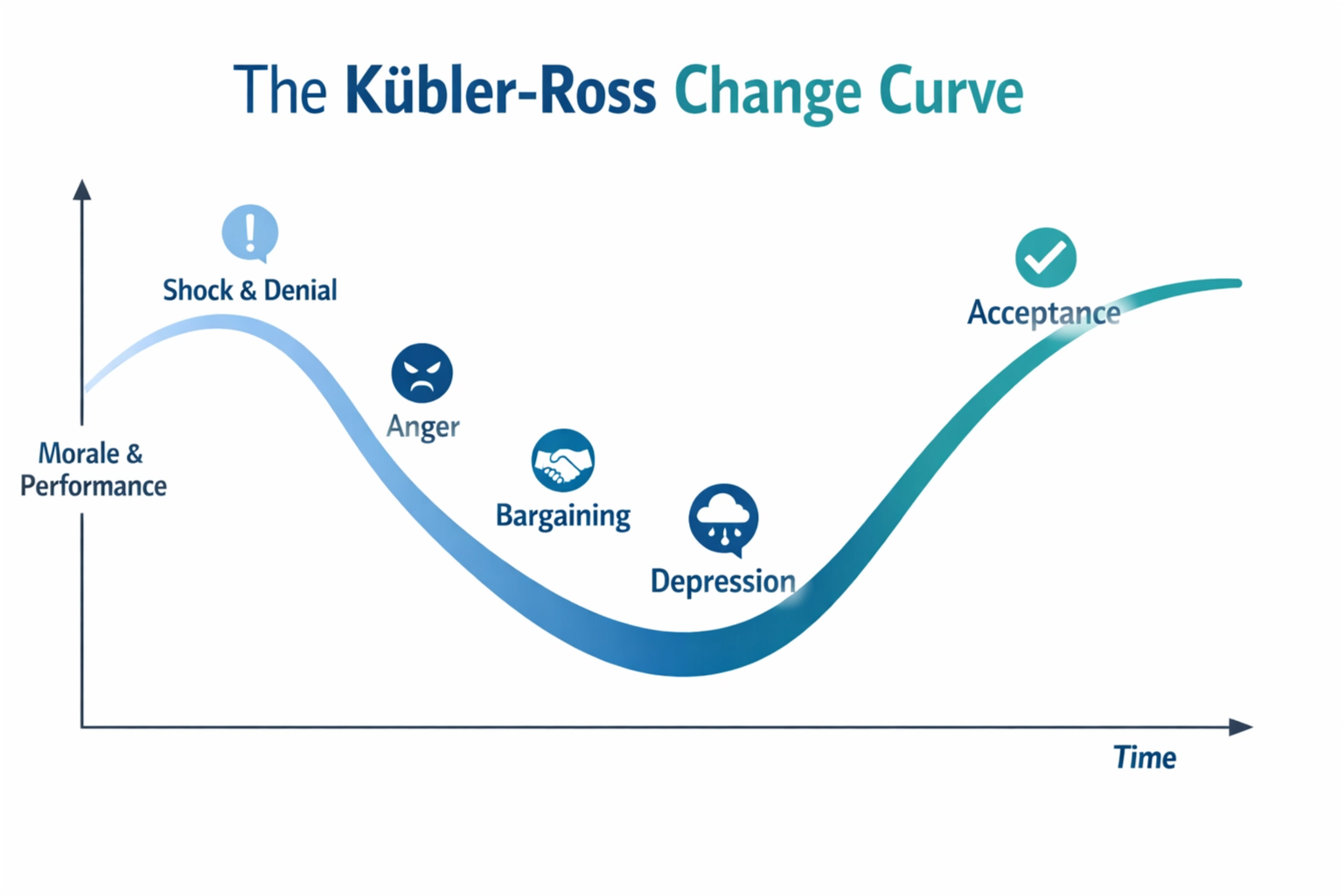
Navigating the Human Side of Transition: An In-Depth Look at the Kübler-Ross Change Curve
Change is an inescapable constant in both personal life and professional environments. However, despite its frequency, human beings are biologically and psychologically wired to seek stability. When that stability is disrupted—whether by a personal loss, a corporate restructuring, or a global shift—the emotional response is often profound and complex. One of the most enduring frameworks for understanding this emotional journey is the Kübler-Ross Change Curve. Originally developed to describe the stages of grief experienced by terminally ill patients, the model has evolved into a cornerstone of modern change management, providing leaders and individuals with a roadmap for navigating the turbulent waters of transition.
The Origins and Evolution of the Model
The Kübler-Ross Change Curve finds its roots in the work of Dr. Elisabeth Kübler-Ross, a Swiss-American psychiatrist. In her seminal 1969 book, On Death and Dying, she introduced what became known as the “Five Stages of Grief”. Her research was groundbreaking at the time, as it humanized the experience of terminal illness and provided a language for the emotions that patients and their families often felt but could not articulate.
While the model was initially intended for the context of bereavement and mortality, its universal applicability soon became apparent. By the 1980s, business consultants and organizational psychologists realized that the emotional trajectory of an employee facing a major corporate change—such as a merger, a new technology rollout, or a layoff—mirrored the stages identified by Kübler-Ross. Today, the “Change Curve” is a trademarked and widely utilized tool in organizational development, helping to bridge the gap between technical change and human adoption.
The Five Stages of the Change Curve
The model identifies five distinct stages that individuals typically move through when confronted with significant change. It is crucial to note that while these stages are presented sequentially, the experience of change is rarely linear. People may skip stages, move backward, or remain in one phase for an extended period.
|
Stage
|
Key Emotional Characteristics
|
Management Objective
|
|
Denial
|
Shock, disbelief, avoidance, filtering information.
|
Provide clear, consistent information; explain the “why.”
|
|
Anger
|
Frustration, resentment, blaming others, cynicism.
|
Listen empathetically; provide a safe space for venting.
|
|
Bargaining
|
Negotiating, seeking exceptions, delaying the inevitable.
|
Remain firm on the change; be open to implementation feedback.
|
|
Depression
|
Low energy, apathy, sadness, low productivity.
|
Provide emotional support, training, and small wins.
|
|
Acceptance
|
Resignation, exploration, learning, integration.
|
Reinforce new behaviors; share success stories.
|
1. Denial
The first reaction to change is often denial. This is a psychological defense mechanism that buffers the immediate shock of the news. In a workplace setting, this might manifest as employees ignoring an announcement, continuing to work as if nothing has changed, or convincing themselves that the change “won’t actually happen” or “won’t affect me.” During this stage, information is often filtered out, and productivity may briefly remain high as individuals cling to the old way of doing things.
2. Anger
As the reality of the change begins to set in, denial gives way to anger. The individual realizes that the change is inevitable and that their previous “normal” is gone. This stage is characterized by frustration, resentment, and the need to find someone or something to blame. Employees might lash out at leadership, express cynicism, or become resistant to even the smallest tasks. While difficult to manage, anger is a sign that the individual is beginning to engage with the reality of the situation.
3. Bargaining
In the bargaining stage, individuals attempt to postpone or minimize the impact of the change. They may try to negotiate for a better deal, seek exceptions for themselves, or offer to work harder if only the change can be reversed. This is a desperate attempt to regain control. In organizations, this might look like employees asking for “just one more month” with the old system or trying to find workarounds that allow them to avoid the new processes.
4. Depression
When it becomes clear that bargaining will not work and the change is permanent, individuals often enter a period of depression. This is not necessarily clinical depression, but rather a state of low energy, apathy, and sadness. The individual feels the full weight of the loss—whether it is a loss of status, a loss of familiar routines, or a loss of colleagues. Productivity typically hits its lowest point here. This is the “valley of despair” in the change curve, and it is the most critical point for empathetic support 4.
5. Acceptance
The final stage is acceptance. This does not necessarily mean the individual is happy about the change, but they have resigned themselves to the new reality and are ready to move forward. They begin to explore the new environment, learn new skills, and find ways to succeed within the new framework. This is the stage of integration, where the “new normal” begins to take root and productivity starts to climb again.
Applications in Organizational Change Management
For leaders and change practitioners, the Kübler-Ross Change Curve is more than just a psychological theory; it is a practical diagnostic tool. By identifying which stage an employee or team is in, leaders can tailor their communication and support strategies accordingly.
- In the Denial stage, communication must be clear, frequent, and consistent. Leaders should focus on explaining the “why” behind the change and providing as much information as possible to help the reality sink in.
- During the Anger stage, the most important thing a leader can do is listen. Allowing employees to vent their frustrations in a safe environment can prevent anger from turning into toxic resistance. It is a time for empathy, not for defensiveness.
- In the Bargaining stage, leaders should remain firm on the necessity of the change while being open to feedback on how the change is implemented. This can give employees a sense of agency without compromising the ultimate goal.
- During the Depression stage, support is paramount. Leaders should provide training, resources, and encouragement. Small wins should be celebrated to help rebuild confidence and momentum.
- In the Acceptance stage, the focus shifts to reinforcement. Leaders should recognize and reward those who have successfully adapted and share success stories to encourage others.
Criticisms and Limitations
Despite its popularity, the Kübler-Ross model is not without its critics. The primary criticism is that it lacks empirical evidence as a universal “law” of human behavior. Critics argue that the stages are not discrete and that the model oversimplifies the highly individual nature of grief and change. Some people may never reach acceptance, while others may move straight from shock to action.
Furthermore, the model can be misused if leaders treat it as a “checklist.” Expecting employees to move through the stages on a set schedule can lead to frustration and a lack of genuine empathy. The curve should be viewed as a descriptive framework for understanding potential reactions, rather than a prescriptive mandate for how people should feel 5.
The Human-Centric Path Forward
The enduring legacy of the Kübler-Ross Change Curve lies in its ability to humanize the process of transition. In an era of rapid digital transformation and constant organizational upheaval, it serves as a powerful reminder that behind every project plan, every software update, and every strategic pivot, there are human beings with emotional lives.
By acknowledging the validity of these emotions—the shock, the fear, the sadness, and eventually the hope—organizations can create a culture of resilience. Successful change management is not just about the technical implementation of new ideas; it is about guiding people through the emotional valley of the change curve and helping them emerge on the other side with a renewed sense of purpose. In the end, the most successful organizations are those that realize that change is not something done to people, but something achieved with them.