

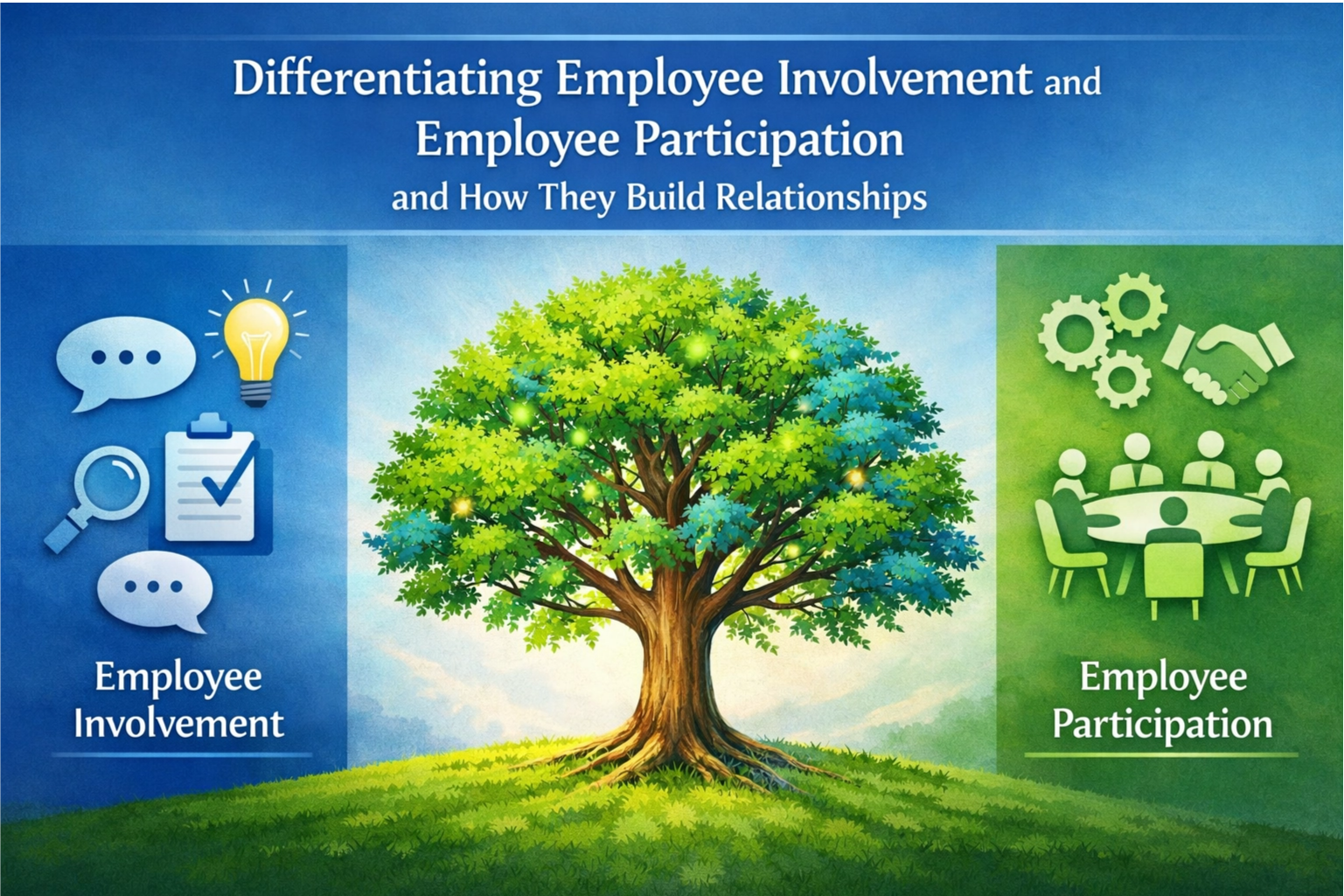
Employee Involvement refers to structured processes that engage employees in organisational life primarily through consultation and feedback mechanisms, without transferring formal decision‑making authority to them. Common methods include staff surveys to elicit views on new policies, suggestion boxes positioned in communal areas, and open town‑hall meetings where leadership presents proposals and invites commentary (CIPD 2023). These channels serve multiple functions: they signal to employees that their perspectives matter, they surface practical insights from the frontline, and they create regular forums for two‑way communication. In a merged public‑sector entity, where staff from previously distinct cultures must learn to collaborate, employee involvement can be a powerful integrative tool. For example, carrying out a shared pulse survey between the two legacy organisations allows the leaders to identify shared issues (e.g., confusion over reporting lines) and address them in time, thereby nullifying rumours and tension. Similarly, rotation of “listening sessions” by new and legacy managers facilitates familiarity between teams and establishes relationships at the personal level.
Employee Participation, however, implies active and institutional employee involvement in decision-making platforms with strong power to impact outcomes. It is typically in the form of joint consultative committees, works councils, or co determination platforms where elected employee representatives appear together with management to discuss and decide upon policies such as flexible work arrangements, health and safety policies, or performance management systems (Rees 2024). The key feature of participation is mutual accountability: if employees know their votes or ideas will directly determine policy, they feel more ownership. After merger, the creation of an equal number staff management committee from both predecessor organisations ensures new processes have the needs and priorities of the entire workforce considered. This not only simplifies implementation but also facilitates collective identity based on respect for each other.
Both involvement and participation serve to decrease the “us versus them” phenomenon that typically arises during times of change. By integrating normal conversation and collective decision making into everyday work, organisations build psychological safety and reinforce social exchange norms: employees offer ideas and effort, and reciprocally are rewarded with identification and power. Over time, such practices establish trust, reinforce interdepartmental relationship, and assist in developing a harmonious culture, all of which are important ingredients of successful integration and long-term organisational coexistence.
A Deeper Dive: Theoretical Frameworks and Practical Distinctions
To further enhance our understanding, we can draw upon established theoretical frameworks and add more nuanced distinctions that are crucial for both academic analysis and practical application in the field of Human Resources.
Marchington and Wilkinson’s Escalator of Participation
A pivotal model for conceptualizing the spectrum of employee voice is Marchington and Wilkinson’s “Escalator of Involvement and Participation.” This framework visualizes engagement as a series of steps with increasing levels of employee influence:
- Information: This is the most basic level, characterized by one-way communication from management to employees. Newsletters, intranets, and notice boards are common tools.
- Communication: This step involves a two-way exchange of information, but decision-making power remains firmly with management. Town halls with Q&A sessions are a good example.
- Consultation: Here, management actively seeks employee opinions before making a decision. While the final say rests with the employer, there is a genuine attempt to consider staff feedback.
- Co-determination: This represents the highest level of participation, where employees, often through representatives, have a formal role in decision-making, including the power to veto or jointly decide on policies.
This escalator helps to classify whether an organization’s practices are closer to simple involvement or true participation.
Direct vs. Indirect Participation
It is also essential to distinguish between the forms of participation:
- Direct Participation: This involves employees directly in decisions and discussions related to their immediate work. Examples include quality circles, team briefings, and continuous improvement groups. It is focused on individual empowerment and tapping into frontline expertise.
- Indirect (or Representative) Participation: This occurs when employees elect representatives to voice their concerns and negotiate on their behalf. This is the domain of Trade Unions and Works Councils. It is a collective form of engagement that deals with broader organizational issues like pay, working conditions, and strategic changes.
Financial Participation: Aligning Interests
Beyond voice and decision-making, participation can also be financial. This is a powerful way to align the interests of employees with those of the organization, fostering a sense of ownership and shared purpose.
- Profit-Sharing Schemes: A portion of the company’s profits is distributed to employees, directly linking their rewards to organizational success.
- Employee Share Ownership Plans (ESOPs): Employees are given the opportunity to acquire company shares, making them part-owners of the business.
These mechanisms transform the employment relationship from a purely contractual one to a partnership.
The UK Legal Context: ICE Regulations
In the United Kingdom, the Information and Consultation of Employees (ICE) Regulations 2004 provide a legal underpinning for employee participation. For businesses with 50 or more employees, these regulations give staff the right to request a formal agreement to be informed and consulted on key business and employment-related matters. This legislation effectively mandates a minimum level of participation, moving beyond voluntary schemes.
The Psychological Contract and the Risk of Pseudo-Participation
The success of both involvement and participation hinges on the psychological contract—the unwritten set of expectations between an employee and an employer. When implemented genuinely, these practices build a relational contract based on trust and mutual respect. However, there is a significant risk of pseudo-participation, where management appears to consult employees but has already made a decision. This can lead to cynicism, erode trust, and damage the psychological contract more than having no participation at all.
Summary of Key Differences
To consolidate these concepts, the following table provides a clear comparison:
|
Feature
|
Employee Involvement (EI)
|
Employee Participation (EP)
|
|
Primary Goal
|
Efficiency and improved communication.
|
Shared power and democratic decision-making.
|
|
Power Dynamics
|
Management retains full control.
|
Power is shared or delegated.
|
|
Key Framework
|
Marchington’s “Information/Communication” levels.
|
Marchington’s “Co-determination” level.
|
|
Typical Form
|
Direct (Surveys, Suggestion boxes).
|
Indirect (Works Councils, Trade Unions).
|
|
Impact on Relationship
|
Builds trust and surfaces frontline ideas.
|
Builds ownership and mutual accountab
|