

Table of Contents
In the rapidly evolving landscape of the 2026 labor market, the traditional “job for life” model has been supplemented by a diverse array of employment arrangements. For both job seekers and employers, understanding the nuances between temporary and permanent contracts is no longer just a matter of human resources compliance; it is a strategic decision that impacts financial stability, career trajectory, and organizational agility. As we navigate a “low-hire, low-fire” economy marked by technological disruption and shifting worker priorities, the choice between these two paths has never been more consequential.
Defining the Core Concepts
To understand the differences, one must first establish clear definitions. While the terminology may vary slightly by jurisdiction, the fundamental structures remain consistent across global markets.
Permanent Contracts
A permanent contract, often referred to as an “open-ended” agreement, is the traditional cornerstone of employment. It has no predetermined end date and continues indefinitely until terminated by either the employer or the employee through resignation, retirement, or dismissal. These roles are typically integrated into the core operations of a business, with the employee being a direct member of the organization’s staff.
Temporary Contracts
Temporary contracts are defined by their finite nature. They are designed to last for a specific period, until a particular project is completed, or to fill a gap caused by seasonal demand or employee absence (such as maternity leave). Temporary work can take several forms:
- Fixed-Term Contracts: Direct employment with a company for a set duration.
- Agency Work (Interim): The worker is employed by a staffing agency but performs work for a “hiring” client.
- Seasonal Work: Employment specifically tied to peak periods, such as retail during holidays or agricultural harvests.
At a Glance: Key Differences
Feature |
Permanent Contract |
Temporary Contract |
Duration |
Indefinite; no set end date |
Finite; specified end date or event |
Job Security |
High; subject to legal notice periods |
Lower; ends automatically at term |
Benefits |
Full package (Pensions, Health, PTO) |
Often limited; varies by length of service |
Hiring Speed |
Slower; rigorous vetting process |
Rapid; often focused on immediate skills |
Career Path |
Clear progression and internal promotion |
Focused on project completion; less upward mobility |
Termination |
Requires notice and often “just cause” |
Ends at contract expiry or short notice |
Training |
Long-term investment and development |
Minimal; expected to be “plug-and-play” |
Job Security and Financial Stability
The most immediate distinction between the two contract types is the level of security they provide. For many, a permanent contract is synonymous with “peace of mind.” It provides a predictable income stream, which is often a prerequisite for securing mortgages, personal loans, or long-term rental agreements. In a permanent role, the burden of proof for dismissal typically lies with the employer, and employees are often protected by statutory notice periods that scale with their length of service. This stability fosters a long-term psychological contract between the individual and the organization, where the employee feels invested in the company’s future because the company has signaled an investment in theirs.
Conversely, temporary contracts carry an inherent risk of “the end.” While some temporary roles offer higher hourly rates to compensate for this lack of security—a concept known as “temp premium”—the financial instability can be taxing. However, in the 2026 market, many professionals are embracing “portfolio careers,” where they string together high-paying temporary contracts to maintain a level of autonomy that permanent roles rarely afford. This shift has led to the rise of the “super-temp”—highly skilled professionals in sectors like cybersecurity or AI ethics who prefer the higher rates and variety of temporary work over the perceived stagnation of a permanent role.
The Psychological Impact of Contract Types
Beyond the financial aspects, the type of contract one holds can significantly influence mental well-being and workplace engagement. Permanent employees often report a higher sense of “organizational belonging,” which can lead to greater job satisfaction and lower stress levels. They are more likely to participate in social committees, mentorship programs, and long-term innovation projects.
Temporary workers, however, may experience “marginalization stress”—the feeling of being an outsider or a “second-class citizen” within the office. This is particularly prevalent in organizations that fail to integrate temporary staff into their communication channels or social events. On the flip side, some workers find the temporary nature of their roles liberating; they are immune to “office politics” and can focus purely on their deliverables without the emotional burden of long-term organizational conflict. Understanding this psychological divide is essential for managers who lead mixed-contract teams.
The Legal Landscape: Rights and Protections
The legal protections afforded to workers vary significantly depending on the contract type and the jurisdiction. Understanding these rights is crucial for avoiding exploitation.
The UK Perspective: Agency Workers Regulations (AWR) 2010
In the United Kingdom, the AWR 2010 provides a robust framework to protect temporary workers. Under these regulations, agency workers are entitled to “Day One” rights, which include access to collective facilities (like staff canteens or childcare) and information about internal job vacancies.
Crucially, the “12-week rule” mandates that after 12 weeks in the same role with the same hirer, a temporary worker is entitled to the same basic working and employment conditions as if they had been recruited directly. This includes:
- Equal pay (including holiday pay and bonuses linked to performance).
- Equivalent working time and rest periods.
- The same entitlement to annual leave as permanent staff.
The European Union: Fixed-Term Work Directive
The EU’s Directive 1999/70/EC focuses on the principle of non-discrimination. It ensures that fixed-term workers are not treated less favorably than comparable permanent workers solely because they have a fixed-term contract, unless there is an “objective justification.” Furthermore, the directive includes measures to prevent the abuse of successive fixed-term contracts, such as limiting the number of renewals or the total duration of employment.
The United States: At-Will Employment
The US landscape is notably different. Most employment is “at-will,” meaning either party can terminate the relationship at any time for any legal reason. While permanent employees often receive more benefits (like 401(k) matching and health insurance), the legal “security” gap between permanent and temporary workers is narrower than in Europe. Temporary workers in the US are often classified as independent contractors or employees of a staffing firm, which can lead to complexities in tax filing and benefit eligibility.
Benefits, Compensation, and “The Hidden Pay Gap”
One of the most significant differences lies in the “total rewards” package. Permanent employees typically enjoy a suite of benefits that can account for 30% or more of their total compensation. This includes:
- Paid Time Off (PTO): While temporary workers often have holiday pay “rolled up” into their hourly rate or accrued, permanent staff have the luxury of taking time off while their salary continues.
- Sick Pay: Permanent contracts often provide enhanced sick pay beyond the statutory minimum.
- Pensions and Retirement: Employers are frequently required to contribute to the pensions of permanent staff, a benefit that can be harder to access for short-term temporary workers.
- Insurance: Life, disability, and health insurance are standard perks for permanent roles in many sectors.
Temporary workers, particularly those on short assignments, may miss out on these long-term financial stabilizers. However, specialized temporary contractors in fields like IT, Engineering, or Life Sciences often command daily rates that far exceed the pro-rata salary of their permanent counterparts, allowing them to fund their own private benefits.
Flexibility vs. Continuity: The Cultural Divide
The choice between temporary and permanent work is often a reflection of a worker’s lifestyle priorities.
The Appeal of Temporary Work
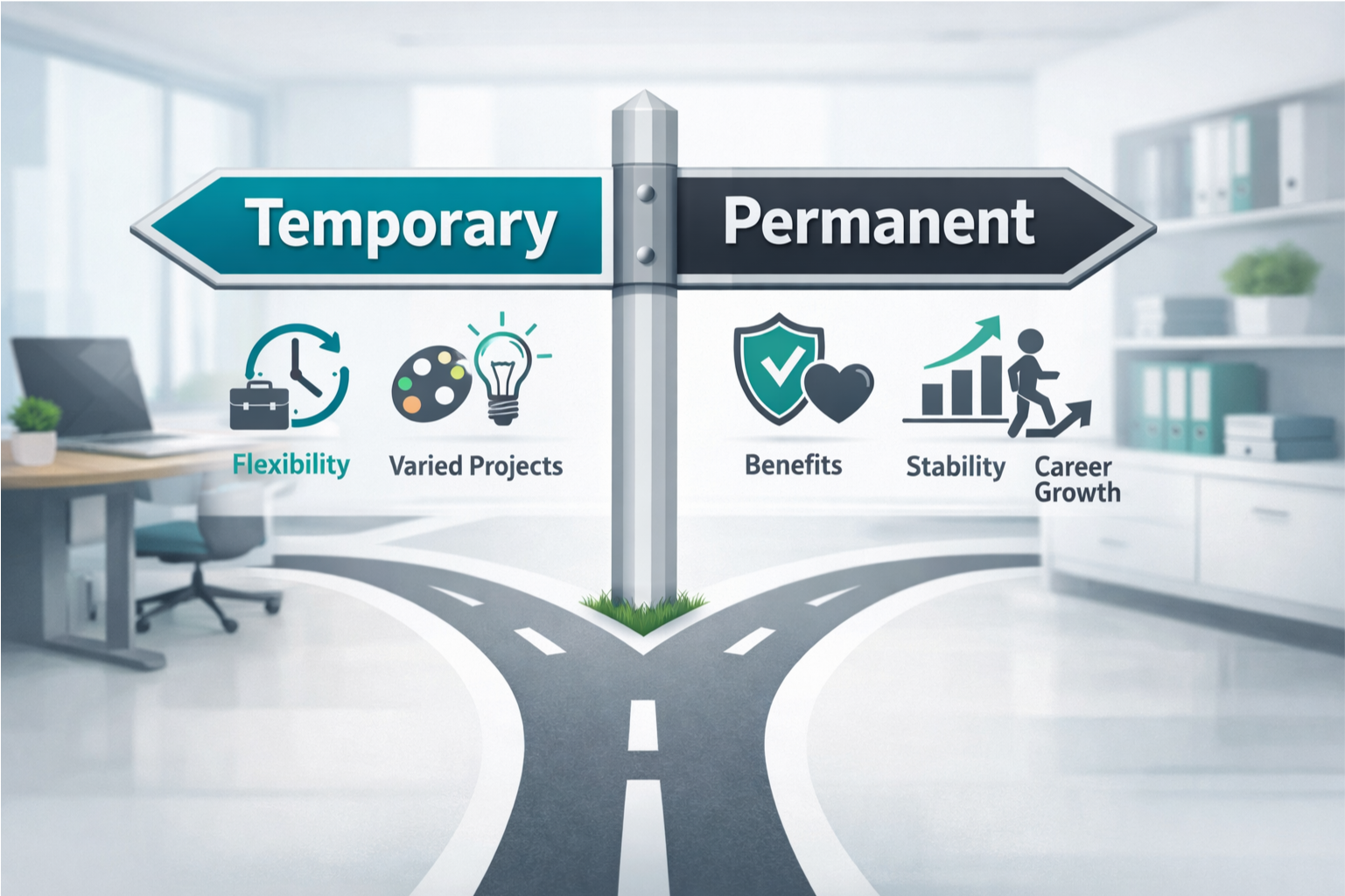
For many, the primary draw of temporary work is flexibility. It allows individuals to “test drive” different companies and industries without a long-term commitment. This is particularly valuable for:
- Career Changers: Gaining experience in a new field without the pressure of a permanent hire.
- Students and Parents: Balancing work with education or family responsibilities.
- Specialists: Focusing on high-impact projects and then moving on once the work is done.
The Strength of Permanent Roles
Permanent roles offer continuity and belonging. Permanent employees are more likely to be integrated into the company culture, participate in long-term strategic planning, and receive investment in the form of professional development and training. For an employer, a permanent workforce is a “knowledge bank” that retains institutional memory and fosters loyalty.
Employer Perspectives: Why Hire One Over the Other?
Organizations weigh several factors when deciding which contract to offer:
- Cost: While permanent employees have higher benefit costs, temporary workers often come with high agency fees.
- Agility: Temporary contracts allow firms to scale their workforce up or down in response to market volatility—a critical capability in the current economic climate.
- Risk Mitigation: Temporary roles can serve as a “probationary period” (often called “temp-to-perm”), allowing the employer to assess a candidate’s fit before committing to a permanent contract.
- Specialization: For short-term projects requiring niche skills (e.g., implementing a new ERP system), hiring a temporary specialist is more efficient than training a permanent staff member.
- Budgetary Flexibility: Permanent hires are often classified as “Fixed Costs” (OPEX), whereas temporary workers can sometimes be billed against specific project budgets (CAPEX). This accounting distinction can make temporary hires more attractive to department heads with strict headcount limits but generous project funding.
The Strategic ROI of a Mixed Workforce
In 2026, leading organizations are no longer viewing temporary and permanent hires as mutually exclusive. Instead, they are calculating the “Strategic ROI” of their workforce mix. A permanent employee’s value is realized through institutional knowledge, brand advocacy, and long-term productivity gains. A temporary worker’s value is realized through immediate problem-solving, speed to market, and the avoidance of long-term liability during economic downturns. By maintaining a 70/30 or 80/20 split between permanent and temporary staff, companies can remain robust yet responsive.
The Future of Work: Trends in 2026
As we move through 2026, the lines between these two categories are blurring. The rise of the “Fractional Executive” and the “Hybrid Contractor” suggests a middle ground where workers provide high-level services to multiple firms on a recurring but non-permanent basis.
AI and the “Augmented” Worker
Artificial Intelligence is fundamentally changing the contract preference for many firms. For roles that are highly susceptible to automation, employers are increasingly opting for temporary contracts to avoid the future costs of redundancy. Conversely, for “AI-Augmented” roles—those that require a human to oversee and refine AI outputs—permanent contracts are becoming more common as firms compete to lock in the rare talent capable of managing these complex systems.
The “Low-Hire, Low-Fire” Paradox
The “low-hire, low-fire” trend identified by labor economists in early 2026 suggests that companies are becoming more cautious. They are retaining their “core” permanent staff at all costs to avoid losing institutional knowledge, while using a “periphery” of temporary workers to manage fluctuations. This “Core-Periphery” model is becoming the standard for modern organizational design. For the worker, this means that landing a permanent role is harder than ever, but once achieved, the security is higher than in previous decades.
Navigating the Transition: From Temp to Perm
For many, a temporary contract is a foot in the door—a “working interview” that can lead to a permanent offer. If your goal is to transition from a temporary to a permanent position, consider the following strategies:
- Exceed Deliverables Early: In a temporary role, your first 30 days are critical. Establishing a reputation for reliability and high-quality output makes you indispensable.
- Build Internal Networks: Don’t just stay at your desk. Network with permanent staff and managers in other departments. Often, a permanent role may open up elsewhere in the company that isn’t yet advertised.
- Express Your Intent: Don’t assume your manager knows you want to stay. During a check-in, mention that you enjoy the company culture and would be interested in permanent opportunities should they arise.
- Upskill on the Job: Use the company’s internal resources or simply learn the proprietary systems. The more “internal” knowledge you have, the more expensive you are to replace with a new hire.
Case Study: A Tale of Two Developers
To illustrate the practical differences, consider Sarah and Mark, both Senior Software Developers.
Sarah chooses a permanent contract at a large financial institution. She earns a stable salary of $140,000, has 25 days of PTO, a 10% pension match, and comprehensive family health insurance. She is currently leading a three-year project to modernize the bank’s core ledger. She feels secure and is planning to buy a house.
Mark chooses a temporary contract (6 months) at a fast-growing tech startup. He is paid $120 per hour (equivalent to roughly $240,000 annually). He has no PTO, no pension, and pays for his own health insurance. However, he loves the fast pace, and when his contract ends, he plans to take two months off to travel before starting a new contract in a different sector.
Neither choice is wrong; they simply serve different life stages and risk appetites. Sarah values the security and long-term impact, while Mark values the income and freedom.
Making the Right Choice
There is no “better” contract; there is only the contract that fits your current needs. If you value stability, long-term growth, and a comprehensive safety net, a permanent contract remains the gold standard. However, if you crave variety, autonomy, and the ability to control your own schedule, the temporary route offers a dynamic alternative.
For employers, the key is balance. A healthy organization requires the stability of a permanent core and the agility of a temporary workforce. By understanding the legal, financial, and cultural differences between these two models, both parties can build a working relationship that is productive, compliant, and mutually beneficial.