

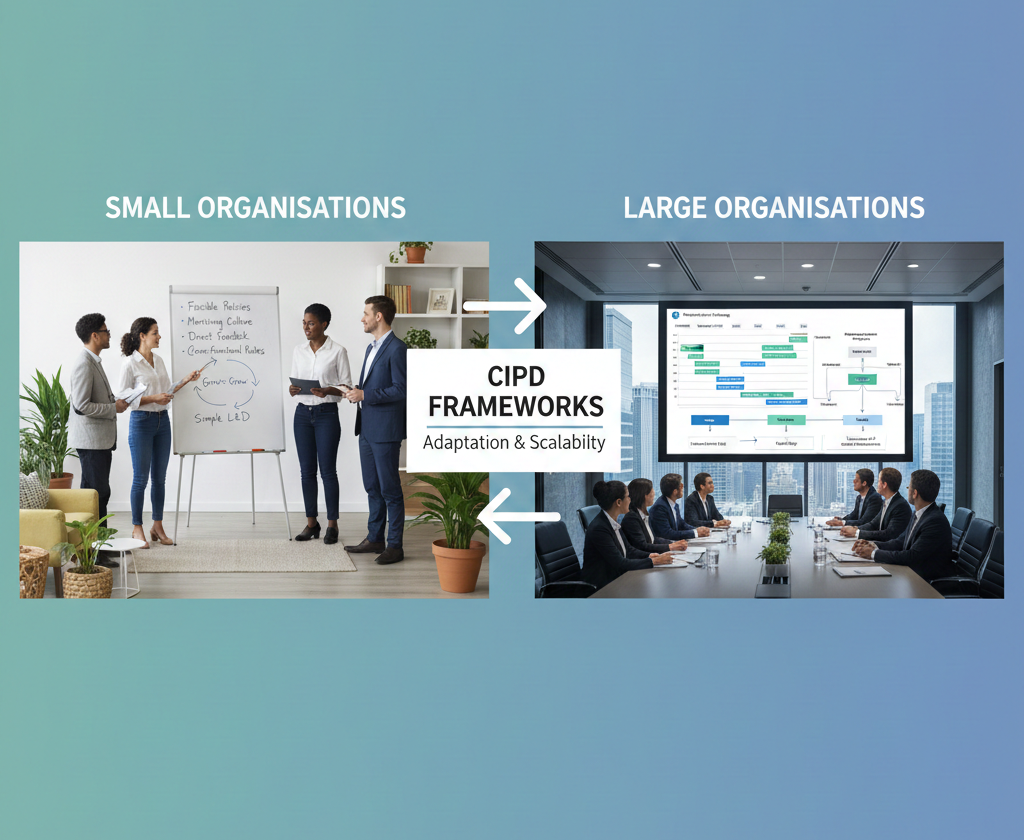
The Chartered Institute of Personnel and Development (CIPD) has long served as the global standard-bearer for the HR and People Development profession. Its frameworks, particularly the CIPD Profession Map, provide a comprehensive blueprint for ethical, evidence-based, and impactful people management. However, the true measure of a framework’s utility lies not in its universal design, but in its contextual application. The journey of applying CIPD principles in a small, agile start-up with twenty employees is fundamentally different from its implementation in a multinational corporation employing hundreds of thousands.
This article undertakes a detailed exploration of this divergence, contrasting the strategic and operational application of CIPD frameworks across small and large organisations. Through a series of in-depth case studies, we will demonstrate how the same professional standards are adapted—from being a foundational tool for compliance and culture in Small and Medium-sized Enterprises (SMEs) to a complex instrument for strategic transformation and risk management in large corporations.
The CIPD Profession Map: A Universal Standard, Contextualised
At the core of the CIPD’s guidance is the CIPD Profession Map, which defines the knowledge, behaviours, and values required for people professionals to create better work and working lives. The Map is structured around four key areas: Purpose, Values, Core Knowledge, and Core Behaviours. While the principles are constant, the emphasis shifts dramatically with organisational size.
Core Behaviours: The Common Thread
Two Core Behaviours—Professional Courage and Influence and Ethical Practice—serve as the most critical common threads. In both contexts, the CIPD framework demands that people professionals act with integrity and challenge decisions that do not align with the organisation’s values or legal requirements.
•In Large Organisations, Professional Courage often manifests as challenging senior leadership on complex, data-driven decisions, such as a major restructuring or a global policy change. It requires navigating complex political landscapes and using robust evidence to influence outcomes.
•In Small Organisations, Professional Courage is often more personal and immediate. It can be the sole HR professional challenging the owner-manager on an informal, non-compliant practice, or advocating for a fair process in a tight-knit environment where personal relationships often blur professional lines.
The Map, therefore, functions as a “North Star” for both compliance and strategic transformation [1]. For the SME, it is a guide to professionalising the informal; for the large corporation, it is a tool for standardising excellence and managing complexity at scale.
Part I: The Large Organisation – Managing Complexity and Specialisation
Large organisations, defined by their scale, geographical spread, and hierarchical structures, face the challenge of complexity. The HR function must be highly specialised, consistent across diverse business units, and capable of managing significant risk. CIPD frameworks are applied here to drive large-scale organisational development and ensure strategic alignment.
Case Study: NatWest Group – The Employee Experience Revolution
NatWest Group, a major financial services provider with approximately 61,000 employees, undertook a massive transformation of its HR operating model, moving away from the traditional Ulrich+ model [2]. The shift was driven by the need to respond to the “war for talent,” rapid technological evolution, and the changing expectations of a majority millennial workforce.
Application of CIPD Frameworks:
- Organisational Development and Design: The transformation was not merely a structural change but a fundamental redesign of how HR delivers value. NatWest adopted a “Goal and Journey” archetype, aligning 60% of the HR function to end-to-end employee lifecycle components (e.g., “Onboarding” or “Career Progression”). This eliminated functional silos and created a holistic, employee-focused solution, directly embodying the CIPD’s focus on Purposeful and Valuing People values.
- Data & Analytics (Specialist Knowledge): The new model heavily relies on Shared Capability teams in areas like Data & Analytics and Behavioural Science [3]. This reflects the CIPD’s emphasis on Evidence-Based Practice. HR decisions are no longer based on intuition but on data-driven insights, such as identifying “key moments that matter” in the employee journey to determine where human interaction is most critical versus where digital solutions (like the “Archie chatbot”) can streamline processes.
- Change Management: The sheer scale of the transformation required a robust change management approach. NatWest used Objectives and Key Results (OKRs) for strategic alignment and Big Room Planning for quarterly prioritisation. This structured, transparent approach is a direct application of CIPD’s guidance on managing large-scale change, ensuring that the entire function is aligned to the same strategic goals.
The NatWest case illustrates how a large organisation uses the CIPD framework to move from a reactive, process-driven function to a proactive, strategic partner, leveraging specialisation to manage complexity.
Case Study: Tesco – Multinational Consistency
Tesco, a multinational retailer with over 330,000 employees, faced the challenge of delivering a consistent employee experience across diverse international markets (UK, Ireland, Central Europe, and India). Their solution was a shift to a four-pillar people function model.
Application of CIPD Frameworks:
- Standardisation and Risk Management: The four-pillar model was designed using design principles and maturity models to establish a clear current state and future aspiration. This systematic approach, aligned with the CIPD’s Professional Courage and Ethical Practice values, ensures that core HR processes (e.g., disciplinary, grievance, reward) are applied consistently, mitigating legal and reputational risk across multiple jurisdictions.
- Iterative Development: Tesco took a staggered, iterative approach to implementation, recognising that a model of this scale must evolve. This agility, often associated with smaller firms, is strategically applied in a large corporate setting to ensure the model remains responsive to changing market and business requirements, a key tenet of the CIPD’s Valuing People behaviour.
Part II: The Small Organisation – Building Foundations and Agility
SMEs, typically defined as having fewer than 250 employees, operate under the constraints of limited resources and a culture that is often informal and owner-led. For these organisations, the CIPD framework is less about managing complexity and more about professionalising the informal and ensuring legal compliance as a foundation for growth.
Case Study: Formalising HR in SMEs – Architect Co. and Photography Co.
The CIPD’s “People Skills” report highlighted several SME vignettes that illustrate the journey from informality to professional HR practice.
Application of CIPD Frameworks:
- Compliance and Risk Mitigation (Core Knowledge): In firms like Architect Co. (28 staff) and Photography Co. (6 staff), the lack of formal HR policies led to internal conflict, confusion over pay and promotions, and even the threat of an employment tribunal. The intervention, guided by CIPD principles, focused on establishing Core Knowledge in areas like Employment Law and People Practice.
-
- Architect Co. implemented formal HR policies, an employee handbook, and appraisal paperwork, which provided clarity and reduced conflict.
-
- Photography Co.’s owner-manager, initially “completely ignorant of the actual law,” experienced a profound mindset shift after the intervention, realising the importance of compliance as a business necessity.
- Professional Courage for Owner-Managers: A recurring theme is the need for the owner-manager to demonstrate Professional Courage by delegating and formalising processes. In small firms, the owner often embodies the entire HR function. The CIPD framework provides the external validation and structure needed for the owner to trust formal processes and move away from an intuitive, but often non-compliant, management style.
Case Study: Innovation and Culture – Coffee Break Languages and Citizens Advice Leicestershire
In agile SMEs, the CIPD’s Values and Core Behaviours often drive innovation and culture change more directly than in large, bureaucratic structures.
Application of CIPD Frameworks:
- Valuing People and Flexible Working: Coffee Break Languages, a small media company, successfully trialled and adopted a flexible four-day week . This initiative is a direct manifestation of the CIPD’s Valuing People behaviour and its framework for Flexible and Hybrid Working. In a small firm, the trial could be co-designed with employees, allowing for rapid feedback and iteration—an agility that would be far more complex in a large organisation. The focus was on Evidence-Based Practice by measuring productivity and wellbeing, proving that innovation can be driven by core values even with limited resources.
- Change Management in a Local Context: Citizens Advice Leicestershire, a local charity, used CIPD Change Management frameworks to navigate a period of crisis and achieve sustainable growth [7]. The change was managed through a focus on Core Knowledge (specifically Culture and Behaviour) to rebuild trust within the small, tight-knit team. The application of Ethical Practice was paramount in restructuring the organisation without losing key talent, a risk that is acutely felt in smaller firms where every employee is critical.
Comparative Analysis: The Divergent Application of Frameworks
The difference in application is not one of superiority, but of necessity and resource allocation. While the large organisation can afford to specialise, the SME must generalise.
1. The HR Role and Structure
|
Feature
|
Small Organisations (SMEs)
|
Large Organisations (Corporates)
|
|
HR Role
|
Generalist: Often a single HR professional or the owner-manager, covering all aspects from recruitment to employee relations.
|
Specialist: Highly segmented roles (e.g., Reward Specialist, People Analytics Manager, L&D Business Partner).
|
|
Framework Use
|
Foundational: Used as a blueprint for compliance, professionalisation, and culture-building.
|
Strategic: Used as a tool for large-scale transformation, risk mitigation, and strategic alignment.
|
|
Decision Making
|
Rapid & Personal: Often based on “Professional Courage” and direct, informal feedback.
|
Evidence-Based & Hierarchical: Data-driven, slower, requiring sign-off across multiple stakeholders.
|
|
Outsourcing
|
High: SMEs are significantly more likely to outsource complex casework (e.g., disciplinary, legal) compared to large firms [8].
|
Low: Complex casework is typically handled internally by specialist in-house teams.
|
2. Learning and Development (L&D) – The 70-20-10 Model
The 70-20-10 model—70% experiential learning, 20% social learning, and 10% formal training—is a CIPD staple, but its implementation is a clear differentiator.
- Large Organisations (Focus on 10% and 20%): Large firms like Peabody have the resources to transition their L&D teams into “Internal Academies” [9]. This allows for structured investment in the 10% (formal training), creating accredited pathways and specialist courses. The 20% (social learning) is formalised through mentoring schemes, coaching, and structured communities of practice. The CIPD framework is used to ensure these formal structures align with strategic capability gaps.
- Small Organisations (Focus on 70%): In SMEs, L&D is almost entirely dominated by the 70% (experiential learning) due to budget constraints. Formal training is rare. The CIPD framework is applied by encouraging cross-functional projects and job rotation, which allows employees to gain Specialist Knowledge outside their primary role. The “learning” is often a by-product of necessity, with the CIPD principles ensuring that this on-the-job experience is structured and reflective, rather than simply chaotic.
3. HR Technology and People Analytics
The application of technology, a critical enabler of the CIPD’s Evidence-Based Practice, is also scaled differently.
- Large Organisations: Technology is integrated into the HR operating model itself. NatWest’s use of the “Archie chatbot” and its investment in a dedicated Data & Analytics capability team are examples of leveraging technology to manage the sheer volume of employee data and queries. The focus is on People Analytics to predict trends, manage succession planning, and measure the impact of HR interventions on business outcomes.
- Small Organisations: Technology adoption is often limited to basic payroll and HRIS systems. The “analytics” are typically informal, relying on direct observation and personal relationships. The CIPD framework encourages the SME to adopt a “light-touch” evidence-based approach, focusing on simple metrics like staff turnover, absence rates, and employee feedback from informal check-ins, rather than complex predictive modelling.
Conclusion: Key Takeaways for People Professionals
The CIPD frameworks are not rigid rules but a set of professional standards that must be interpreted and applied through a contextual lens. The case studies of NatWest, Tesco, Architect Co., and Coffee Break Languages demonstrate that the success of CIPD principles is defined by their adaptability.
For Large Organisations, the key takeaway is the necessity of structural agility. The CIPD framework provides the language and rigour to dismantle outdated models (like the rigid Ulrich structure) and rebuild them around the employee experience, leveraging specialisation and data to manage complexity and risk. The focus is on standardising excellence across a vast and diverse landscape.
For Small Organisations, the key takeaway is the power of professionalisation. The CIPD framework offers a vital roadmap for owner-managers and generalist HR professionals to move from informal, high-risk practices to compliant, value-adding HR. The focus is on building a resilient foundation for growth, where core values like Ethical Practice and Valuing People are embedded directly into the company culture.
Ultimately, whether managing a global workforce or a local team, the CIPD frameworks provide the essential professional compass. They ensure that people professionals, regardless of their organisation’s size, are equipped with the knowledge, behaviours, and courage to champion better work and working lives, driving both business success and societal value.
References
1.CIPD. (2024). The Profession Map for Organisations. Link
2.NatWest Group. (2024). Transforming the HR Operating Model Case Study. CIPD Knowledge Hub.
3.CIPD. (2024). Transforming the HR operating model: NatWest Group. Link
4.CIPD. (2024). Transforming the HR operating model: Tesco. Link
5.CIPD. (2017). People Skills: Deep-dive SME vignettes. PDF Link
6.CIPD. (2025). A flexible four-day week model: Coffee Break Languages. CIPD Case Studies.
7.CIPD. (2025). Change management journey: Citizens Advice Leicestershire. CIPD Case Studies.
8.CIPD. (2020). People Profession Survey 2020 UK and Ireland. Scribd Link
9.Peabody. (2024). Transitioning L&D into an Internal Academy. CIPD Case Studies.