

The ADKAR Model: A Comprehensive Guide to Individual-Led Organizational Change
In the contemporary business environment, change is not merely an occasional disruption but a constant reality. From digital transformations and mergers to shifts in remote work policies, organizations must adapt rapidly to survive and thrive. However, most organizational changes fail not because of flawed strategy or technology, but because the people within the organization do not adopt the new ways of working. This is where the ADKAR Model of change management becomes indispensable. Developed by Jeff Hiatt, the founder of Prosci, after studying the change patterns of more than 700 organizations, ADKAR provides a results-oriented framework that focuses on the individual as the fundamental unit of change.
The Philosophy of ADKAR: Individual Change as the Foundation
The core premise of the ADKAR model is that organizational change can only be successful if each individual involved in the change reaches specific milestones. While many change management frameworks focus on the “macro” level—such as project phases, communication plans, and organizational restructuring—ADKAR operates at the “micro” level. It recognizes that an organization does not change; rather, the people within the organization change. If the individuals do not transition successfully, the organizational change will fail to deliver its intended benefits.
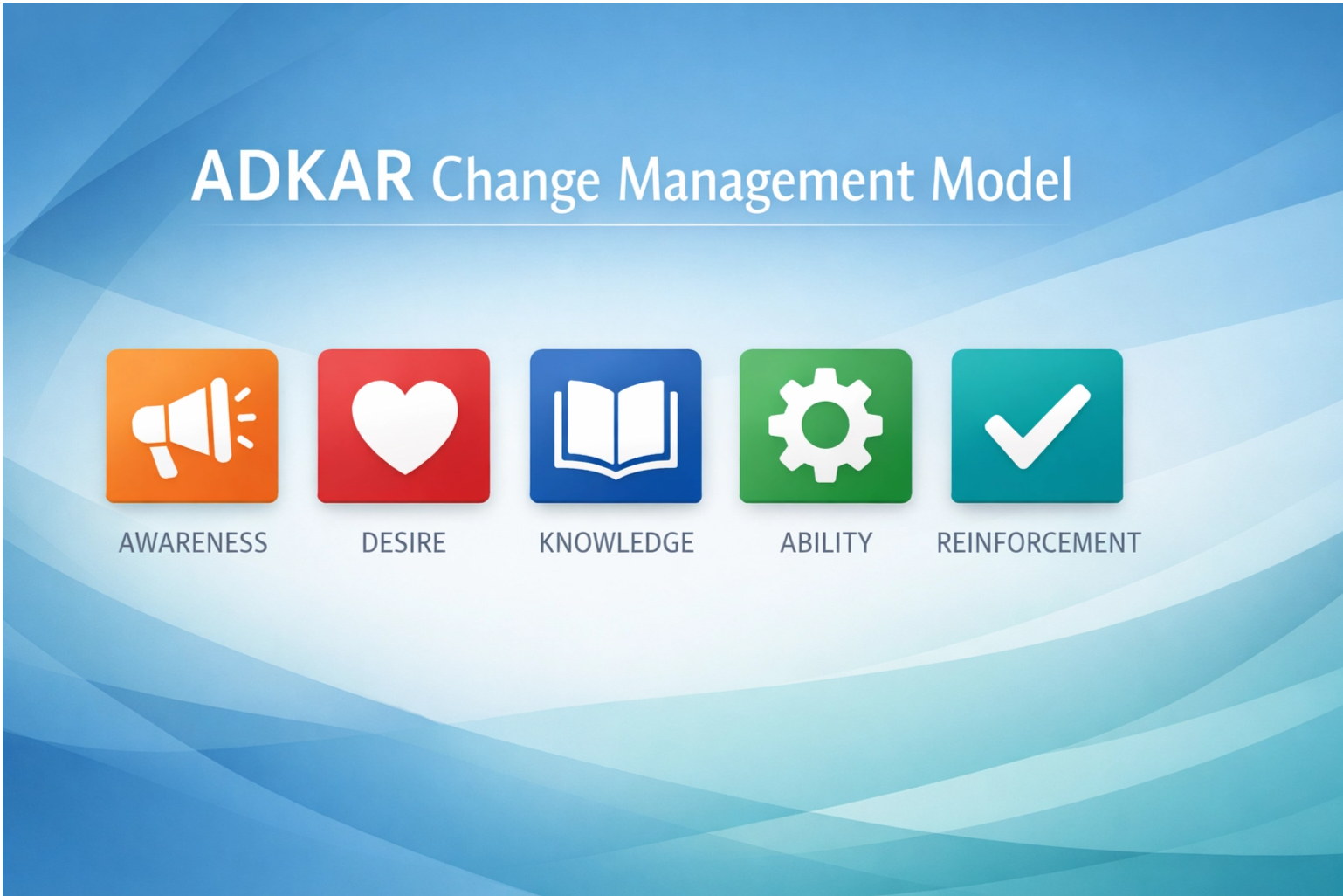
ADKAR is an acronym representing five distinct outcomes that an individual must achieve for change to be successful and sustainable: Awareness, Desire, Knowledge, Ability, and Reinforcement. These stages are sequential; an individual must typically achieve one before moving effectively to the next.
1. Awareness: The “Why” Behind the Change
The first building block of the ADKAR model is Awareness of the need for change. This is more than just knowing that a change is happening; it is understanding why the change is necessary and what the risks are of staying the same.
In many organizations, resistance begins because employees do not see the logic behind a new initiative. Leaders often assume that because they understand the strategic necessity, everyone else does too. However, without a clear explanation of the “burning platform” or the opportunity at hand, employees may perceive the change as arbitrary or unnecessary. Effective awareness building involves transparent communication from senior leaders and immediate supervisors, addressing the external and internal factors driving the transition.
2. Desire: The Personal Decision to Support Change
Once an individual is aware of why a change is needed, the next step is Desire—the personal decision to support and participate in the change. This is often the most challenging stage of the ADKAR model because it involves personal choice and motivation, which cannot be directly controlled by management.
Desire is driven by the “What’s In It For Me?” (WIIFM) factor. Individuals evaluate how the change will affect their job security, workload, and professional growth. To build desire, change leaders must address individual concerns and align the change with the personal values or goals of the employees. It requires active listening, empathy, and sometimes, the use of incentives or the removal of barriers that cause fear or resentment.
3. Knowledge: Knowing How to Change
With the awareness of the need and the desire to participate, the individual then requires Knowledge on how to change. This includes the technical skills needed to use new tools, as well as an understanding of new processes, roles, and responsibilities.
Knowledge is often equated with training, but it is broader. It involves understanding the “future state” and how one’s daily activities will look once the change is implemented. A common pitfall in change management is providing training (Knowledge) before employees have the Awareness and Desire to learn. When training is delivered too early, it is often ignored or forgotten because the “why” hasn’t been established.
4. Ability: Turning Knowledge into Action
There is a significant difference between knowing how to do something and being able to do it. Ability is the demonstrated capability to implement the change and achieve the desired performance levels.
An employee might attend a training session on a new software (Knowledge) but may still struggle to use it efficiently in a high-pressure environment (Ability). Building ability requires time, practice, and coaching. It often involves a “learning curve” where productivity may temporarily dip as individuals gain proficiency. Organizations must provide a safe environment for experimentation and offer hands-on support to bridge the gap between theory and practice.
5. Reinforcement: Making the Change Stick
The final stage is Reinforcement, which ensures that the change is sustained over time and that individuals do not revert to old habits. Human nature tends toward the path of least resistance, and without reinforcement, people often slip back into familiar ways of working once the initial excitement or pressure of the change fades.
Reinforcement can take many forms, including recognition, rewards, performance metrics, and celebrations of success. It also involves identifying and correcting deviations from the new process. Leadership must remain visible and committed to the change long after the “go-live” date to signal that the new way of working is the permanent standard.
The Strategic Advantages of the ADKAR Model
The ADKAR model offers several distinct advantages over more traditional, top-down change management approaches:
|
Feature
|
Description
|
|
Outcome-Oriented
|
Focuses on specific goals (outcomes) rather than just completing tasks or activities.
|
|
Diagnostic Tool
|
Allows leaders to identify exactly where a change is stalling by pinpointing which of the five elements is missing.
|
|
Individual Focus
|
Acknowledges that people change at different speeds and requires personalized interventions.
|
|
Scalability
|
Can be applied to a single person, a small team, or an entire global enterprise.
|
|
Common Language
|
Provides a simple, shared vocabulary for managers and employees to discuss change.
|
Practical Application: Diagnosing the “Barrier Point”
One of the most powerful applications of ADKAR is its use as a diagnostic tool. When a change initiative is failing, leaders can use the model to identify the “barrier point”—the first element of ADKAR where the individual scores low (typically below a 3 on a 1-5 scale).
For example, if employees are trained but still not using a new system, the barrier point might not be Knowledge, but Desire. In this case, more training will not help; instead, leaders need to focus on motivation and addressing resistance. Conversely, if employees want to change but don’t know how, the focus should shift to training and coaching. By identifying the specific barrier point, organizations can target their resources more effectively rather than using a “one-size-fits-all” communication or training plan.
Challenges and Considerations
While ADKAR is highly effective, it is not without challenges. Its focus on the individual can be resource-intensive in very large organizations. Managing the ADKAR journey for thousands of employees requires a robust network of “change champions” and managers who are trained in coaching.
Additionally, some critics argue that the model is too linear. In reality, change can be messy, and individuals may move back and forth between stages. For instance, a person might have the Desire to change initially but lose it when they realize the difficulty of gaining the necessary Ability. Change leaders must remain agile and prepared to revisit earlier stages of the model as the project evolves.
Leading Change in a Volatile World
The Prosci ADKAR model has stood the test of time because it addresses the most fundamental element of any transformation: the human element. By breaking down the complex psychological process of change into five manageable building blocks, it empowers leaders to move beyond “hope” as a strategy and instead drive predictable, sustainable results.
In an era of rapid technological advancement and shifting global markets, the ability to manage change is a core competency for any successful organization. Whether implementing a new ERP system, navigating a corporate merger, or fostering a culture of diversity and inclusion, the ADKAR model provides the roadmap. By focusing on Awareness, Desire, Knowledge, Ability, and Reinforcement, organizations can ensure that their most valuable asset—their people—are not just spectators of change, but active and successful participants in it.