

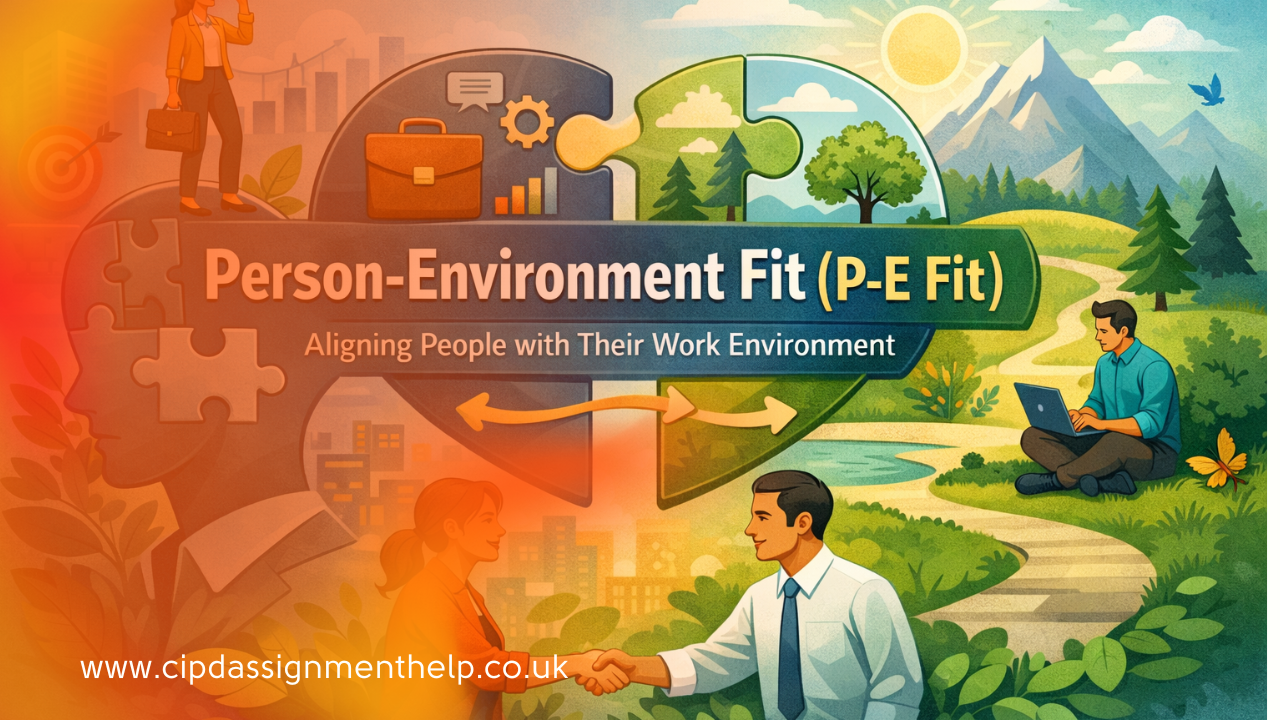
In the dynamic landscape of modern workplaces, understanding the intricate relationship between individuals and their work environments is paramount for fostering both employee well-being and organizational success. One foundational concept that sheds light on this relationship is Person-Environment Fit (P-E Fit). P-E Fit refers to the degree of compatibility or match between an individual’s characteristics and the characteristics of their surrounding environment . This compatibility can manifest in various forms, encompassing an individual’s needs, values, goals, abilities, and personality, as well as the environmental factors such as job demands, organizational culture, and the characteristics of colleagues .
The concept of P-E Fit has garnered significant attention in Industrial and Organizational Psychology due to its profound implications for various workplace outcomes, including job satisfaction, performance, and employee retention . While the overarching idea of P-E Fit is straightforward, its application and understanding are nuanced, involving several distinct dimensions and theoretical perspectives.
Domains of Person-Environment Fit
P-E Fit is not a monolithic concept but rather a broad umbrella encompassing several specific types of fit, each focusing on a different aspect of the individual-environment interaction. These domains provide a more granular understanding of how compatibility influences workplace dynamics:
Person-Organization Fit (P-O Fit)
Person-Organization Fit (P-O Fit) is arguably the most extensively studied domain within P-E Fit. It is defined as the compatibility between individuals and organizations, occurring when: (a) at least one entity provides what the other needs, (b) they share similar fundamental characteristics, or (c) both . A high degree of value congruence—where an employee’s values align with the organization’s culture—is a critical component of P-O Fit. This alignment fosters a strong organizational culture, enhances trust among coworkers, and contributes to a shared sense of community . The benefits of strong P-O Fit for organizations include reduced turnover, increased organizational citizenship behaviors, and higher organizational commitment . The Attraction-Selection-Attrition (ASA) theory posits that individuals are drawn to, select, and remain with organizations that align with their own characteristics, leading to a more homogeneous workforce over time .
Person-Job Fit (P-J Fit)
Person-Job Fit (P-J Fit) focuses on the compatibility between an individual’s characteristics and the demands and requirements of a specific job role . This domain primarily operates from a complementary perspective, emphasizing the match between an employee’s Knowledge, Skills, and Abilities (KSAs) and the job’s demands . It also considers whether the job supplies meet the employee’s needs and desires, influencing job satisfaction and stress levels . A strong P-J Fit ensures that employees possess the necessary competencies to perform their tasks effectively and that their personal needs are met by the job itself.
Person-Group Fit (P-G Fit)
Person-Group Fit (P-G Fit) examines the psychological compatibility between an individual and their workgroup or team. Although a relatively newer area of research, P-G Fit is strongly linked to group-oriented outcomes such as coworker satisfaction and feelings of cohesion within the team . When individuals fit well with their group, it can lead to more harmonious working relationships and improved team performance.
Person-Person Fit (P-P Fit)
Person-Person Fit (P-P Fit), also known as Person-Supervisor Fit in many contexts, describes the compatibility between an individual’s cultural preferences and those of other specific individuals, such as supervisors, mentors, or colleagues . This concept aligns with the similarity-attraction hypothesis, suggesting that people are drawn to and work more effectively with others who share similar values, attitudes, and opinions . Research indicates that Person-Supervisor Fit, for instance, is strongly correlated with supervisor satisfaction .
Person-Skill Fit (P-S Fit)
Person-Skill Fit (P-S Fit) is a contemporary domain that defines the alignment between an individual’s skills and the diverse tasks required by an organization, particularly in evolving work environments . This model is especially relevant for organizations adapting to new forms of work, such as gig work, freelancing, and remote work, aiming to enhance dynamic alignment and improve outcomes in modern, flexible settings .
Antecedents of Person-Environment Fit
Achieving a high level of P-E Fit is not a matter of chance; it is often the result of deliberate organizational practices and individual choices. Several key antecedents contribute to the development of a strong fit between individuals and their work environments:
Training and Development
Organizational training and development programs play a crucial role in enhancing P-E Fit. By providing employees with opportunities to update their skills and knowledge, organizations can improve Person-Job Fit by ensuring that employees are well-equipped to meet the demands of their roles . Training also serves as a powerful socialization tool, helping employees understand and internalize the organization’s values and culture, thereby strengthening Person-Organization Fit .
Performance Appraisal
Performance appraisal systems, when designed and implemented effectively, can also be a significant antecedent of P-E Fit. By recognizing and rewarding employees for skill development and knowledge enhancement, organizations can bolster Person-Job Fit . Furthermore, when performance appraisals focus on an employee’s alignment with organizational values and goals, they can reinforce Person-Organization Fit . At the group level, recognizing and rewarding team achievements can foster a sense of collective purpose and enhance Person-Group Fit .
Attraction-Selection-Attrition (ASA) Processes
The Attraction-Selection-Attrition (ASA) model, proposed by Schneider (1987), provides a compelling framework for understanding how organizations naturally become more homogeneous over time in terms of the people they employ .
- Attraction: Individuals are attracted to organizations that they perceive as having values and characteristics congruent with their own.
- Selection: Organizations select applicants who they believe will fit well within the existing organizational culture and job roles.
- Attrition: Individuals who find themselves to be a poor fit are more likely to leave the organization, either voluntarily or involuntarily.
This cycle results in a workforce that is more aligned with the organization’s culture and values, leading to higher overall P-E Fit.
Consequences of Person-Environment Fit
The degree of P-E Fit has significant consequences for both individuals and organizations. A strong fit is generally associated with a range of positive outcomes, while a poor fit can lead to negative consequences.
Positive Outcomes
- Job Satisfaction: P-E Fit, particularly Person-Job Fit, is a strong predictor of job satisfaction . When individuals feel that their skills are well-utilized and their needs are met by their job, their satisfaction levels are likely to be high.
- Organizational Commitment: A strong Person-Organization Fit fosters a sense of belonging and loyalty, leading to higher levels of organizational commitment .
- Performance: While the link between P-E Fit and performance can be complex, a good fit is generally associated with better job performance. When employees are in roles that match their abilities and are in an environment that supports their values, they are more likely to be motivated and effective.
- Reduced Turnover: High P-E Fit is a key factor in employee retention. Individuals who feel that they fit well with their organization and job are less likely to seek employment elsewhere .
Negative Outcomes
- Stress: A poor fit, especially when there is a discrepancy between an individual’s needs and what the environment supplies, can be a significant source of stress .
- Burnout: Misfit, particularly in demanding jobs, can lead to emotional exhaustion and burnout.
- Counterproductive Work Behaviors: In some cases, a poor fit can lead to negative behaviors that are detrimental to the organization.
Assessing Person-Environment Fit
Measuring P-E Fit is a complex task, and researchers have developed various methods to assess it. These methods can be broadly categorized into direct and indirect measures.
Direct Measures
Direct measures involve asking individuals to report their perceived level of fit. For example, an employee might be asked to rate their agreement with statements like, “My values are a good fit with this organization’s values.” These measures are subjective and capture the individual’s personal experience of fit.
Indirect Measures
Indirect measures assess the person and the environment separately and then compare the two to determine the degree of fit. This can be done in several ways:
- Difference Scores: This method involves subtracting the score for the environment from the score for the person on a particular dimension. However, this approach has been criticized for its statistical limitations.
- Profile Correlation: This method involves correlating the profile of an individual’s characteristics with the profile of the environment’s characteristics.
- Polynomial Regression: This is a more sophisticated statistical technique that allows for a more nuanced examination of the relationship between the person, the environment, and the outcomes of interest. It can model complex, non-linear relationships and is considered a more robust method for assessing fit .
Person-Environment Fit is a powerful concept that has far-reaching implications for the modern workplace. By understanding the different domains of fit and the factors that contribute to it, organizations can create environments that are more supportive, engaging, and productive. From a practical standpoint, organizations can leverage the principles of P-E Fit in their recruitment, selection, and training processes to build a workforce that is not only skilled but also aligned with the organization’s culture and values. For individuals, seeking out environments that are a good fit for their own characteristics can lead to a more fulfilling and successful career.