

In the modern professional landscape, workplace stress has transitioned from a peripheral concern to a central challenge for organizational health and individual well-being. Among the various theoretical frameworks developed to understand this phenomenon, Robert Karasek’s Demand-Control-Support (DCS) Model remains one of the most influential and enduring . Originally introduced as the Job Demand-Control (JDC) model in 1979 and later expanded to include Social Support, this model provides a systematic way to analyze how job characteristics interact to produce either psychological strain or professional growth .
The Evolution of the Model
The DCS model originated from Robert Karasek’s observation that stress is not merely a product of high workload but rather the result of an imbalance between the demands placed on a worker and the resources available to meet those demands. In 1988, Johnson and Hall expanded Karasek’s original two-dimensional model by adding Social Support, acknowledging that the presence of helpful colleagues and supervisors can significantly buffer the negative effects of high-strain environments .
The Three Core Dimensions
The DCS model is built upon three primary axes that define the psychosocial environment of a workplace:
- Psychological Demands: This refers to the workload, time pressure, cognitive complexity, and emotional effort required by the job. It is not inherently negative; rather, it represents the “pressure” of the role.
- Decision Latitude (Control): This is composed of two sub-factors:
-
- Skill Discretion: The degree to which a job allows a worker to use their specific skills and learn new ones.
-
- Decision Authority: The level of autonomy a worker has over how they perform their tasks and make decisions.
-
- Social Support: This dimension measures the quality of interactions with peers and supervisors. High social support involves receiving instrumental help (assistance with tasks) and emotional support (empathy and encouragement).
The Four Quadrants of the Job Strain Model
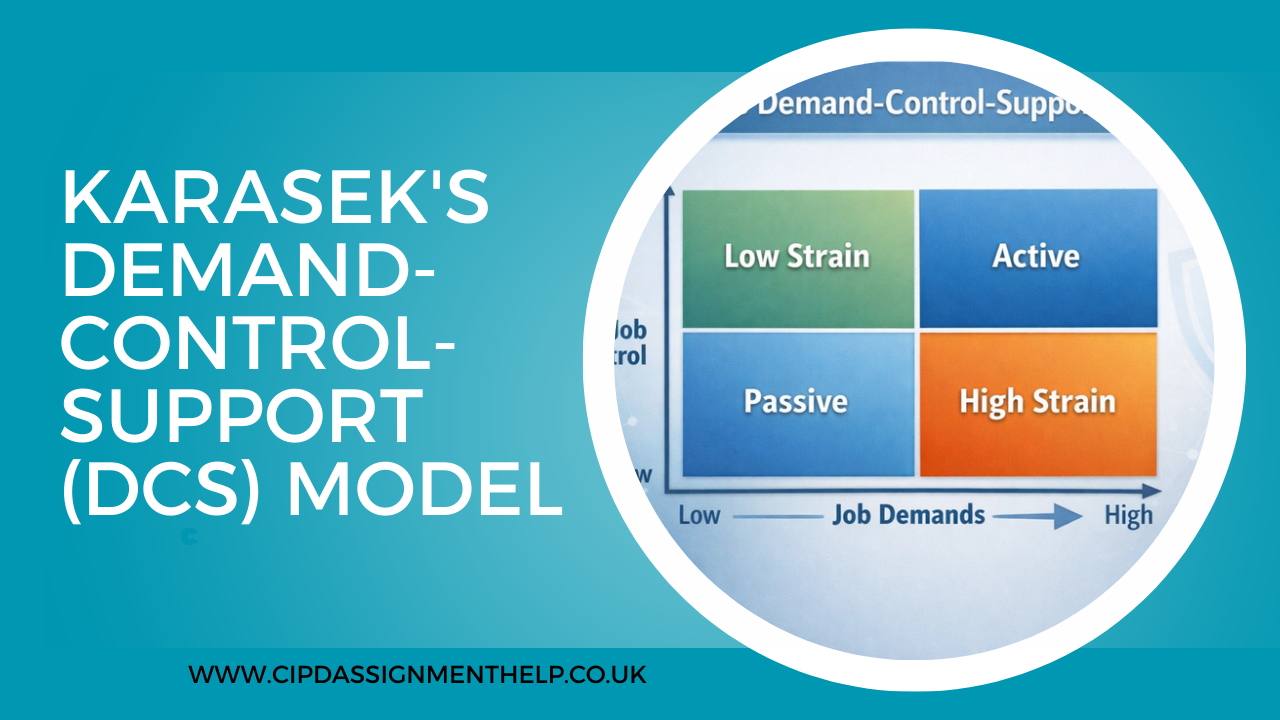
Karasek’s model is best visualized as a matrix where Demands and Control intersect to create four distinct work environments. Each quadrant predicts different psychological and physiological outcomes for the employee.
|
Quadrant
|
Demand Level
|
Control Level
|
Characteristics and Outcomes
|
|
High Strain
|
High
|
Low
|
The Danger Zone. Characterized by high pressure but little autonomy. This quadrant is strongly linked to burnout, cardiovascular disease, and chronic stress .
|
|
Active
|
High
|
High
|
The Growth Zone. High demands are met with high control, leading to “active learning,” motivation, and the development of new skills. Stress is perceived as a challenge rather than a threat.
|
|
Passive
|
Low
|
Low
|
The Stagnation Zone. Characterized by repetitive, unchallenging work with no autonomy. Leads to “learned helplessness,” boredom, and the gradual atrophy of professional skills.
|
|
Low Strain
|
Low
|
High
|
The Comfort Zone. Low pressure combined with high autonomy. While generally healthy, it may lack the stimulation required for significant professional development.
|
The “Iso-Strain” Hypothesis
The most critical extension of the model is the Iso-Strain Hypothesis. It posits that the highest risk to health occurs when a “High Strain” job (High Demand, Low Control) is combined with Low Social Support. This state of “isolated strain” is a potent predictor of severe health issues, particularly:
- Cardiovascular Health: Numerous longitudinal studies have linked iso-strain to an increased risk of coronary heart disease and hypertension .
- Mental Health: It is a primary driver of clinical depression, anxiety, and severe occupational burnout.
- Organizational Impact: High iso-strain environments typically suffer from high turnover rates, increased absenteeism, and “presenteeism” (where employees are physically present but unproductive).
Critical Perspectives and Limitations
While the DCS model is a cornerstone of occupational psychology, it is not without its critics. Modern researchers have pointed out several limitations:
“The model’s strength lies in its simplicity, but that simplicity can also be a weakness. It often overlooks individual differences such as personality traits, coping mechanisms, and resilience, which dictate how different people perceive the same set of demands.”
Furthermore, some studies suggest that the effects of demands, control, and support are additive rather than interactive. This means that increasing control might help reduce stress, but it doesn’t always “buffer” the specific impact of extreme demands as neatly as the model suggests.
Modern Relevance: Remote Work and Digital Demands
In the era of remote and hybrid work, the DCS model has found new relevance. While remote work often increases Decision Latitude (control over one’s schedule and environment), it can simultaneously increase Psychological Demands through “always-on” digital expectations and decrease Social Support due to physical isolation.
Organizations today are using the DCS framework to design “Active” jobs by:
- Empowering Employees: Increasing decision authority to match rising workloads.
- Fostering Digital Communities: Implementing structured social support systems to replace water-cooler interactions.
- Skill Enrichment: Providing continuous learning opportunities to enhance skill discretion.
A Framework for Action
Karasek’s Demand-Control-Support model is more than a theoretical exercise; it is a practical diagnostic tool for leaders and HR professionals. By understanding that stress is a structural issue—not just an individual failing—organizations can move away from superficial “wellness” initiatives and toward fundamental job redesign. To create a healthy, high-performing workforce, the goal is clear: move employees out of the “High Strain” and “Passive” quadrants and into the “Active” zone where challenge meets autonomy.