

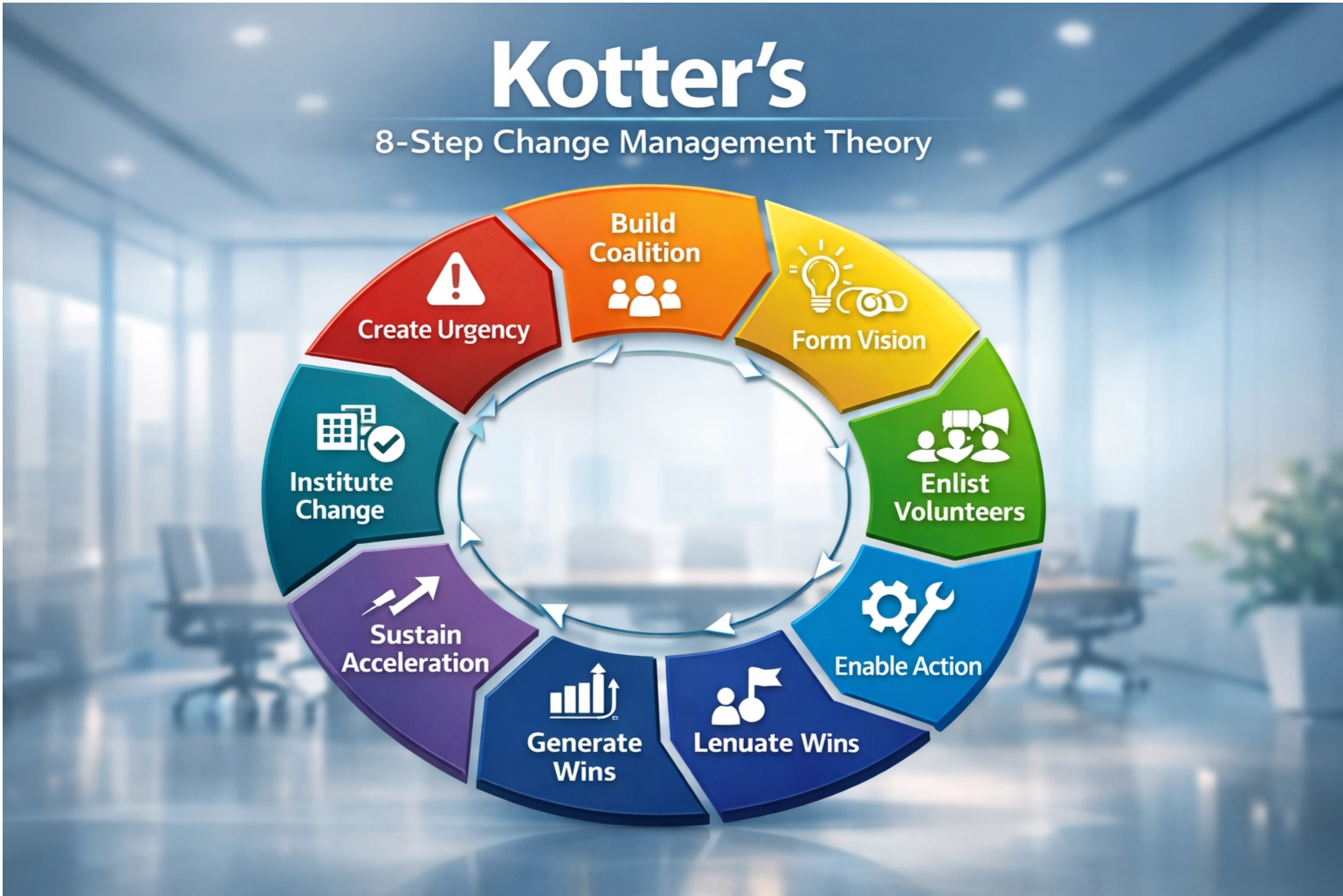
In the contemporary business landscape, characterized by rapid technological advancements and shifting market dynamics, the ability to manage change effectively is no longer a luxury but a fundamental necessity for organizational survival. Among the various frameworks developed to guide leaders through these transitions, John Kotter’s Eight-Step Process for Leading Change remains one of the most influential and widely adopted models. Introduced in his seminal 1996 book, Leading Change, Kotter’s theory provides a structured roadmap for navigating the complexities of organizational transformation. This article explores the evolution of Kotter’s model, provides a detailed breakdown of its eight steps, and evaluates its enduring relevance in the modern era.
The Genesis and Evolution of the Theory
John Kotter, a professor at Harvard Business School, developed his model after observing over 100 organizations attempting to implement large-scale changes. He identified that most of these efforts failed not because of poor strategy, but because of a lack of attention to the human and cultural dimensions of change. His initial model was presented as a linear, sequential process designed for traditional, hierarchical organizations.
However, as the pace of change accelerated, Kotter refined his theory. In his 2014 book, Accelerate, he transitioned from “steps” to “8 Accelerators,” emphasizing a more dynamic and continuous approach. While the core principles remained consistent, the updated framework acknowledged the need for organizations to operate with a “dual operating system”—one focused on daily operations and another dedicated to rapid, agile innovation.
A Step-by-Step Breakdown of the Framework
Kotter’s model is built on the premise that change is a process, not an event. Each of the eight steps serves a specific purpose in overcoming resistance and building momentum.
1. Create a Sense of Urgency
The foundation of any successful change effort is a compelling reason to act. Kotter argues that without a genuine sense of urgency, people will remain comfortable in the status quo. Leaders must identify potential threats and opportunities, using data and storytelling to convince the organization that the current state is unsustainable. This step is not about inducing panic, but about fostering a proactive mindset that embraces the need for something new.
2. Build a Guiding Coalition
No single leader can drive large-scale change alone. This step involves assembling a diverse team of influential individuals from various levels and departments. This “guiding coalition” must possess a combination of positional power, expertise, credibility, and leadership skills. Their primary role is to act as the engine of the change effort, working together to overcome silos and model the new behaviors expected of others.
3. Form a Strategic Vision and Initiatives
A clear, concise vision provides direction and motivation. It answers the “why” behind the change and describes a future state that is both desirable and achievable. Along with the vision, leaders must develop strategic initiatives—specific actions that will turn the vision into reality. A well-defined vision simplifies decision-making and helps align the efforts of thousands of employees toward a common goal.
4. Enlist a Volunteer Army (Communicate the Vision)
In the original model, this step focused on communicating the vision through every possible channel. In the evolved “Accelerators” model, Kotter emphasizes the importance of enlisting a “volunteer army.” This means moving beyond top-down communication to inspire a large number of employees to contribute their energy and ideas to the change effort. Success depends on making the vision relatable and ensuring that it is reinforced through both words and actions.
5. Enable Action by Removing Barriers
Change is often hindered by structural obstacles, such as outdated processes, restrictive job descriptions, or managers who resist the new direction. This step requires leaders to proactively identify and remove these barriers. By empowering employees to act on the vision, organizations foster a sense of ownership and creativity, making it easier for the new initiatives to take root.
6. Generate Short-Term Wins
Large-scale change can be exhausting and time-consuming. To maintain momentum and silence critics, it is essential to achieve and celebrate visible, early successes. These “short-term wins” provide evidence that the sacrifices are paying off and help build the confidence needed to tackle more significant challenges. They serve as milestones that validate the strategy and keep the organization engaged.
7. Sustain Acceleration (Consolidate Gains)
A common pitfall in change management is declaring victory too early. Kotter warns that premature celebrations can lead to a resurgence of old habits. Instead, organizations should use the momentum from short-term wins to drive further change. This involves continuously improving processes, developing new leaders who can champion the vision, and ensuring that the change effort remains a top priority until it is fully integrated.
8. Institute Change (Anchor the Change)
The final step is to embed the new practices into the organizational culture. Culture is the “social glue” that determines how things get done. For change to be permanent, it must be reflected in the organization’s values, norms, and systems. This includes aligning recruitment, promotion, and reward systems with the new way of working. Only when the change is “how we do things around here” can it be considered truly successful.
Evaluating the Model: Benefits and Criticisms
Kotter’s theory has endured for decades because of its practical, easy-to-understand structure. Its primary strengths include:
|
Benefit
|
Description
|
|
Structured Roadmap
|
Provides a clear sequence of actions, reducing the ambiguity often associated with change.
|
|
Focus on Leadership
|
Emphasizes that change is a leadership task, not just a management or administrative one.
|
|
Cultural Emphasis
|
Recognizes that lasting change requires a shift in the underlying organizational culture.
|
Despite its popularity, the model has faced criticisms, particularly in the context of the modern, agile workplace.
“The primary criticism of Kotter’s original model is its top-down, linear nature, which may not account for the organic, bottom-up change seen in today’s flatter organizations.”
Other limitations include:
- Sequential Rigidity: Critics argue that following the steps in a strict sequence can be slow and may not suit organizations that need to pivot rapidly.
- Lack of Individual Focus: While the model addresses organizational dynamics, it provides less guidance on the psychological and emotional journey of individual employees.
- Potential for Change Fatigue: The heavy emphasis on urgency can lead to burnout if not managed carefully over long periods.
Kotter’s Theory in the 21st Century
While the business world has changed significantly since 1996, the core tenets of Kotter’s change management theory remain relevant. The shift from “Steps” to “Accelerators” reflects a necessary adaptation to a more volatile and uncertain environment. Today’s leaders must balance the structured approach of the 8-step process with the agility required to respond to constant disruption.
Ultimately, Kotter’s greatest contribution is the reminder that successful change is about people. By fostering urgency, building strong coalitions, and anchoring new behaviors in culture, organizations can navigate the complexities of transformation and emerge stronger, more resilient, and better equipped for the future. Whether implemented as a linear process or a continuous cycle of acceleration, Kotter’s framework continues to serve as a vital guide for any leader seeking to lead their organization toward a better tomorrow.