

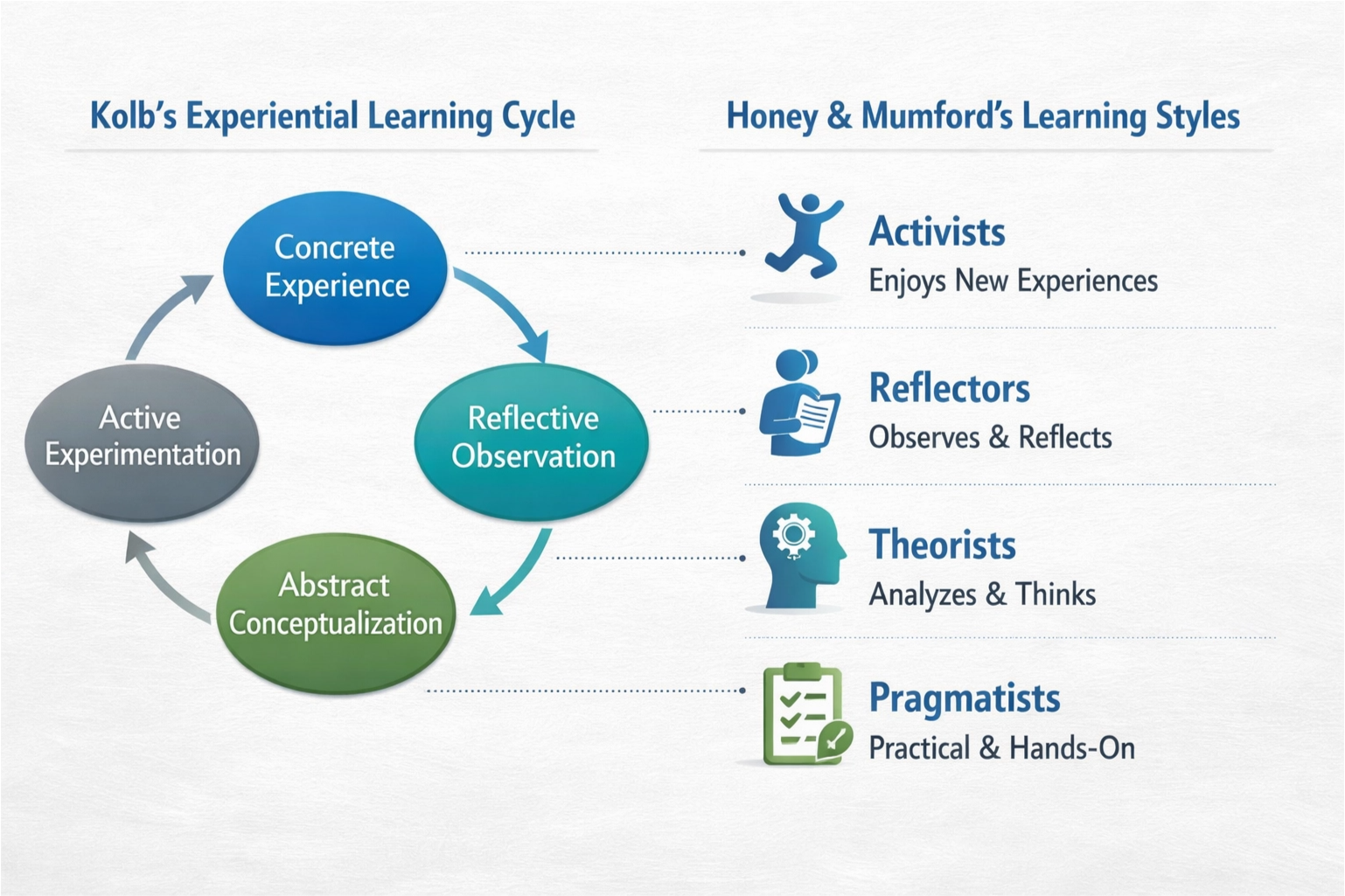
This article outlines the key differences between David Kolb’s Experiential Learning Cycle and Peter Honey and Alan Mumford’s Learning Styles. While closely related, these models serve distinct purposes in understanding and applying learning theory.
1. Origins and Relationship
David Kolb’s Experiential Learning Cycle (ELC), first published in 1984, is a foundational theory that describes learning as a continuous process of experiencing, reflecting, conceptualizing, and experimenting . It posits that individuals learn through a four-stage cycle that can be entered at any point.
Peter Honey and Alan Mumford developed their Learning Styles Questionnaire (LSQ) in 1986, directly building upon Kolb’s ELC . They observed that individuals tend to have a preferred way of engaging with Kolb’s cycle, leading them to categorize these preferences into four distinct learning styles. Essentially, Honey and Mumford operationalized Kolb’s theoretical cycle into practical, identifiable styles.
2. Core Components and Focus
Kolb’s Experiential Learning Cycle
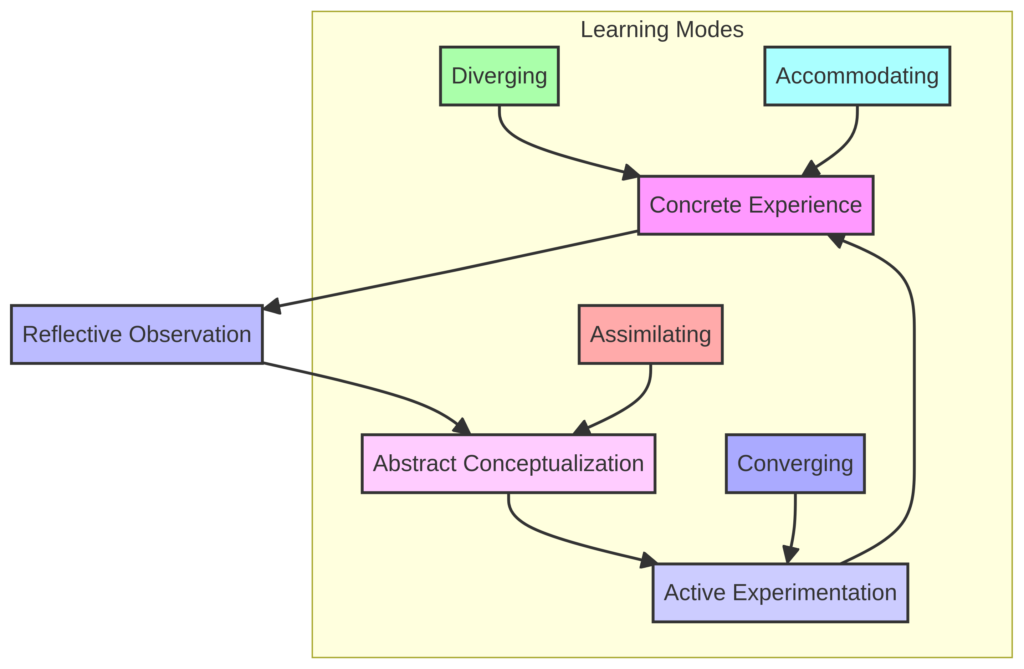
Kolb’s model focuses on the process of learning, emphasizing a cycle of transformation of experience into knowledge. The four stages are:
- Concrete Experience (CE): Engaging in a new experience or situation.
- Reflective Observation (RO): Reviewing and reflecting on the experience from various perspectives.
- Abstract Conceptualization (AC): Forming abstract concepts and generalizations from observations.
- Active Experimentation (AE): Testing the implications of concepts in new situations.
Kolb’s model also identifies four learning modes or styles that arise from the combination of two dimensions: Active/Reflective and Abstract/Concrete. These are Diverging, Assimilating, Converging, and Accommodating .
Honey & Mumford’s Learning Styles
Honey and Mumford’s model focuses on individual preferences for learning, translating Kolb’s stages into observable behaviors and attitudes. Their four styles directly correspond to Kolb’s stages:
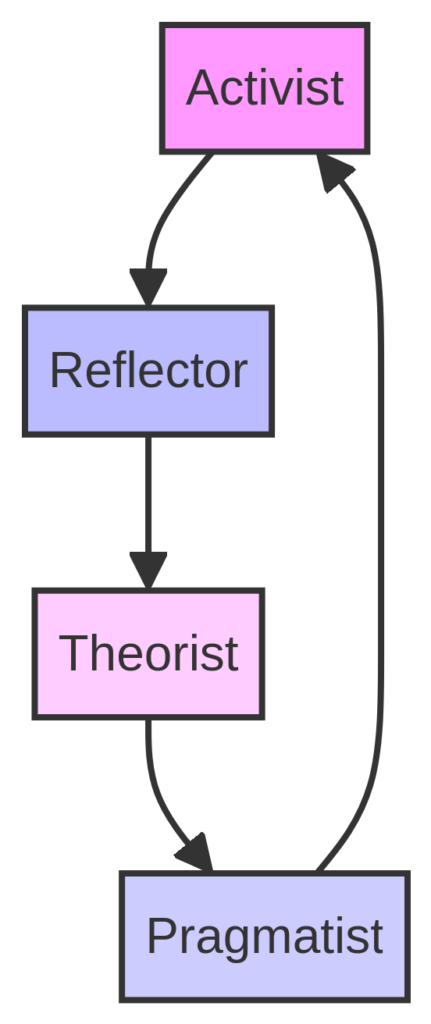
- Activists (corresponding to Concrete Experience): Enjoy new experiences, are open-minded, and thrive on immediate involvement.
- Reflectors (corresponding to Reflective Observation): Prefer to observe, collect data, and ponder before drawing conclusions. They are thoughtful and cautious.
- Theorists (corresponding to Abstract Conceptualization): Value logic, rationality, and systematic thinking. They seek to understand underlying principles and frameworks.
- Pragmatists (corresponding to Active Experimentation): Are keen to try out new ideas and theories to see if they work in practice. They are practical and results-oriented.
3. Application and Purpose
|
Feature |
Kolb’s Experiential Learning Cycle |
Honey & Mumford’s Learning Styles |
|
Primary Focus |
The process of learning; how knowledge is created through experience. |
Individual preferences within the learning process; identifying typical learning behaviors. |
|
Nature |
A theoretical model describing a cyclical learning process. |
A practical tool (questionnaire) for self-assessment and identifying preferred styles. |
|
Output |
A framework for understanding learning dynamics and designing holistic learning experiences. |
Categorization of individuals into distinct styles to tailor learning interventions or team composition. |
|
Emphasis |
The dynamic, continuous nature of learning. |
The stable, characteristic ways individuals approach learning. |
|
Use Case |
Designing curricula, understanding group learning dynamics, promoting reflective practice. |
Personal development, team building, customizing training delivery, career guidance. |
4. Key Differences Summarized
While Honey and Mumford’s styles are derived from Kolb’s cycle, the fundamental difference lies in their emphasis. Kolb provides a theoretical framework for how learning occurs, highlighting the cyclical nature of experience and reflection. Honey and Mumford, on the other hand, offer a practical typology for who learns in what way, providing a more accessible language for individuals to understand their own learning preferences and for trainers to adapt their delivery.
Kolb’s model is often used to design comprehensive learning programs that encourage learners to move through all stages of the cycle. Honey and Mumford’s styles are frequently used for self-awareness and to ensure that learning activities cater to a diverse range of preferences within a group, even if the concept of
“learning styles” has faced criticism regarding its impact on learning outcomes .
References
[1] Kolb, D. A. (1984). Experiential Learning: Experience as the Source of Learning and Development. Prentice-Hall.

[2] Honey, P., & Mumford, A. (1986). The Manual of Learning Styles. Peter Honey Publications.

[3] Pashler, H., McDaniel, M., Rohrer, D., & Bjork, R. (2008). Learning Styles: Concepts and Evidence. Psychological Science in the Public Interest, 9(3), 105-119. Available at: