

Table of Contents
Operational efficiency is the cornerstone of sustainable business growth in an increasingly competitive and volatile global marketplace. It represents the ability of an organization to deliver high-quality products or services using the minimum necessary resources, including time, capital, and labor. In the context of modern management, operational efficiency is not a static destination or a one-time achievement; rather, it is a dynamic state that requires constant nurturing and strategic oversight. This is where the concept of Continuous Improvement (CI) becomes indispensable. By fostering a culture of perpetual refinement, organizations can systematically identify bottlenecks, eliminate non-value-added activities, and optimize their value streams to meet evolving customer demands.
Historical Evolution of Efficiency Paradigms
To appreciate the current state of continuous improvement, one must understand its historical trajectory. The quest for efficiency began in earnest during the Industrial Revolution, moving from the “Scientific Management” principles of Frederick Taylor—which focused on labor productivity and time-motion studies—to the more holistic approaches of the mid-20th century. The most significant shift occurred with the development of the Toyota Production System (TPS) in post-war Japan. Taiichi Ohno and Shigeo Shingo pioneered a system that moved away from mass production toward “Just-in-Time” manufacturing, laying the groundwork for what we now call Lean. This evolution marked a transition from viewing workers as mere extensions of machines to recognizing them as the primary source of intellectual capital and process innovation.
Defining the Relationship
Continuous improvement is both a philosophy and a rigorous set of methodologies focused on the ongoing enhancement of products, services, or processes. When applied effectively, it acts as the primary engine for driving operational efficiency. While operational efficiency measures the “output-to-input” ratio, continuous improvement provides the “how” for improving that ratio over time.
“Operational excellence is the execution of the business strategy more consistently and reliably than the competition. Continuous improvement is the primary vehicle to reach that state.”
Concept |
Focus |
Primary Objective |
Operational Efficiency |
Resource Utilization |
Maximizing output with minimal input. |
Continuous Improvement |
Process Evolution |
Identifying and implementing incremental enhancements. |
Operational Excellence |
Cultural Integration |
Creating a self-sustaining environment of high performance. |
Theoretical Frameworks of Continuous Improvement
To understand how CI drives efficiency, one must examine the foundational frameworks that guide its implementation. These methodologies provide structured, repeatable approaches to problem-solving and process optimization.
1. Kaizen: The Philosophy of Incremental Change
Originating from Japan, Kaizen translates to “change for the better.” Unlike radical transformations or “Kaizen Blitzes,” the core philosophy emphasizes small, daily improvements involving every employee. By focusing on minor adjustments—such as rearranging a workstation to reduce reaching time—organizations can achieve significant cumulative gains. The beauty of Kaizen lies in its low-risk nature; small changes are easy to test, easy to reverse if they fail, and collectively powerful when they succeed.
2. Lean Management: The War on Waste
Lean management is centered on the maximization of customer value while minimizing waste. It identifies eight types of waste, often referred to by the acronym DOWNTIME:
- Defects: Efforts spent on fixing errors, which consumes time and materials.
- Overproduction: Making more than is required, leading to excess inventory and storage costs.
- Waiting: Idle time between process steps, which disrupts flow and extends lead times.
- Non-utilized Talent: Failing to leverage the creative and problem-solving skills of employees.
- Transportation: Unnecessary movement of products or information, increasing the risk of damage or loss.
- Inventory: Excess stock sitting idle, which ties up capital and hides underlying process problems.
- Motion: Unnecessary physical movement by people, leading to fatigue and inefficiency.
- Extra-processing: Performing more work or using higher-quality materials than the customer requires or values.
3. Six Sigma: Precision and Consistency
While Lean focuses on speed and waste, Six Sigma focuses on quality and consistency. It uses statistical methods to identify and remove the causes of defects and minimize variability. By achieving a “Six Sigma” level of quality, an organization produces no more than 3.4 defects per million opportunities. This precision is vital in industries where errors can be catastrophic, such as aerospace, healthcare, and finance. The reduction in variability directly drives efficiency by making processes more predictable and reducing the “buffer” resources typically needed to handle unexpected errors.
4. The PDCA Cycle: A Scientific Approach
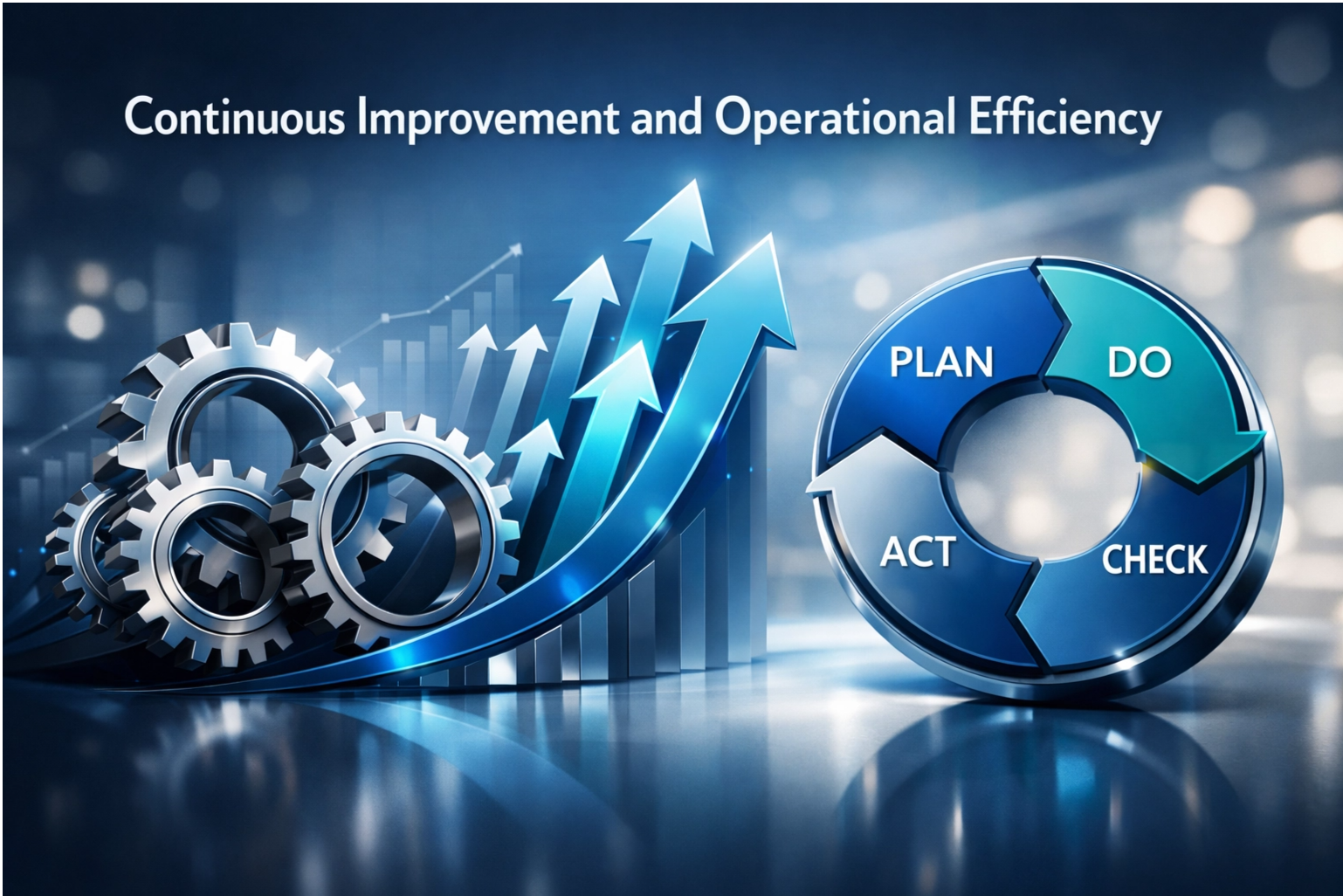
The Plan-Do-Check-Act (PDCA) cycle, also known as the Deming Cycle, provides a repetitive four-stage model for continuous improvement.
- Plan: Identify an opportunity, analyze the root cause of the problem, and plan a change.
- Do: Implement the change on a small scale (a pilot study) to minimize disruption.
- Check: Use data to analyze the results of the change against the original objectives.
- Act: If the change was successful, standardize the new process; if not, learn from the failure and start the cycle again.
The Mechanisms: How CI Drives Operational Efficiency
The transition from a standard operation to an efficient one is facilitated by several key mechanisms inherent in continuous improvement strategies.
Waste Elimination and Cost Reduction
The most direct impact of CI on operational efficiency is the reduction of costs through waste elimination. When a company adopts Lean principles, it scrutinizes every step of its workflow. For instance, in a manufacturing context, reducing inventory levels frees up capital that was previously tied up in unsold goods and reduces the need for expensive warehouse space. In a service environment, reducing waiting times for customer inquiries improves throughput and customer satisfaction simultaneously.
Process Standardization and Knowledge Management
Efficiency is often hampered by “tribal knowledge”—a situation where different employees perform the same task in different ways based on personal preference. CI encourages the creation of Standard Operating Procedures (SOPs). Standardization ensures that the most efficient method currently known is documented and followed by everyone. This reduces the learning curve for new employees, minimizes errors caused by inconsistency, and provides a stable baseline from which further improvements can be measured. Without a standard, there can be no meaningful improvement.
Quality as a Driver of Efficiency
A common misconception is that increasing speed or reducing costs must inevitably compromise quality. In reality, CI posits that quality is a driver of efficiency. “Doing it right the first time” eliminates the need for rework, inspections, and scrap. By utilizing Six Sigma tools to reduce process variation, organizations can ensure that their outputs consistently meet specifications. This “First-Time-Right” approach protects brand reputation and reduces the “hidden factory” costs—the resources spent on correcting mistakes that should never have happened.
Optimizing Resource Allocation and Value Stream Mapping
Continuous improvement involves a shift from “working harder” to “working smarter.” Through techniques like Value Stream Mapping (VSM), organizations can visualize the entire flow of materials and information from the supplier to the customer. This visualization helps management identify where resources are being underutilized or where bottlenecks are occurring. By redistributing labor or investing in targeted automation, companies can increase their throughput without necessarily increasing their headcount, thereby improving the productivity of their human capital.
Continuous Improvement in the Digital Age: CI 4.0
The advent of the Fourth Industrial Revolution (Industry 4.0) has provided new tools that amplify the power of continuous improvement. Digital Transformation is not a replacement for CI but an accelerator.
- Big Data and Analytics: Traditional Six Sigma relied on manual data collection. Today, IoT sensors can provide real-time data on machine performance, allowing for “Predictive Maintenance.” This prevents unplanned downtime, a major source of operational inefficiency.
- Artificial Intelligence (AI): AI algorithms can analyze complex supply chain variables to optimize inventory levels more accurately than any human planner, further reducing waste.
- Digital Twins: Organizations can create virtual replicas of their processes to test CI ideas in a risk-free environment before implementing them in the real world.
- Robotic Process Automation (RPA): By automating repetitive, rule-based tasks in the office, CI teams can eliminate human error and free up employees to focus on higher-value improvement initiatives.
Cultural Transformation and Employee Engagement
Perhaps the most critical—and often overlooked—aspect of continuous improvement is the human element. For CI to drive long-term operational efficiency, it must be embedded in the organizational culture.
The Power of “Gemba” and Leadership
In CI terminology, the Gemba is the “actual place” where value is created—the factory floor, the sales office, or the software development lab. Management must “go to Gemba” to understand the reality of operations rather than relying solely on sanitized reports. This practice fosters trust and ensures that improvement initiatives are grounded in practical reality. Leaders must transition from “command and control” to “coach and facilitate,” providing the resources and support needed for teams to improve their own work.
Empowering the Frontline
Operational inefficiencies are often most visible to those who perform the tasks daily. A successful CI culture empowers frontline workers to identify problems and suggest solutions. When employees feel that their insights are valued, their engagement increases. High employee engagement is strongly correlated with lower turnover, higher productivity, and a more proactive approach to problem-solving. This democratization of improvement means that an organization has thousands of problem-solvers instead of just a few “experts.”
Measuring Success: Key Performance Indicators (KPIs)
To ensure that continuous improvement efforts are actually driving operational efficiency, organizations must track specific metrics. Data provides the objective evidence needed to validate changes and justify further investment.
Metric Category |
Key Performance Indicator (KPI) |
Impact on Efficiency |
Time |
Cycle Time |
Shorter cycles mean faster delivery and higher throughput. |
Quality |
First-Pass Yield (FPY) |
Higher FPY reduces the cost of rework, scrap, and warranty claims. |
Cost |
Total Cost of Quality (CoQ) |
Measuring both the cost of prevention and the cost of failure. |
Productivity |
Overall Equipment Effectiveness (OEE) |
Measures how well a manufacturing operation is utilized. |
Agility |
Changeover Time |
Reducing the time to switch between tasks increases flexibility. |
Overcoming Challenges in Implementation
Despite its clear benefits, implementing a continuous improvement program is not without hurdles. Organizations often face systemic resistance that can stall efficiency gains.
- Resistance to Change: Humans are naturally inclined toward the status quo. Overcoming this requires clear communication from leadership regarding the “why” behind the changes and the personal benefits to employees.
- Lack of Leadership Commitment: CI is not a “set it and forget it” project. It requires ongoing support, funding, and participation from the highest levels of management. If leadership loses interest, the culture will revert to its previous state.
- Short-Term Thinking: Operational efficiency gains from CI are often cumulative and long-term. Organizations focused solely on quarterly results may abandon CI initiatives prematurely in favor of “quick fixes” that don’t address root causes.
- Data Silos and Poor Visibility: Without integrated data systems, it is difficult to measure the impact of improvements across the entire value chain. Efficiency in one department should not come at the expense of another (sub-optimization).
The Competitive Imperative
In the modern business era, operational efficiency is no longer an optional advantage; it is a prerequisite for survival. The integration of continuous improvement methodologies—such as Lean, Six Sigma, and Kaizen—provides the roadmap for achieving this efficiency. By systematically attacking waste, standardizing processes, leveraging digital tools, and empowering employees, organizations can create a virtuous cycle of performance.
Ultimately, the drive for operational efficiency through continuous improvement is about more than just the bottom line. It is about building an organization that is resilient, adaptable, and relentlessly focused on delivering value. As markets continue to shift and technology continues to evolve, the organizations that thrive will be those that view “good enough” as the starting point for the next improvement. Continuous improvement is not a project with an end date; it is a permanent commitment to excellence that defines the leaders of tomorrow.