

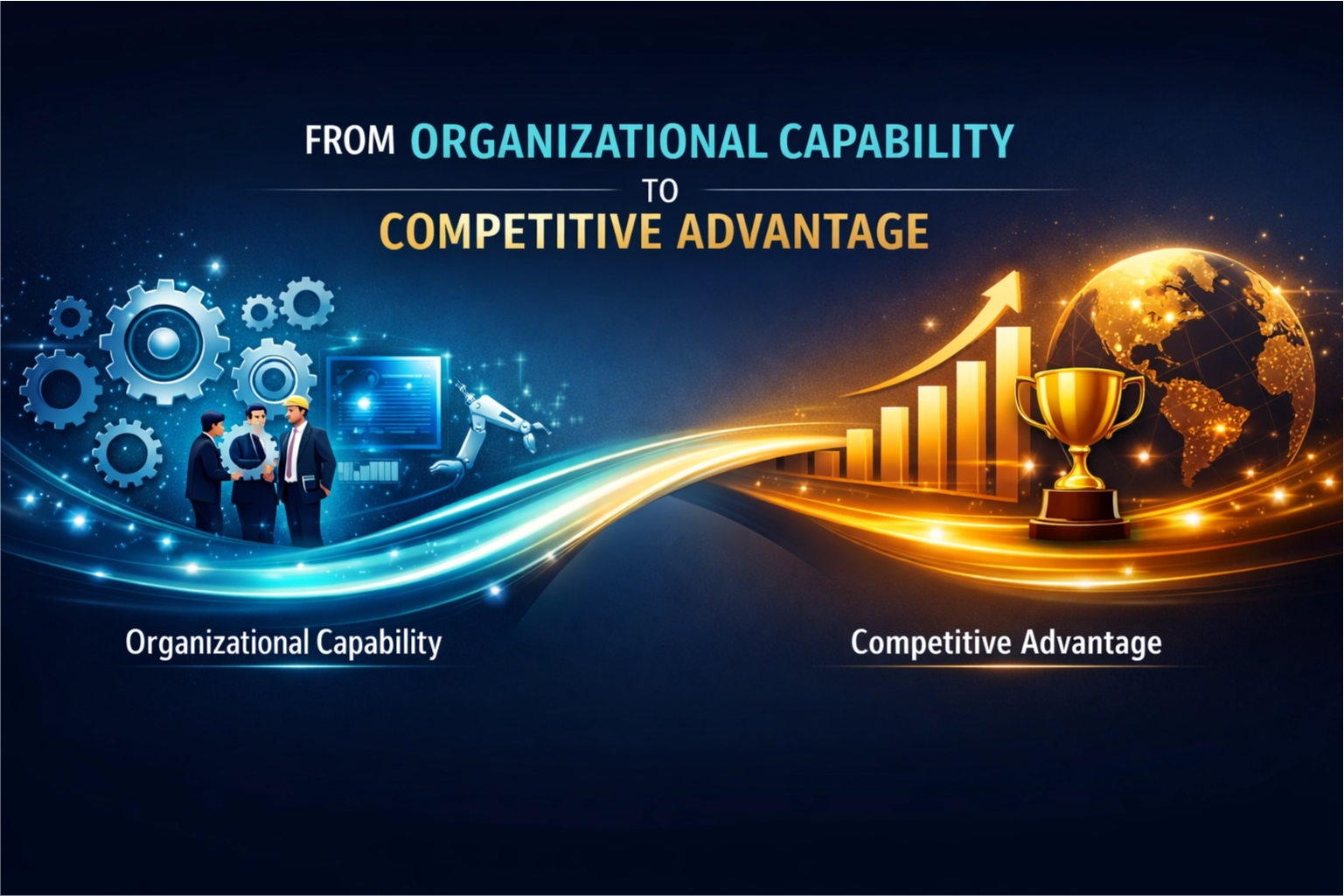
In the hyper-competitive landscape of the twenty-first century, the traditional pillars of business success—exclusive access to raw materials, proprietary technology, or even massive capital reserves—are no longer the insurmountable barriers to entry they once were. Digital transformation, globalized supply chains, and the democratization of information have leveled the playing field, allowing agile startups to disrupt century-old incumbents with startling speed. In this environment, strategic leaders are forced to ask a fundamental question: what truly separates a market leader from a transient success? The answer lies not in what a company has, but in what it can do. This is the essence of organizational capability, and it is the primary driver of sustainable competitive advantage.
The relationship between these two concepts is both profound and complex. While competitive advantage is the desired outcome—a position of superiority that allows a firm to generate higher value than its rivals—organizational capability is the internal engine that produces that outcome. It is the “DNA” of the organization, a unique combination of processes, people, and culture that competitors find nearly impossible to replicate. To understand this link, one must look beyond the surface-level metrics of profitability and market share and delve into the structural and behavioral frameworks that define how a firm operates.
Defining the Strategic Foundations
Before exploring the link between these concepts, it is essential to establish clear definitions. Competitive advantage is often misunderstood as a simple lead in sales or a better product. However, in strategic management, it refers to the ability of a firm to create more economic value than its competitors. This value can be realized through two primary routes: cost leadership, where a firm produces products at a lower cost than rivals, or differentiation, where a firm offers unique features that customers are willing to pay a premium for. Regardless of the path chosen, the advantage is only “sustainable” if it persists over time despite the efforts of competitors to duplicate or neutralize it.
Organizational capability, on the other hand, represents the collective skills, expertise, and alignment of an organization’s people and systems. It is the firm’s capacity to deploy resources—tangible and intangible—using organizational processes to effect a desired end. While a resource might be a piece of sophisticated machinery or a patent, the capability is the organization’s ability to operate that machinery with unmatched efficiency or to turn that patent into a commercially viable product. The distinction is critical: resources are assets that can often be bought or sold on the open market, whereas capabilities are deeply embedded in the organization’s routines and are therefore much harder to trade or imitate.
Concept |
Primary Focus |
Nature |
Strategic Role |
Competitive Advantage |
Market Position
|
External / Outcome-oriented
|
Defines “Where” and “How” to compete successfully.
|
Organizational Capability |
Internal Processes
|
Internal / Process-oriented
|
Defines the “How” of execution and value creation.
|
The synergy between these two elements forms the core of modern strategic thinking. A firm might possess world-class resources, but without the organizational capabilities to manage them, those resources remain dormant. Conversely, a firm with strong capabilities can often outperform rivals who have superior resources but lack the organizational “glue” to hold them together. This realization has shifted the focus of strategy from the external environment (the “Five Forces” model) to the internal workings of the firm, giving rise to the Resource-Based View.
The Resource-Based View and the VRIO Framework
The Resource-Based View (RBV) of the firm, pioneered by scholars like Jay Barney, revolutionized strategy by arguing that the source of competitive advantage lies within the firm’s internal resources and capabilities. According to this perspective, firms are bundles of heterogeneous resources and capabilities that are not perfectly mobile across companies. This heterogeneity is what allows some firms to consistently outperform others. To determine whether a specific capability can truly serve as a source of sustainable competitive advantage, Barney proposed the VRIO framework—an acronym for Value, Rarity, Inimitability, and Organization.
For a capability to be strategically significant, it must first be Valuable. It must allow the firm to exploit external opportunities or neutralize environmental threats. However, value alone only leads to competitive parity. If every firm in an industry possesses the same valuable capability, no one has an edge. Therefore, the capability must also be Rare. When a valuable capability is controlled by only a small number of competing firms, it creates the potential for a temporary competitive advantage.
The true test of sustainability, however, lies in Inimitability. If a competitor can easily observe, understand, and replicate a capability, the advantage will be short-lived. Capabilities are often difficult to imitate because they are “socially complex” (involving intricate human relationships) or “causally ambiguous” (where the link between the capability and the resulting advantage is not entirely clear, even to the firm itself). Finally, the firm must be Organized to capture value. This involves having the right reporting structures, management controls, and compensation policies in place to fully exploit the potential of its resources and capabilities.
“A firm is said to have a competitive advantage when it is implementing a value creating strategy not simultaneously being implemented by any current or potential competitors.” — Jay Barney
While the RBV provides a robust framework for understanding advantage in stable environments, it has been criticized for being too static. In industries characterized by rapid technological change or shifting consumer preferences, a capability that was valuable yesterday may become a liability tomorrow. This limitation led to the development of the Dynamic Capabilities framework.
The Evolution: Dynamic Capabilities
Proposed by David Teece and his colleagues, the concept of Dynamic Capabilities addresses the firm’s ability to integrate, build, and reconfigure internal and external competencies to address rapidly changing environments. If ordinary capabilities are about “doing things right” (operational efficiency), dynamic capabilities are about “doing the right things” at the right time. They are the meta-capabilities that allow a firm to stay relevant when its traditional sources of advantage are eroded.
Teece identified three primary pillars of dynamic capabilities: Sensing, Seizing, and Transforming.
- Sensing: This involves scanning, searching, and exploring across technologies and markets to identify opportunities and threats. It requires a high degree of organizational “peripheral vision” and an openness to new information.
- Seizing: Once an opportunity is sensed, the firm must be able to mobilize resources to address it. This often involves making significant investments in new products, processes, or services, even if they threaten the firm’s existing business model.
- Transforming: The final pillar is the ability to reconfigure the firm’s asset base and organizational structure. This is often the most difficult step, as it requires overcoming “path dependency”—the tendency of organizations to keep doing what they have always done because it worked in the past.
The link between dynamic capabilities and competitive advantage is evolutionary. In a volatile market, the advantage is not a fixed destination but a moving target. Companies like Apple and Amazon have demonstrated an uncanny ability to sense shifts in consumer behavior and seize them by transforming their business models—moving from computers to mobile devices, or from online bookselling to cloud computing. Their advantage is not found in a single product, but in their dynamic capability to reinvent themselves.
Practical Dimensions: Where Capabilities Manifest
To move from theory to practice, leaders must identify the specific organizational capabilities that drive their unique competitive advantage. While these vary by industry, they generally fall into three broad categories: operational, innovation, and cultural capabilities. Each of these plays a distinct role in the value creation process and serves as a different link to the firm’s market position.
Operational capabilities are the foundation of cost leadership. They include supply chain management, lean manufacturing, and efficient customer service. For a company like Walmart, the link between capability and advantage is direct: its sophisticated logistics and inventory management systems allow it to maintain lower prices than any competitor, creating a sustainable cost advantage. These capabilities are built through years of incremental improvement and the codification of best practices into organizational routines.
Innovation capabilities are the drivers of differentiation. This is not just about R&D spending, but about the organization’s ability to foster creativity, manage the development pipeline, and bring new ideas to market quickly. A firm with strong innovation capabilities can command premium prices and capture “first-mover” advantages. The link here is one of speed and relevance; by the time competitors have copied the latest feature, the innovative firm has already moved on to the next generation of products.
Cultural capabilities are perhaps the most potent and least understood. Culture is the collective mindset of the organization—its values, beliefs, and “the way things are done around here.” A culture of accountability, agility, or customer-centricity acts as a force multiplier for all other capabilities. It is the ultimate source of inimitability because culture cannot be bought; it must be grown over time. When a company’s culture is perfectly aligned with its strategy, it creates an environment where employees are empowered to make decisions that reinforce the firm’s competitive position without constant oversight.
Capability Type |
Strategic Focus |
Primary Outcome |
Example Metric |
Operational |
Efficiency
|
Cost Advantage
|
Inventory Turnover / Operating Margin
|
Innovation |
Creativity
|
Differentiation
|
Time-to-Market / % Revenue from New Products
|
Cultural |
Alignment
|
Sustainability
|
Employee Engagement / Retention Rates
|
Strategic Implementation: Auditing and Building Capabilities
The link between capability and advantage is not automatic; it requires deliberate strategic management. Leaders must begin with a “capability audit” to identify which areas of the organization are truly world-class and which are merely meeting industry standards. This involves looking honestly at the firm’s performance relative to its strategy. If the goal is to be the low-cost provider, but operational costs are rising, there is a clear capability gap that must be addressed.
Building these capabilities requires a long-term commitment to human capital. Since capabilities reside in the collective knowledge of people, investing in training, leadership development, and knowledge-sharing platforms is essential. Furthermore, leaders must ensure that the organization’s structure supports its capabilities. A rigid, hierarchical structure may be efficient for operational tasks but can stifle the agility needed for dynamic capabilities.
Finally, the link must be continuously monitored. Competitive advantage is fragile, and the capabilities that created it can easily erode through complacency or neglect. Successful organizations treat capability building as a continuous process of learning and adaptation, rather than a one-time project. They understand that in a world of constant change, the only truly sustainable advantage is the ability to learn and adapt faster than the competition.
The Strategic Imperative
The link between organizational capability and competitive advantage is the defining characteristic of modern business strategy. While resources provide the raw materials for success, it is the organization’s capabilities that transform those materials into superior value. By focusing on the VRIO framework and cultivating dynamic capabilities—sensing, seizing, and transforming—leaders can build a firm that is not only successful today but resilient enough to thrive in the uncertainties of tomorrow.
In the final analysis, competitive advantage is an external reflection of internal excellence. A company that masters its internal processes, aligns its people with its purpose, and remains agile in the face of change will always find a way to outperform its rivals. The challenge for leaders is to stop looking for the “silver bullet” in the external market and start building the invisible engine of organizational capability that powers long-term success. The path to the top is built from the inside out.