

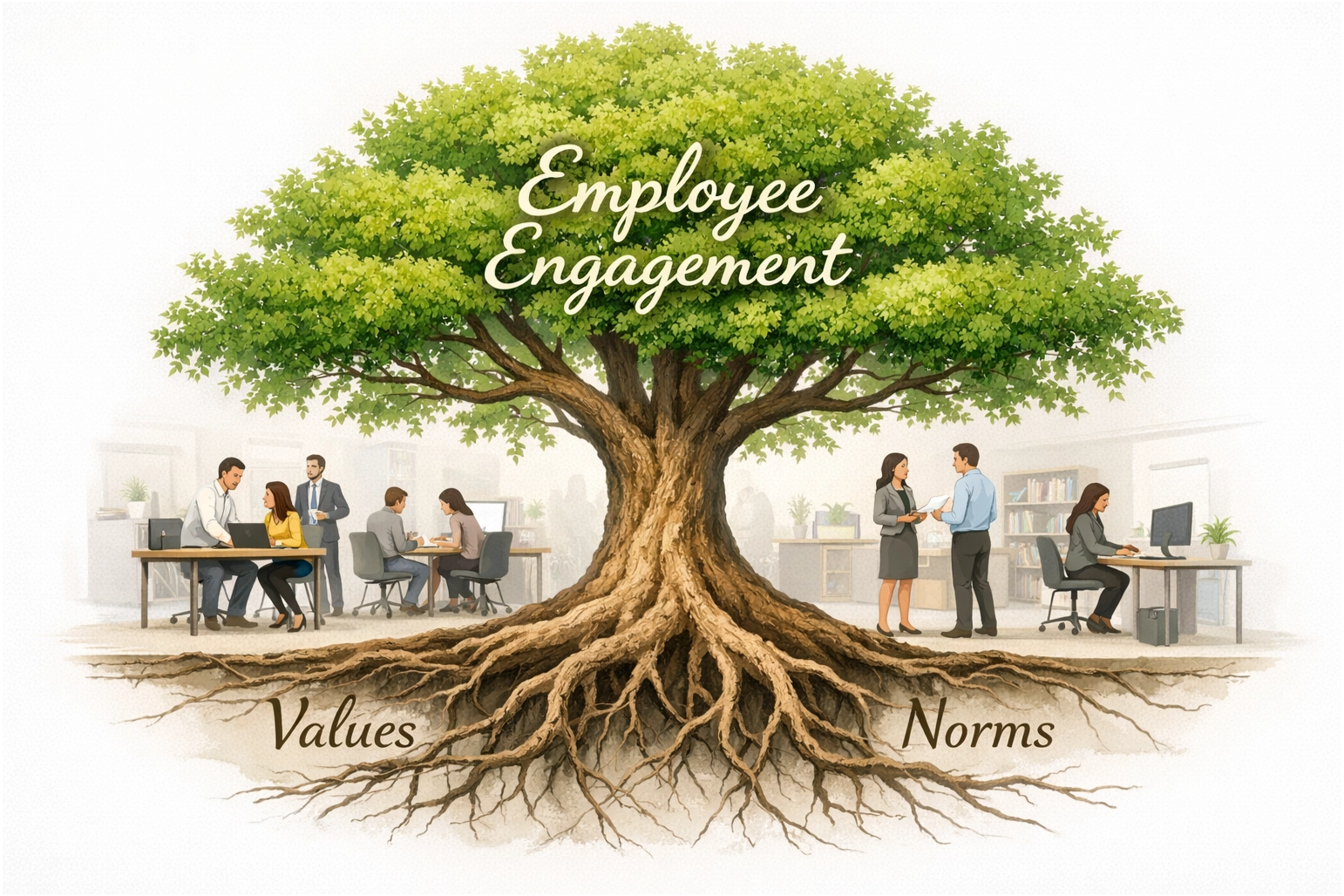
In the rapidly evolving landscape of the modern workplace, organizations are increasingly finding that traditional incentives—competitive salaries and comprehensive benefit packages—are no longer sufficient to secure the long-term commitment of their workforce. According to a landmark report by Gallup in early 2025, U.S. employee engagement has plummeted to a ten-year low, with only 31% of employees reporting that they feel actively engaged in their work . This decline signals a profound disconnect between the organizational machinery and the human element that powers it. At the heart of this disconnect lies a failure to cultivate a cohesive culture built upon shared values and robust organizational norms. These elements act as the “invisible glue,” aligning individual aspirations with corporate objectives and transforming a collection of disparate workers into a unified, high-performing team.
To understand the profound impact of these cultural pillars, one must first distinguish between shared values and organizational norms. While often used interchangeably, they represent distinct, though complementary, layers of organizational culture. Shared values are the fundamental beliefs and guiding principles that define an organization’s identity and long-term vision, answering the question of “why” the organization exists and what it stands for beyond mere profit. In contrast, organizational norms are the unwritten rules and behavioral standards that dictate the “how” of daily operations, influencing everything from meeting conduct to feedback delivery.
Feature |
Shared Values |
Organizational Norms |
Primary Question |
Why do we do what we do?
|
How do we behave daily?
|
Nature |
Abstract, philosophical, and aspirational.
|
Concrete, behavioral, and observable.
|
Function |
Provides a moral and strategic compass.
|
Establishes social expectations and standards.
|
Visibility |
Often stated in mission statements.
|
Often unspoken and learned through observation.
|
The intersection of these two elements creates the psychological environment in which employees operate. When an organization’s stated values are reflected in its daily norms, it fosters integrity and predictability. Conversely, a “values gap”—where high-minded principles are contradicted by tolerated toxic behaviors—is a significant contributor to employee disengagement and cynicism. Bridging this gap allows leaders to cultivate an environment where engagement is a natural byproduct of a healthy organizational ecosystem.
The Theoretical Framework: The Science of Engagement
The relationship between cultural alignment and employee engagement is deeply rooted in several key psychological and sociological theories. Social Exchange Theory (SET) posits that engagement is a reciprocal relationship: when employees perceive a supportive, value-driven environment, they feel a psychological obligation to respond with higher levels of effort, loyalty, and commitment . This “reciprocity norm” suggests that engagement is a dynamic response to the organizational climate, not merely an employee’s personality trait.
Furthermore, Person-Organization Fit (P-O Fit) highlights the importance of value alignment. Research consistently shows that when an individual’s personal values align with those of their employer, they experience higher job satisfaction, reduced stress, and a greater sense of belonging . This alignment fulfills the fundamental human needs for autonomy, competence, and relatedness, as described in Self-Determination Theory . When shared values and norms support these needs, employees are more likely to be intrinsically motivated, finding meaning in their work that transcends transactional aspects.
The Power of Shared Values: Aligning Purpose and Action
Shared values serve as the strategic and moral compass of an organization, empowering employees at all levels. When values such as “innovation,” “customer-centricity,” or “integrity” are deeply embedded, they provide clarity in ambiguous situations. An employee who understands that “integrity” is a non-negotiable value does not need a manual for ethical dilemmas; the value itself dictates the appropriate action. This clarity fosters autonomy, as employees confidently make decisions aligned with the organization’s core identity.
Moreover, shared values transform work by connecting daily tasks to a larger mission. In an environment where values are lived, employees see their contributions as part of a meaningful whole. This connection is vital for engagement, particularly for younger generations who prioritize purpose-driven work. When an organization successfully communicates its values, it creates a “narrative of belonging” that motivates employees to exceed basic job descriptions.
Impact of Shared Values |
Description |
Benefit to Engagement |
Strategic Clarity |
Provides a consistent framework for making difficult choices.
|
Reduces anxiety and increases confidence in decision-making.
|
Cultural Cohesion |
Unites diverse teams under a common set of principles.
|
Enhances the sense of belonging and team spirit.
|
Trust Building |
Aligns stated goals with actual management behavior.
|
Eliminates cynicism and fosters a culture of psychological safety.
|
Purpose Alignment |
Connects individual roles to the organization’s broader impact.
|
Increases intrinsic motivation and long-term commitment.
|
The power of shared values is entirely dependent on their authenticity. The “values gap”—the distance between what a company says it values and what it actually rewards—is a primary driver of disengagement. For values to drive engagement, they must be integrated into every facet of the employee lifecycle, from recruitment and onboarding to performance reviews and promotion criteria. Only when employees see their leaders “walking the talk” do these values become a credible force for positive change.
The Impact of Norms: Shaping the Daily Experience
While values provide the “why,” organizational norms provide the “how,” shaping the micro-interactions that define an employee’s daily experience. Norms are the social guardrails that determine what is acceptable and what is not, often influencing behavior more directly than formal policies. In high-engagement cultures, norms are intentionally cultivated to support transparency, collaboration, and psychological safety. For instance, a norm of radical candor—where feedback is given directly and frequently—prevents resentment and ensures problems are addressed proactively. This transparency builds trust, a cornerstone of employee engagement.
Collaboration norms also play a critical role in breaking down organizational silos. When the prevailing norm is knowledge sharing and mutual support rather than internal competition, employees feel more connected to their peers and the organization. This sense of relatedness is a powerful driver of engagement. Furthermore, recognition norms—where appreciation is expressed not just by managers but also among peers—create a positive feedback loop that reinforces high performance. When “catching someone doing something right” becomes a standard behavioral pattern, it elevates overall morale and engagement.
“Psychological safety is the belief that one will not be punished or humiliated for speaking up with ideas, questions, concerns, or mistakes. It is a product of the norms we establish within our teams.” — Amy Edmondson, Harvard Business School Professor
The establishment of psychological safety is perhaps the most critical norm for engagement. In an environment where the norm is to punish failure or silence dissent, employees naturally disengage to protect themselves. Conversely, when norms encourage vulnerability and risk-taking, employees are more likely to be creative, innovative, and fully invested in their work. These behavioral standards create a “safe harbor” that allows employees to bring their full selves to work, leading to higher levels of cognitive and emotional engagement.
Case Studies: Leading with Culture and Purpose
Several world-class organizations demonstrate the tangible benefits of prioritizing shared values and norms as a strategy for engagement. These companies view culture not as a “soft” asset but as a competitive advantage.
- Zappos: The online retailer is legendary for its focus on culture, centered around ten core values, including “Deliver WOW Through Service” and “Create Fun and A Little Weirdness.” Zappos integrates these values into its hiring process so strictly that they famously offer new hires money to quit if they feel they aren’t a cultural fit. This ensures every employee is deeply aligned with the company’s norms from day one .
- Patagonia: By aligning its corporate values with environmental activism, Patagonia attracts employees passionate about its mission. Their norms, such as the “Let My People Go Surfing” policy, reflect deep trust in employee autonomy and a commitment to work-life integration. This alignment of personal passion and corporate purpose results in exceptionally high retention and engagement rates .
- Netflix: Known for its “Culture Memo,” Netflix operates on a norm of “context, not control.” They prioritize high performance and radical honesty, encouraging constant feedback. By establishing clear behavioral expectations and hiring only “stunning colleagues” who thrive in such an environment, Netflix has built a culture of high accountability and intense engagement .
Company |
Core Value/Norm Focus |
Engagement Outcome |
Zappos |
Cultural Fit & Service
|
High employee loyalty and customer satisfaction.
|
Patagonia |
Purpose & Autonomy
|
Exceptional retention and mission-driven performance.
|
Netflix |
Radical Honesty & High Performance
|
Rapid innovation and a self-managing workforce.
|
Practical Strategies for Leaders: Cultivating the Invisible Glue
Building a culture of shared values and norms is a continuous process of intentional leadership. For leaders looking to revitalize employee engagement, the following strategies provide a roadmap for cultural alignment:
- Conduct a Cultural Audit: Leaders must understand their current culture, identifying “shadow norms”—unspoken rules that may undermine engagement, such as a “hustle culture” leading to burnout or avoiding difficult conversations.
- Co-Create Values and Norms: Engagement is significantly higher when employees have a voice in defining the culture. Leaders should involve employees at all levels in articulating core values and supporting behavioral norms. This ensures relevance and employee ownership.
- Model the Behavior: The most effective way to establish a norm is for leaders to demonstrate it consistently. If a leader expects transparency, they must be transparent. If they value work-life balance, they must respect boundaries. Leadership behavior is the most powerful signal of what is truly valued.
- Integrate into the Employee Lifecycle: Values and norms must be reinforced at every touchpoint. This includes hiring for cultural “add” rather than just “fit,” recognizing and rewarding behaviors aligned with values, and using values as a framework for coaching and development.
The Long-Term ROI of a Value-Driven Culture
The effect of shared values and norms on employee engagement is both profound and measurable. While salaries and benefits may attract employees, it is the culture—the shared beliefs and daily behaviors—that keeps them inspired, productive, and committed. In an era of record-low engagement and shifting worker expectations, cultivating a cohesive, value-driven culture is no longer a “nice-to-have” skill; it is a strategic imperative.
By investing in the “invisible glue” of shared values and norms, organizations can create an environment where employees feel a deep sense of purpose and belonging. This alignment not only boosts individual engagement but also enhances organizational resilience, innovation, and long-term success. Ultimately, a strong culture is the most sustainable competitive advantage an organization can possess, transforming the workplace from a mere site of labor into a community of shared intent and collective achievement.