

Table of Contents
In today’s rapidly evolving business landscape, the human resources (HR) function has transcended its traditional administrative role to become a critical strategic partner. For organizations to thrive, their HR strategies must be inextricably linked with their overarching business objectives. This alignment ensures that talent management, employee development, and workforce planning actively contribute to achieving the company’s mission and vision. One powerful yet often underutilized tool in achieving this crucial synergy is the SWOT analysis.
A SWOT analysis, an acronym for Strengths, Weaknesses, Opportunities, and Threats, provides a structured framework for evaluating an organization’s internal capabilities and external environment. While commonly applied to overall business strategy, its application within the HR domain offers profound insights, enabling HR leaders to craft strategies that are not only responsive to current challenges but also proactive in seizing future opportunities. This blog post will delve into how HR professionals can leverage SWOT analysis to forge a robust connection between HR initiatives and broader organizational goals, ultimately driving sustainable success.
Understanding SWOT in an HR Context
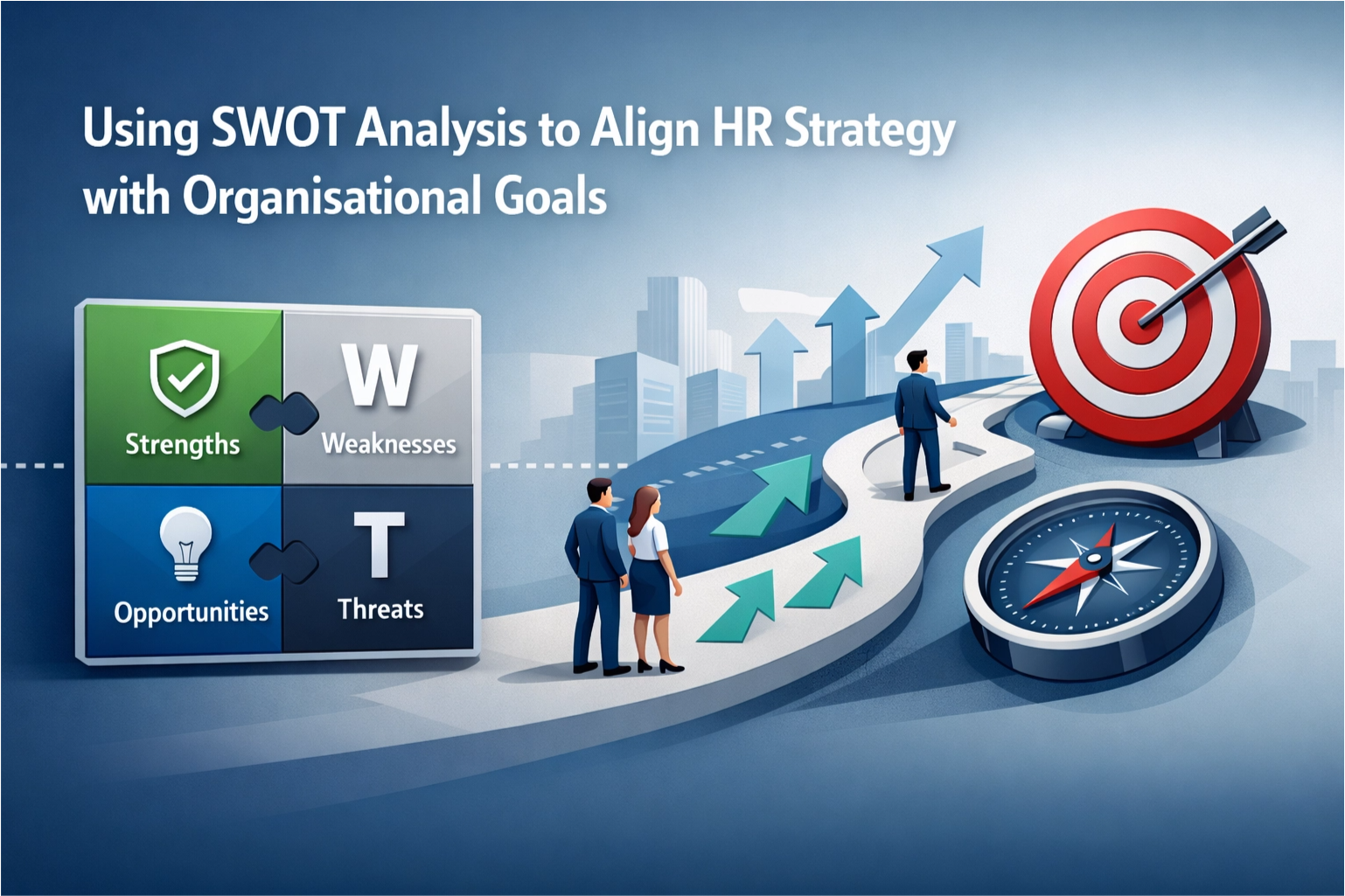
At its core, a SWOT analysis categorizes factors influencing an entity into four distinct areas: internal strengths and weaknesses, and external opportunities and threats . When applied to HR, these categories take on specific meanings that directly relate to the human capital of an organization.
Strengths (Internal & Helpful)
These are the internal attributes and resources within the HR department or the workforce that give the organization a competitive advantage. They are factors that HR can control and leverage. Examples include a highly skilled and engaged workforce, robust training and development programs, a strong employer brand, effective talent acquisition processes, or a positive organizational culture that fosters innovation and collaboration . A strong HR team with deep expertise in areas like compensation, benefits, or employee relations can also be a significant strength.
Weaknesses (Internal & Harmful)
Weaknesses are internal limitations, deficiencies, or areas where the HR function or the workforce underperforms, hindering the achievement of organizational objectives. Like strengths, these are controllable factors. Common HR weaknesses might include high employee turnover in critical roles, an outdated Human Resources Information System (HRIS), a lack of diversity in leadership, inadequate succession planning, or inefficient HR processes that lead to bottlenecks and employee dissatisfaction . Identifying these areas is the first step towards improvement.
Summary of HR SWOT Components
The following table provides a concise summary of the internal and external factors that HR leaders must evaluate during a SWOT analysis.
SWOT Component | Nature | Focus Area | Examples in HR |
Strengths | Internal | Helpful | High employee engagement, strong employer brand, robust training programs, deep HR expertise. |
Weaknesses | Internal | Harmful | High turnover in critical roles, outdated HRIS, lack of leadership diversity, inefficient processes. |
Opportunities | External | Helpful | Emerging AI technologies, remote work trends, shifts in workforce demographics, new favorable laws. |
Threats | External | Harmful | Tight labor market, rising healthcare costs, unfavorable labor law changes, intense talent competition. |
Opportunities (External & Helpful)
Opportunities are external factors or trends that HR can capitalize on to enhance its effectiveness and contribute to organizational success. These are generally outside the direct control of the HR department but can be strategically exploited. Examples include emerging technologies like AI in recruitment and HR analytics, shifts in workforce demographics (e.g., the rise of the gig economy), new legislative changes that favor certain HR practices, or a growing talent pool in a specific industry . Remote work trends, for instance, present an opportunity to access a wider talent pool.
Threats (External & Harmful)
Threats are external factors that could negatively impact the HR function or the organization’s ability to attract, retain, and develop talent. These are also beyond HR’s direct control and require proactive risk mitigation strategies. Potential threats include a tight labor market making talent acquisition difficult, rising healthcare costs impacting compensation and benefits, unfavorable changes in labor laws or regulations, intense competition for skilled workers, or a negative public perception of the company’s employment practices . Economic downturns or industry disruptions can also pose significant threats to workforce stability.
Aligning HR Strategy with Organizational Goals Using SWOT
The true power of a SWOT analysis in HR lies not just in identifying these factors, but in using them as a foundation to strategically align HR initiatives with the broader organizational vision. This process moves HR from a reactive, operational function to a proactive, strategic partner .
Step 1: Achieve Clarity on Organizational Goals
Before HR can effectively align its strategies, there must be a crystal-clear understanding of the organization’s overarching goals and what ‘winning’ truly means for the business. This involves engaging with senior leadership, including the CEO or COO, to gain insights into the company’s strategic direction, market position, and desired outcomes . HR leaders should ask probing questions to understand not only the vision but also the tangible, deliverable outcomes expected in the near future. Without this foundational clarity, HR efforts risk being misdirected, no matter how well-intentioned.
For example, if a company’s primary goal is aggressive market expansion into new territories, HR’s strategic focus might shift towards rapid talent acquisition in those regions, developing cross-cultural training programs, and establishing competitive compensation structures tailored to local markets. Conversely, if the goal is to become a market leader through innovation, HR might prioritize attracting and retaining top-tier R&D talent, fostering a culture of continuous learning, and implementing performance management systems that reward creativity and risk-taking.
Step 2: Conduct the HR-Specific SWOT Analysis
Once organizational goals are clear, HR can conduct its own SWOT analysis, framing each element in the context of how it impacts or can support these goals. This is where the questions outlined in the previous section become invaluable. For instance, when assessing Strengths, HR might consider: “What HR achievements directly support our market expansion goal?” or “What unique HR capabilities give us an edge in attracting innovative talent?” .
Similarly, for Weaknesses, questions could include: “What internal HR factors are hindering our ability to rapidly scale our workforce?” or “Are our current HR systems agile enough to support a culture of innovation?” .
When looking at Opportunities, HR should ask: “How can emerging HR technologies facilitate our expansion into new markets?” or “Can we leverage the growing remote talent pool to access specialized skills needed for innovation?” .
Finally, for Threats, HR must consider: “What external factors (e.g., labor laws in new regions) could impede our expansion?” or “How might intense competition for R&D talent impact our ability to innovate?” .
The output of this step is a comprehensive matrix of internal and external factors, each analyzed through the lens of the organization’s strategic objectives.
Step 3: Develop Aligned HR Strategies and Initiatives
With a clear understanding of both organizational goals and the HR-specific SWOT, the next step is to formulate concrete HR strategies and initiatives that directly address the findings. This involves leveraging strengths, mitigating weaknesses, capitalizing on opportunities, and preparing for threats. This phase requires critical thinking and often involves cross-functional collaboration .
Leveraging Strengths: If a strength is a robust internal training program, HR might leverage it to upskill existing employees for new roles required by market expansion, reducing the need for external hiring. If a strong employer brand is identified, HR can amplify recruitment efforts by highlighting this advantage.
Mitigating Weaknesses: If an outdated HRIS is a weakness, a strategic initiative might be to invest in a modern, scalable system that supports global operations or enhances data analytics for better talent insights. If high turnover in critical roles is a weakness, HR might implement targeted retention programs, improve leadership development, or revise compensation strategies.
Capitalizing on Opportunities: If AI in recruitment is an opportunity, HR could pilot AI-powered tools to streamline candidate sourcing and screening, accelerating hiring for expansion. If the gig economy offers flexible talent, HR might develop a robust contractor management framework to tap into specialized skills without increasing permanent headcount.
Preparing for Threats: If a tight labor market is a threat, HR could proactively build talent pipelines through university partnerships or apprenticeship programs. If changing labor laws pose a risk, HR might invest in legal counsel and compliance training to ensure smooth operations in new regions.
Step 4: Drive Functional Collaboration and Communication
Effective alignment isn’t a solitary HR endeavor. It requires active collaboration with other functional leaders to ensure that HR strategies are integrated into broader business operations . This means HR working closely with sales, marketing, operations, and finance to ensure that all departments are growing in the same direction . For instance, if HR is developing a new talent acquisition strategy for a product launch, it must collaborate with the product development and marketing teams to understand the specific skill sets required and the timelines involved.
Furthermore, the strategy must be communicated clearly and compellingly across the organization. As Pullen suggests, it shouldn’t be a dense, data-heavy slide deck, but rather a clear, concise narrative that even an average worker can understand and explain . This narrative helps employees internalize the strategy and translate it into their daily actions, ensuring that everyone is working towards the same objectives. This clear communication transforms HR from a mere manager of processes into a strategic influencer, driving meaningful organizational change.
In an era where human capital is increasingly recognized as the most valuable asset, aligning HR strategy with organizational goals is not merely a best practice—it is a strategic imperative. The SWOT analysis provides a robust, systematic approach for HR leaders to navigate the complexities of internal capabilities and external forces. By meticulously identifying strengths, weaknesses, opportunities, and threats, and then intentionally linking these insights to the organization’s strategic objectives, HR can move beyond operational tasks to become a true driver of business success.
This proactive and integrated approach ensures that every HR initiative, from talent acquisition to employee development and retention, directly contributes to the company’s competitive advantage and long-term prosperity. Ultimately, a well-executed HR SWOT analysis empowers organizations to build a resilient, agile, and high-performing workforce capable of achieving ambitious goals in an ever-changing global marketplace.