

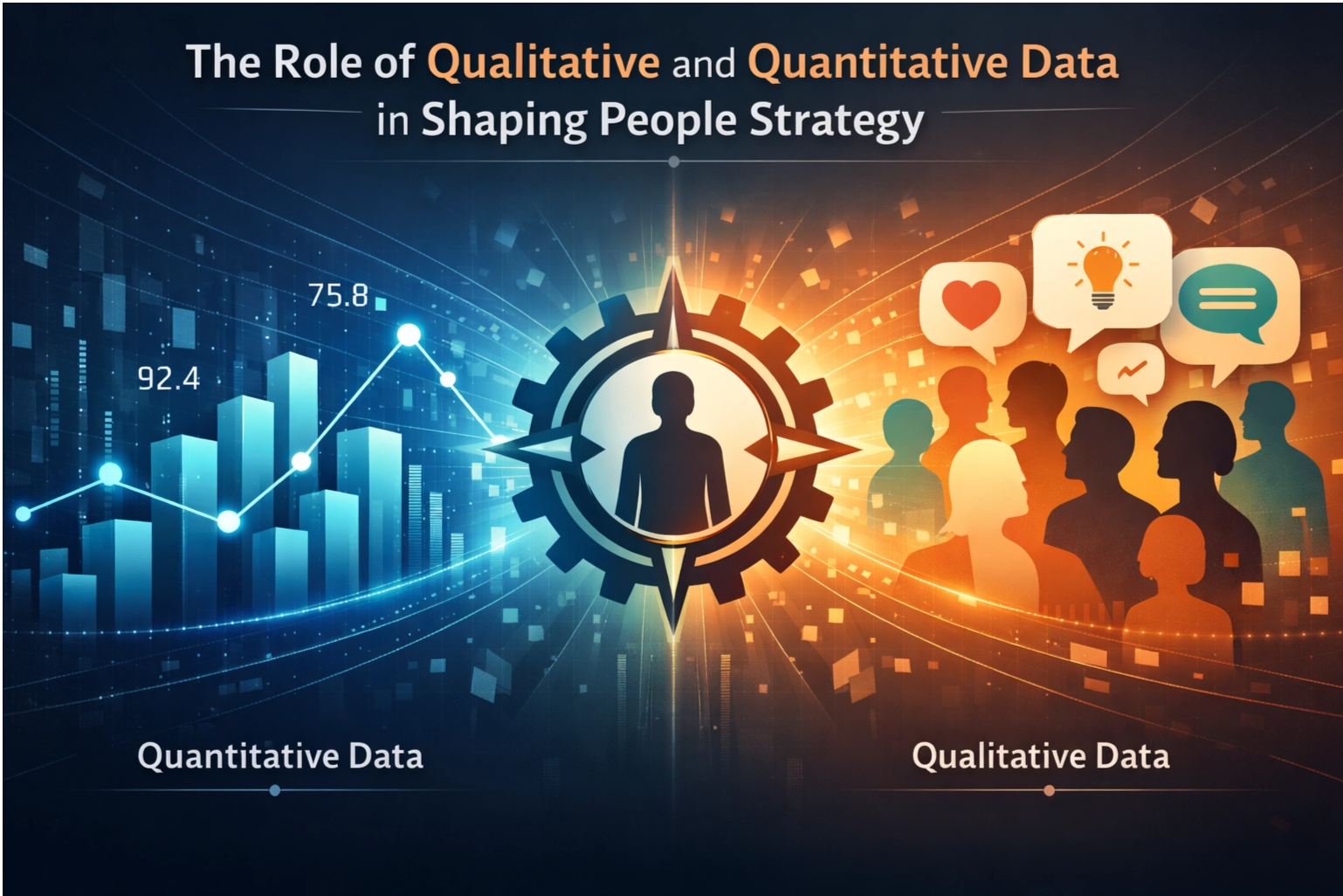
In the contemporary corporate landscape, the function of Human Resources has undergone a profound metamorphosis. No longer confined to the administrative periphery of payroll and compliance, modern HR—often rebranded as People Operations—has emerged as a core strategic driver. Central to this evolution is the sophisticated application of data. A robust people strategy is no longer a product of intuition or anecdotal evidence; rather, it is a meticulously crafted framework grounded in the dual pillars of qualitative and quantitative data. This article explores how the integration of these two data types provides a multidimensional view of the workforce, enabling leaders to build organizations that are both high-performing and deeply human-centric.
The Quantitative Pillar: The Precision of the ‘What’
Quantitative data represents the numerical foundation of people analytics. It provides the “what” of organizational performance—measurable, objective, and scalable metrics that allow for benchmarking and trend analysis. In the context of people strategy, quantitative data encompasses a vast array of indicators, from basic headcount and attrition rates to more complex metrics such as revenue per full-time equivalent (FTE) and diversity representation across leadership tiers.
The primary strength of quantitative data lies in its objectivity. Numbers provide a universal language that resonates in the boardroom, allowing HR leaders to present their strategies in terms that align with financial and operational goals. For instance, a quantitative analysis of turnover costs—factoring in recruitment, onboarding, and lost productivity—can provide a compelling business case for investing in employee retention programs. Furthermore, quantitative data allows for the identification of patterns that might remain invisible to the naked eye. Predictive analytics, for example, can utilize historical data to identify “flight risks” among high-potential employees, allowing for proactive intervention.
However, a purely quantitative approach is not without its limitations. Numbers, while precise, are often devoid of context. A high turnover rate in a specific department tells a leader that there is a problem, but it does not explain the root cause. It could be a toxic management style, a lack of career progression, or uncompetitive compensation. Relying solely on metrics can lead to the “numbers trap,” where organizations optimize for the metric itself rather than the underlying health of the workforce. To truly understand the “why” behind the “what,” organizations must turn to qualitative data.
The Qualitative Pillar: The Depth of the ‘Why’
If quantitative data is the skeleton of a people strategy, qualitative data is the flesh and blood. It captures the nuances of human experience—emotions, perceptions, motivations, and cultural undercurrents. Qualitative data is typically descriptive and non-numerical, derived from sources such as open-ended survey responses, exit interviews, focus groups, and performance review narratives.
The role of qualitative data is to provide the narrative context that numbers lack. It allows HR leaders to understand the “employee experience” in its most authentic form. For example, while a quantitative survey might show a high level of employee engagement, qualitative feedback might reveal that this engagement is driven by a fear of failure rather than a genuine passion for the work. This distinction is critical for long-term organizational health. Qualitative insights are particularly valuable in areas such as psychological safety, belonging, and cultural alignment—concepts that are inherently difficult to quantify but are essential for innovation and collaboration.
Despite its richness, qualitative data presents significant challenges in terms of scalability and objectivity. Analyzing thousands of open-ended survey comments is a labor-intensive process, and the interpretation of such data is often subject to the biases of the analyst. Furthermore, qualitative findings are often dismissed as “anecdotal” or “soft” by stakeholders who prefer the perceived certainty of hard numbers. To overcome these hurdles, modern organizations are increasingly leveraging technology, such as Natural Language Processing (NLP) and sentiment analysis, to categorize and quantify qualitative feedback at scale.
The Integrated Model: Data Triangulation in People Strategy
The most effective people strategies do not choose between qualitative and quantitative data; instead, they employ a “mixed methods” approach known as data triangulation. By cross-referencing multiple data sources, organizations can validate their findings and gain a more holistic understanding of their workforce. This integration is essential for making informed decisions across the entire employee lifecycle.
Strategic Area |
Quantitative Input (The ‘What’) |
Qualitative Input (The ‘Why’) |
Strategic Outcome |
Talent Acquisition |
Time-to-hire, cost-per-hire, offer acceptance rates.
|
Candidate feedback on the interview process, recruiter notes.
|
A streamlined hiring process that attracts and retains top-tier talent.
|
Employee Retention |
Attrition rates, tenure, exit survey scores.
|
Exit interview narratives, stay interview feedback.
|
Targeted interventions that address the root causes of turnover.
|
Performance Management |
KPI achievement, 360-degree feedback scores.
|
Narrative performance reviews, peer comments.
|
A development-focused culture that recognizes both results and behaviors.
|
Diversity & Inclusion |
Representation metrics, pay equity ratios.
|
Inclusion surveys, focus group insights on belonging.
|
An equitable workplace where diverse talent can thrive and feel valued.
|
Learning & Development |
Training completion rates, skill assessment scores.
|
Employee feedback on training relevance and application.
|
A curriculum that effectively closes skill gaps and supports career growth.
|
Consider the challenge of employee burnout. A quantitative analysis might show a correlation between high overtime hours and declining productivity. While this identifies a correlation, it does not provide a solution. By integrating qualitative data from focus groups, the organization might discover that the burnout is not caused by the workload itself, but by a lack of autonomy and unclear expectations. Armed with this integrated insight, the people strategy can move beyond “reducing hours” to “empowering employees” and “clarifying roles,” leading to a more sustainable and effective intervention.
The Role of Technology and Artificial Intelligence
The integration of qualitative and quantitative data has been significantly accelerated by advancements in technology. Modern Human Resources Information Systems (HRIS) and Learning Management Systems (LMS) provide a centralized repository for quantitative data, making it easier to track and report on key metrics. Simultaneously, AI-powered tools are revolutionizing the way organizations handle qualitative information.
Natural Language Processing (NLP) algorithms can now analyze vast quantities of text—from Slack messages and internal communication channels to Glassdoor reviews and open-ended survey comments—to identify emerging themes and shifts in sentiment in real-time. This allows HR leaders to move from reactive to proactive strategies. For example, an AI tool might detect a sudden spike in negative sentiment regarding “work-life balance” or “managerial support” following a major project launch or organizational restructuring. This early warning system enables an immediate leadership response, such as town hall meetings or targeted support programs, before the issue manifests as increased turnover or a decline in productivity.
The sophistication of these tools is rapidly increasing. Beyond simple keyword matching, modern sentiment analysis can detect nuance, sarcasm, and the emotional intensity of feedback. This allows for a much more granular understanding of the organizational climate. However, the integration of AI into people analytics necessitates a high degree of ethical rigor and technical oversight. Algorithms can inadvertently perpetuate existing biases if they are trained on flawed or unrepresentative historical data—for instance, an AI tool might undervalue certain communication styles if they were not prevalent in the “successful” historical cohorts it was trained on. Furthermore, the collection of employee sentiment data must be balanced with a respect for individual privacy and a commitment to data security. Organizations must ensure that data is anonymized where possible and that the “human in the loop” remains the final arbiter of any significant personnel decisions.
Ethical Considerations and the Human Element
As organizations become more data-driven, they must also become more ethics-driven. The collection and analysis of people data carry significant responsibilities. Employees must trust that their data is being used to improve their experience, not to monitor or penalize them. Transparency is the cornerstone of this trust; organizations should be clear about what data is being collected, how it is being analyzed, and what actions are being taken as a result.
Furthermore, HR leaders must remain vigilant against the “data-only” trap. Data is a tool to inform judgment, not a replacement for it. The most successful people strategies are those that use data to enhance human empathy and intuition, rather than replace it. A leader who sees a decline in an employee’s performance metrics should use that data as a prompt for a compassionate conversation, rather than a justification for a disciplinary action. In the final analysis, people strategy is about people, and data is simply a means to understand them better.
The Future of Data-Driven People Strategy: Towards Hyper-Personalization
As we look toward the future, the role of data in shaping people strategy is set to become even more personalized and dynamic. The convergence of qualitative and quantitative data is paving the way for “hyper-personalization” in the employee experience. Just as consumer-facing companies use data to tailor products and marketing to individual preferences, HR departments will increasingly use data to tailor career paths, learning opportunities, and benefit packages to the unique needs of each employee.
In this future state, the distinction between “qualitative” and “quantitative” may become increasingly blurred. Continuous feedback loops—powered by wearable technology that tracks physiological stress markers (quantitative) and real-time pulse surveys that capture mood (qualitative)—will provide a constant stream of insights. This will allow for “nudge-based” people strategies, where small, data-informed interventions can steer organizational culture and individual performance in real-time. For example, if data suggests a team is experiencing high levels of cognitive load, the system might automatically “nudge” the manager to schedule a focus-free afternoon or a team-building activity.
However, the realization of this future depends on the ability of HR leaders to bridge the gap between data science and human psychology. The most sophisticated algorithms in the world cannot replace the fundamental human need for connection, recognition, and purpose. The future of people strategy is not about replacing human judgment with data, but about using data to make human judgment more informed, more equitable, and more effective.
The Competitive Advantage of a Balanced Approach
The role of qualitative and quantitative data in shaping people strategy is not a zero-sum game. The organizations that will thrive in the future are those that can master the interplay between the precision of statistics and the depth of sentiment. Quantitative data provides the clarity and scale needed for strategic alignment, while qualitative data provides the nuance and empathy required for cultural health.
By integrating these two pillars, HR leaders can move beyond simple reporting to true organizational insight. They can build strategies that are not only efficient and profitable but also resilient and inclusive. In an era where the “war for talent” is more intense than ever, the ability to truly understand and respond to the needs of the workforce is the ultimate competitive advantage. The future of people strategy lies at the intersection of data and humanity, where every number tells a story and every story is backed by evidence.