

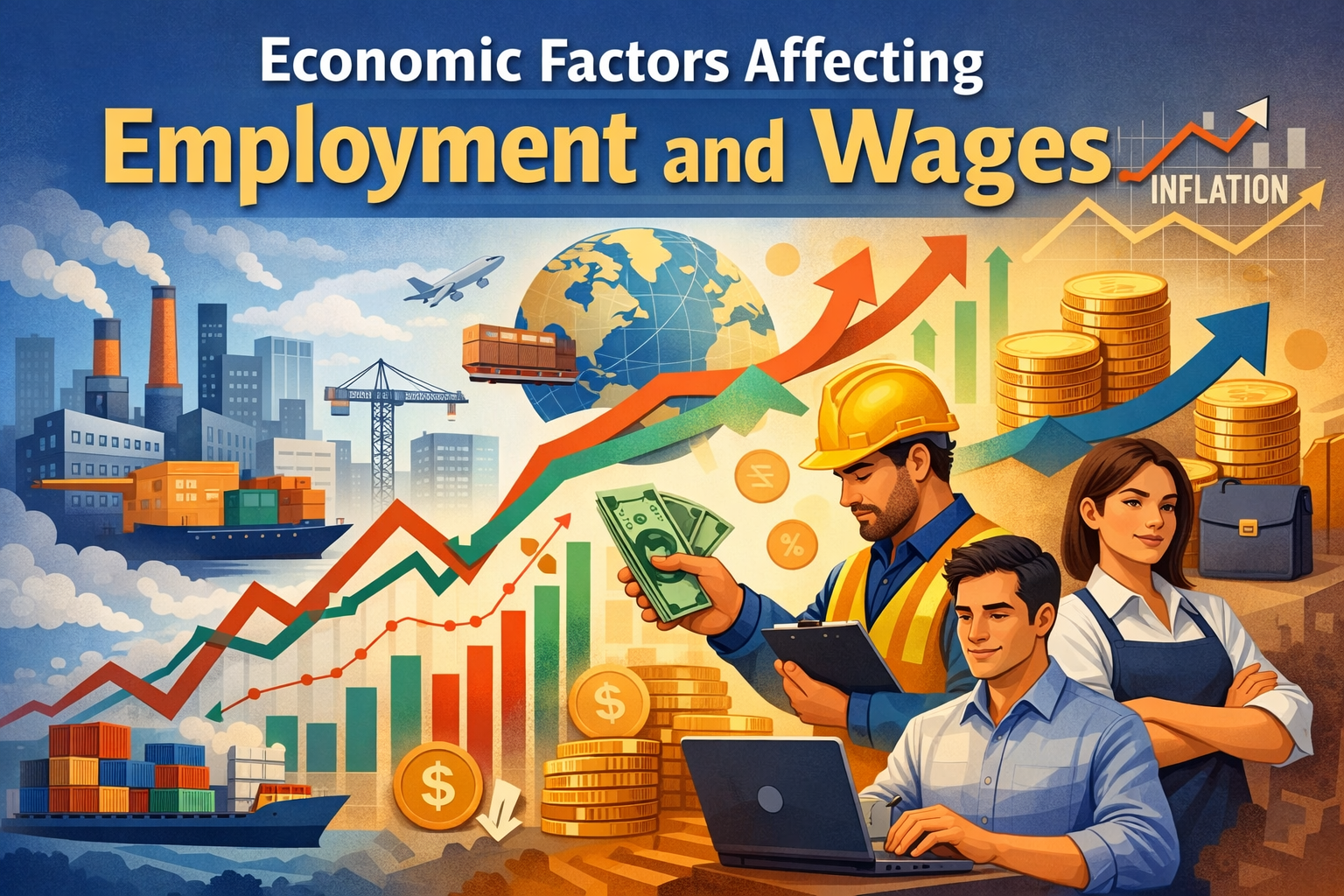
The labor market serves as the primary mechanism through which the fruits of economic activity are distributed among the population. Employment and wages are not merely statistics on a government report; they are the bedrock of social stability, consumer spending, and individual well-being. However, as we navigate the complexities of the mid-2020s, it has become increasingly clear that the forces governing who gets hired and how much they are paid are undergoing a profound transformation. From the lingering effects of global inflation to the disruptive potential of generative artificial intelligence, the modern worker exists at the intersection of various powerful economic currents. Understanding these factors is essential for policymakers, business leaders, and workers alike as they seek to navigate an era defined by volatility and rapid change.
The Fundamental Mechanics: Supply and Demand in the Labor Market
At its most basic level, the price of labor—wages—and the quantity of labor—employment—are determined by the interaction of supply and demand. The supply of labor is dictated by the size of the working-age population, their willingness to work, and their level of education and skill. Conversely, the demand for labor is a “derived demand,” meaning it depends on the demand for the goods and services that workers produce. When an economy is expanding, businesses require more staff to meet rising consumer needs, leading to higher employment and upward pressure on wages.
However, this theoretical equilibrium is often disrupted by market frictions. Information asymmetry, geographical mismatches, and the time required for retraining mean that the labor market rarely “clears” perfectly. For instance, in 2025, many sectors faced a paradox: high vacancy rates in technical roles alongside rising unemployment in traditional administrative sectors. This highlights that the “supply” of labor is not a monolithic block but a diverse array of skills that must align with the evolving “demand” of the marketplace.
Factor |
Influence on Employment |
Influence on Wages |
Population Growth |
Increases the potential labor pool, often leading to higher employment.
|
Can exert downward pressure if supply outpaces demand.
|
Education Levels |
High-skill supply reduces unemployment in advanced sectors.
|
Increases the “skill premium” for highly educated workers.
|
Business Investment |
Drives job creation through expansion and new ventures.
|
Increases wages as firms compete for talent to run new operations.
|
Labor Participation |
Affects the total available workforce; higher rates boost GDP.
|
Can moderate wage growth by increasing the pool of available workers.
|
Macroeconomic Volatility: The Shadow of Inflation and Economic Cycles
Macroeconomic conditions play a decisive role in shaping the short-term and medium-term outlook for workers. The relationship between inflation and wages is particularly critical. While nominal wages—the dollar amount on a paycheck—may rise during periods of high inflation, real wages—the purchasing power of those dollars—often stagnate or decline. In 2025, for example, many low-wage workers saw their nominal pay increase, yet they faced worsening affordability as the cost of housing and essential goods outpaced their earnings. This phenomenon, often referred to as “wage-price lagging,” occurs because wages are typically stickier than prices; they take longer to adjust to new economic realities.
Economic cycles also dictate the rhythm of the labor market. During a recession, or even a period of “bruising” stagnation as seen in late 2025, businesses often respond to declining revenues by freezing hiring or implementing layoffs. This cyclical unemployment is a direct result of reduced aggregate demand. Furthermore, the role of monetary policy cannot be overstated. When central banks raise interest rates to combat inflation, the cost of borrowing for businesses increases, which often leads to a cooling of the job market. The following table illustrates the typical impacts of different economic phases on the labor market.
Economic Phase |
Employment Trend |
Wage Growth Trend |
Expansion |
Strong growth; low unemployment.
|
Accelerating; real wage gains are common.
|
Peak |
Full employment; labor shortages.
|
High; firms offer bonuses and perks to retain staff.
|
Contraction |
Declining; rising layoffs and hiring freezes.
|
Stagnant or falling in real terms; focus on job security.
|
Trough |
High unemployment; “jobless recovery” potential.
|
Weak; workers have little bargaining power.
|
The year 2025 served as a stark reminder of these cycles. After years of post-pandemic recovery, the U.S. economy added significantly fewer jobs than estimated—just 181,000 compared to an initial forecast of over half a million. This slowdown was driven by a combination of high interest rates and a cooling of consumer sentiment, demonstrating how sensitive employment is to the broader macroeconomic environment.
The Productivity-Pay Gap: A Decades-Long Divergence
One of the most concerning trends in modern labor economics is the widening chasm between productivity and worker compensation. Historically, from the end of World War II until the late 1970s, productivity and wages grew in tandem. As workers became more efficient through better tools and processes, their pay increased accordingly, ensuring that the benefits of economic growth were broadly shared. However, since 1979, this link has largely been severed. While productivity has continued to climb, the hourly compensation of the typical worker has lagged significantly behind.
This decoupling is often attributed to the decline of the “labor share” of national income. Instead of going to workers, a larger portion of the value created by productivity gains has been directed toward capital owners in the form of corporate profits and executive compensation. Factors contributing to this gap include the erosion of labor unions, the globalization of supply chains, and policy choices that have favored capital over labor. By 2026, data indicated that while labor productivity rose by nearly 5%, hourly compensation only grew by 2.9%, further entrenching a system where the rewards of efficiency are concentrated at the top.
The AI Revolution and Technological Displacement
Technological advancement has always been a double-edged sword for the labor market. On one hand, it creates new industries and increases the demand for labor through the “productivity effect.” On the other hand, it can lead to “displacement,” where machines or software replace human tasks. The current wave of generative artificial intelligence (AI) is unique in its speed and the types of roles it impacts. Unlike previous industrial revolutions that primarily affected manual labor, AI is increasingly targeting “cognitive” and “knowledge-based” tasks.
In early 2026, the labor market began to feel the tangible effects of AI’s potential. Many companies, particularly in the tech and financial sectors, initiated layoffs not necessarily because AI was already performing the jobs of thousands, but because of its potential to do so in the near future. This proactive restructuring reflects a shift in corporate strategy toward “AI-first” operations. However, the impact of AI is not purely negative. Research suggests that AI-related roles often offer higher wages, better benefits, and more flexible work arrangements, such as remote work. The challenge lies in the transition: how to move workers from displaced roles into the newly created, high-value positions of the AI economy.
“Artificial Intelligence has emerged as a transformative force in the labor market, reshaping the nature of work, job roles, and employment opportunities. While it creates demand for labor through a productivity effect, it simultaneously reduces demand through a displacement effect.” — International Economic Development Council Report, 2025
Globalization and the International Labor Pool
Globalization has fundamentally altered the wage-setting process by integrating billions of workers into a single global labor market. For workers in developed economies, this has often meant facing competition from lower-wage regions through offshoring and outsourcing. While this has lowered the cost of goods for consumers, it has also placed downward pressure on wages in sectors like manufacturing and, increasingly, services like software development and customer support.
The economic factor of “comparative advantage” dictates that countries will specialize in what they can produce most efficiently. In a globalized world, high-income countries have shifted toward high-skill, service-oriented economies, while labor-intensive production has moved to developing nations. However, this transition is rarely smooth. The “hollowing out” of the middle class in many Western nations is a direct consequence of this global shift, where mid-skill jobs are lost to international competition, leaving a polarized labor market of high-wage professionals and low-wage service workers.
Globalization Aspect |
Impact on Wages |
Long-term Employment Effect |
Offshoring |
Downward pressure on domestic low-to-mid skill wages.
|
Structural unemployment in specific manufacturing regions.
|
Global Talent Sourcing |
Increases competition for high-skill remote roles.
|
Expands the available talent pool for innovative firms.
|
Trade Liberalization |
Lowers consumer prices, effectively boosting “real” wages.
|
Drives specialization in high-value industries.
|
Supply Chain Integration |
Ties local employment to global stability.
|
Increases vulnerability to international economic shocks.
|
Institutional and Policy Factors: The Rules of the Game
Beyond the raw forces of supply, demand, and technology, the labor market is shaped by the institutional framework and government policies of a nation. These “rules of the game” determine the bargaining power of workers and the costs of hiring for employers. Minimum wage laws are perhaps the most debated of these policies. While critics argue that high minimum wages can lead to reduced employment—as businesses may cut staff to manage costs—recent studies from 2023 and 2024 suggest that in concentrated labor markets, increasing the minimum wage can actually boost employment by drawing more people into the workforce and increasing consumer spending.
Labor unions and collective bargaining also play a vital role in wage determination. In industries with high union density, workers typically enjoy higher wages, better benefits, and greater job security. However, the steady decline of union membership over the last several decades has weakened the collective bargaining power of the average worker, contributing to the aforementioned productivity-pay gap. Additionally, taxation and social safety nets influence labor supply; high marginal tax rates may discourage extra work, while robust unemployment benefits can provide workers with the “reservation wage” needed to wait for a job that matches their skills, rather than accepting the first available low-wage role.
Human Capital: The Role of Education and Skills
In the 21st-century economy, “human capital”—the stock of knowledge, habits, social and personality attributes embodied in the ability to perform labor so as to produce economic value—is the most critical determinant of an individual’s earning potential. The “college premium,” or the wage gap between those with a degree and those without, remains significant, though its nature is changing. As we move into 2026, the focus is shifting from formal degrees to “skills-based” hiring.
The mismatch between the current education system and the needs of the modern economy is a significant economic factor affecting employment. Many workers find themselves “underemployed,” working in jobs that do not utilize their skills, while industries like green energy and advanced manufacturing face acute labor shortages. This “skills gap” acts as a drag on economic growth and suppresses wages in sectors where workers are oversupplied. Lifelong learning and vocational retraining have thus become economic necessities rather than optional extras.
The factors affecting employment and wages in 2026 are multifaceted and deeply interconnected. We have seen how the fundamental laws of supply and demand are constantly being reshaped by macroeconomic cycles, the relentless march of technological innovation, and the far-reaching effects of globalization. The “bruising” job market of 2025 served as a potent reminder that stability is never guaranteed, and that the decoupling of productivity from pay remains a central challenge for the modern social contract.
To foster a labor market that is both resilient and equitable, a holistic approach is required. Policymakers must address the structural barriers to wage growth, businesses must invest in the long-term development of their human capital, and individuals must remain adaptable in the face of an ever-changing technological landscape. Ultimately, the goal is an economy where employment is accessible, and wages reflect not just the cost of living, but the true value of the labor provided. By understanding these economic drivers, we can better prepare for a future that, while uncertain, holds the potential for unprecedented prosperity if managed with foresight and fairness.