

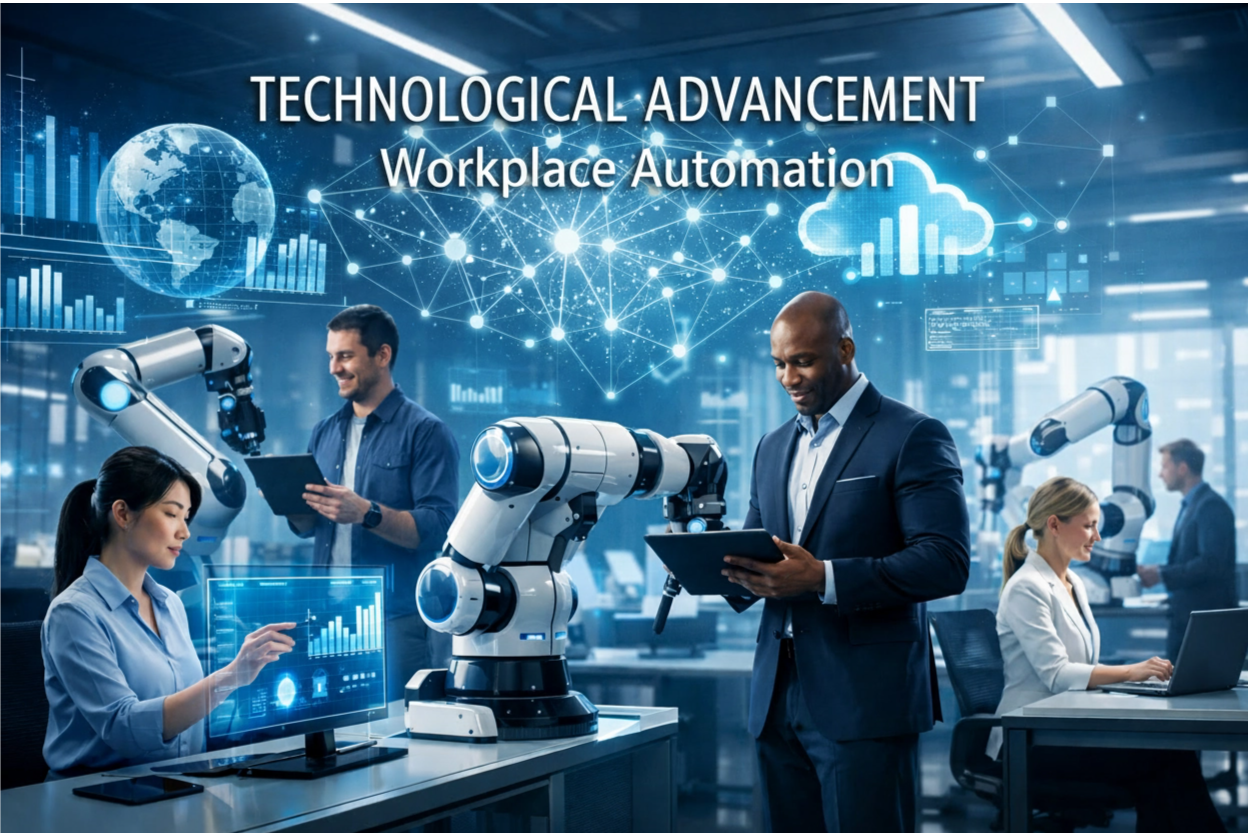
The global labor landscape is currently undergoing its most significant transformation since the Industrial Revolution. As of 2026, the convergence of artificial intelligence (AI), advanced robotics, and the Internet of Things (IoT) has moved beyond the realm of speculative fiction and into the core of corporate strategy. This shift, often characterized as the “Agentic Reality,” represents a fundamental change in how work is conceived, executed, and managed. According to the World Economic Forum’s Future of Jobs Report 2025, while approximately 92 million jobs are projected to be displaced over the next five years, nearly 170 million new roles are expected to emerge, resulting in a net gain of 78 million positions by 2030 . However, this numerical optimism masks a complex reality of structural upheaval, skill gaps, and the urgent need for organizational redesign.
“Intelligence isn’t confined to screens anymore; it’s embodied, autonomous, and solving real problems in the physical world.” — Deloitte Tech Trends 2026
The Technological Drivers of Automation
The current wave of automation is driven by several key technological advancements that have reached critical maturity in 2026. These are not isolated tools but interconnected systems that create a “silicon-based workforce” capable of operating with increasing autonomy.
1. Agentic Artificial Intelligence
Unlike the generative AI models of 2023 and 2024, which primarily focused on content creation, Agentic AI in 2026 is capable of planning, executing, and refining multi-step workflows. These “AI Agents” can manage entire processes—such as procurement, customer service, or software development—with minimal human intervention. Gartner predicts that by 2027, 40% of agentic projects will fail, not due to technical limitations, but because organizations attempt to automate broken legacy processes rather than redesigning them for an AI-native environment .
2. Embodied Intelligence and Robotics
Robotics has transitioned from rigid, programmed machines to flexible, AI-driven entities. In 2025, Amazon deployed its millionth robot, coordinated by its DeepFleet AI, which improved warehouse efficiency by 10% through real-time path optimization . Similarly, BMW’s factories now feature autonomous vehicles that navigate production routes independently, marking the transition to Industry 6.0, where human-centric design meets intelligent automation.
3. Digital Twins and Inference Economics
The widespread adoption of Digital Twins—virtual replicas of physical assets or systems—allows companies to simulate and optimize automation before physical implementation. This is supported by a 280-fold drop in AI token costs over the past two years, making “inference economics” a viable strategy for scaling automation across global operations .
Technology |
Primary Function in 2026 |
Impact Level |
Agentic AI |
Autonomous process management and decision-making
|
High
|
Advanced Robotics |
Flexible physical labor and logistics optimization
|
High
|
Digital Twins |
Predictive maintenance and system simulation
|
Medium
|
Edge Computing |
Real-time data processing for autonomous systems
|
Medium
|
The Automation Landscape: Statistics and Trends
The impact of automation is not uniform across the global workforce. Instead, it is creating a “pipeline shock” that disproportionately affects entry-level roles while creating high-demand positions for those with specialized technological literacy.
Displacement vs. Creation
The narrative of “AI taking jobs” has evolved into a more nuanced understanding of task automation. While only 1% of layoffs in early 2025 were directly attributed to AI productivity gains, 66% of enterprises have reported reducing entry-level hiring as AI agents begin to handle junior-level tasks such as data entry, basic coding, and administrative scheduling .
Public Sentiment and Corporate Adoption
As of February 2026, 51% of American workers express concern that AI will replace their current roles within the next twelve months . This anxiety is mirrored by corporate urgency; 86% of global businesses expect to be significantly reshaped by AI technologies by 2030 . The gap between “piloting” and “production” is closing, with 11% of organizations now having AI agents fully integrated into their production environments .
Sector-Specific Transformations
Manufacturing: The Rise of Industry 6.0
In the manufacturing sector, automation has moved beyond the assembly line. Industry 6.0 focuses on the synergy between human creativity and machine precision. Smart factories use IoT sensors to create self-healing supply chains, where machines can predict their own maintenance needs and order replacement parts autonomously.
Healthcare: Precision and Efficiency
Automation in healthcare is saving lives by handling high-volume data analysis. AI-driven diagnostic tools can now screen medical images with 98% accuracy, allowing human doctors to focus on complex cases and patient care. In 2026, robotic-assisted surgery has become a standard in 30% of urban hospitals, reducing recovery times by an average of 15% .
Finance: The Algorithmic Workforce
The financial sector has seen the most rapid adoption of agentic automation. From algorithmic trading to automated compliance monitoring, AI agents now handle 70% of routine financial analysis. This has shifted the role of financial advisors from data crunchers to strategic consultants who leverage AI-generated insights to provide personalized wealth management.
The Human-AI Synergy: From Replacement to Augmentation
The most successful organizations in 2026 are those that view automation not as a way to reduce headcount, but as a means to achieve “Superagency.” This concept, championed by McKinsey and other leading consultancies, refers to the empowerment of human workers through AI augmentation, allowing them to perform at levels previously impossible .
The Rise of the “Centaur” Worker
In the modern workplace, the “Centaur” model—where humans and AI work in tandem—has become the gold standard. For example, a software engineer using an AI agent can write and debug code five times faster than a solo developer. However, this requires a shift in mindset: the human is no longer the “doer” of every task but the “orchestrator” of a suite of digital tools.
Redesigning Workflows
The failure of many early automation projects was rooted in “paving the cow path”—simply applying technology to existing, inefficient processes. In 2026, leading firms are engaging in “Process Reimagination.” Instead of automating a 10-step manual process, they are using AI to achieve the same outcome in two steps, fundamentally changing the nature of the job.
Ethical and Societal Implications
As automation becomes ubiquitous, the ethical challenges associated with its deployment have moved to the forefront of public debate. The “black box” nature of some AI decision-making processes has led to calls for greater transparency and accountability.
1. Algorithmic Bias and Fairness
Automated systems are only as unbiased as the data they are trained on. In 2025, several high-profile cases of AI-driven recruitment tools discriminating against minority candidates led to the implementation of the Global AI Governance Framework, which requires companies to audit their automation systems for bias annually.
2. Data Privacy and Surveillance
The integration of IoT and AI in the workplace has raised significant concerns about “bossware”—the use of automation to monitor employee productivity in real-time. Striking a balance between operational efficiency and the right to privacy remains a contentious issue, with many jurisdictions introducing “Right to Disconnect” laws to prevent 24/7 digital surveillance.
3. The Digital Divide
There is a growing risk of a “two-tier” workforce: those who can leverage automation to enhance their value and those whose skills are rendered obsolete. Without significant intervention, automation could exacerbate existing wealth inequalities both within and between nations.
Future-Proofing the Workforce: The Upskilling Imperative
The rapid pace of technological change has shortened the “half-life” of professional skills. In 2026, the most valuable asset a worker can possess is not specific technical knowledge, but adaptability and meta-learning capabilities.
Key Skills for the Automated Era
According to recent LinkedIn data, the top five most in-demand skills in 2026 are:
- Analytical Thinking: The ability to interpret AI-generated data and identify strategic opportunities.
- Technological Literacy: Understanding how to interact with and manage agentic AI systems.
- Creative Problem-Solving: Tackling “edge cases” that automation cannot handle.
- Emotional Intelligence: Managing human relationships and empathy in a machine-dominated environment.
- Ethical Judgment: Navigating the complex moral landscape of automated decision-making.
The Role of Education and Policy
Traditional educational models are struggling to keep up. In response, many companies have launched internal “Universities” to provide continuous reskilling. Governments are also exploring policies such as Universal Basic Income (UBI) or Robot Taxes to fund the transition for displaced workers and ensure that the benefits of automation are shared broadly across society.
Skill Category |
Human Role |
Machine Role |
Strategy |
Setting goals and vision
|
Optimization and execution
|
Empathy |
Conflict resolution and care
|
Sentiment analysis
|
Creativity |
Original ideation
|
Iteration and rendering
|
Ethics |
Moral accountability
|
Rule-based compliance
|
A Forward-Looking Perspective
The technological advancements of 2026 have brought us to a crossroads. Workplace automation is no longer a future threat; it is a present reality that is reshaping every facet of our professional lives. While the challenges of displacement and ethical governance are significant, the potential for human flourishing in an augmented world is equally profound.
By moving from a mindset of “Man vs. Machine” to “Man with Machine,” we can unlock new levels of productivity and innovation. The “Silent Revolution” of automation is not about the end of work, but the evolution of work into something more creative, more strategic, and ultimately, more human. As we navigate this transition, our success will be defined not by the power of our algorithms, but by the strength of our commitment to inclusive growth and lifelong learning.