

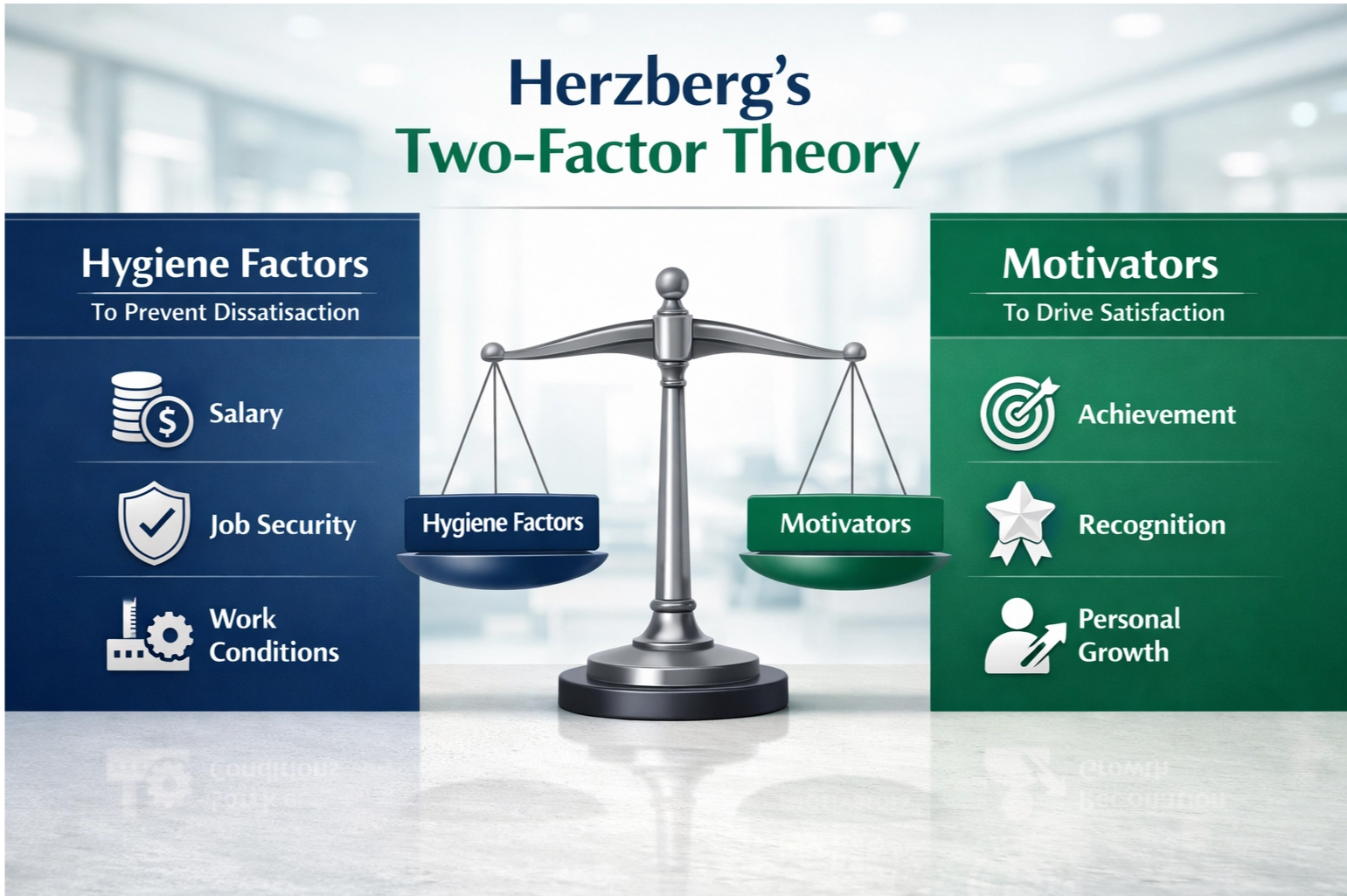
Understanding employee motivation is crucial for organizational success. Psychologist Frederick Herzberg’s Two-Factor Theory, or Motivation-Hygiene Theory, developed in 1959, posits that job satisfaction and dissatisfaction are influenced by distinct sets of factors, rather than being opposite ends of a single spectrum.
Herzberg’s research, based on interviews with 200 accountants and engineers, revealed that factors leading to job satisfaction were different from those leading to dissatisfaction. This led to the core idea: the opposite of “Satisfaction” is “No Satisfaction,” and the opposite of “Dissatisfaction” is “No Dissatisfaction.” Therefore, eliminating dissatisfaction does not automatically create satisfaction; both sets of factors must be addressed independently to achieve true motivation.
Concept |
Description |
Focus |
Hygiene Factors |
Extrinsic elements related to the environment.
|
Preventing dissatisfaction.
|
Motivators |
Intrinsic elements related to the work itself.
|
Creating satisfaction and engagement.
|
Understanding Hygiene Factors: The Foundation of Workplace Stability
Hygiene factors, often referred to as maintenance factors, are essential for the existence of motivation at the workplace. However, they do not lead to positive satisfaction in the long term. If these factors are absent or inadequate, they lead to significant dissatisfaction. Like hygiene in a medical sense, these factors “keep the environment clean” but do not “cure” the problem of low motivation. They are extrinsic to the work itself, meaning they relate to the environment in which the work is performed rather than the tasks being executed.
Key Hygiene Factors in Detail:
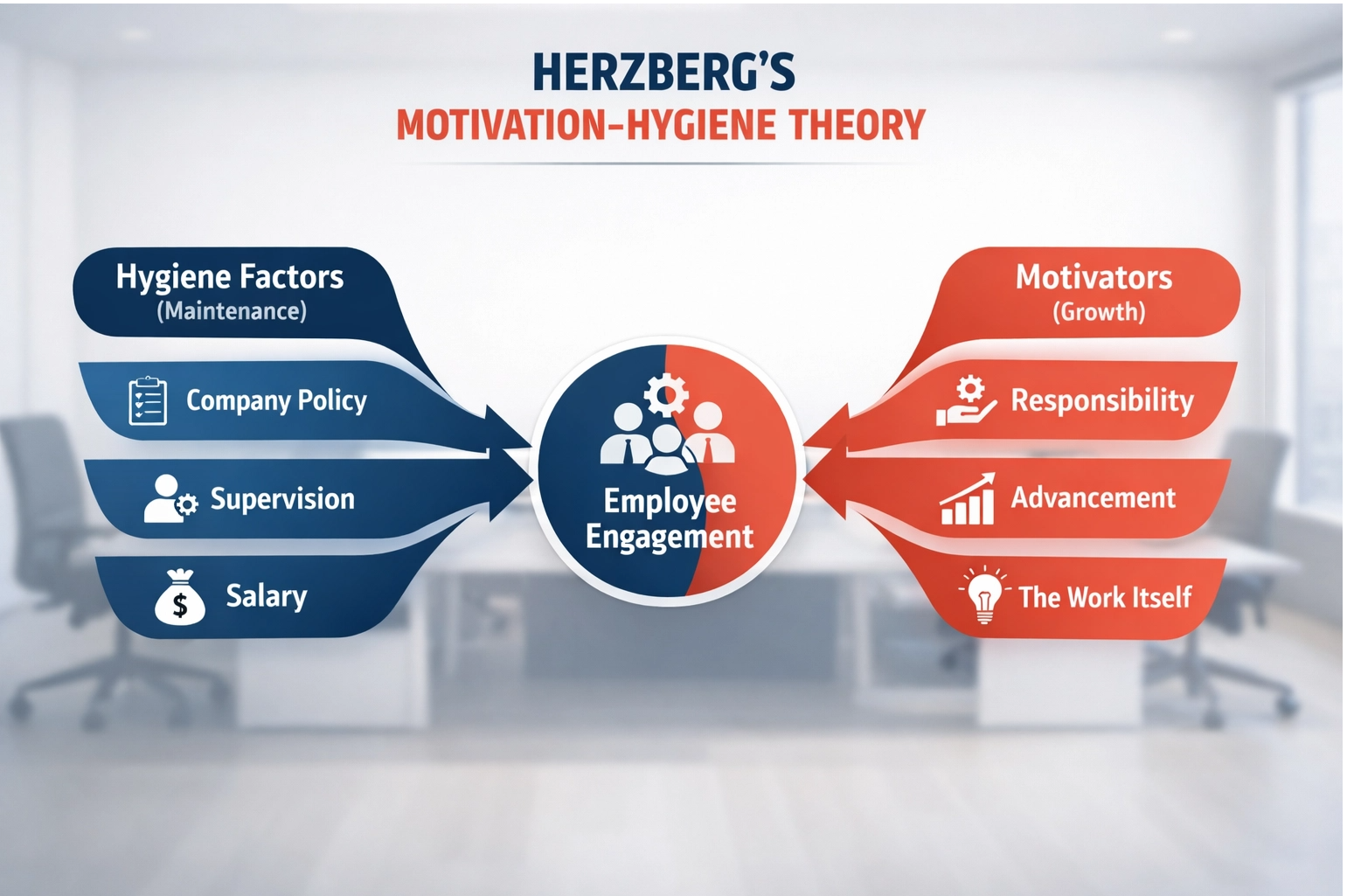
- Company Policy and Administration: This includes the “red tape” of an organization. Bureaucratic hurdles or unfair policies can quickly frustrate employees. For example, opaque promotion policies or difficult expense approval processes lead to high dissatisfaction.
- Supervision: The quality of leadership is crucial. Herzberg found that poor relationships with supervisors are a top source of dissatisfaction. Micromanagement is a classic hygiene failure, whereas supportive leadership prevents resentment.
- Salary and Compensation: Herzberg categorized salary as a hygiene factor. While low pay causes dissatisfaction, high pay doesn’t provide long-term motivation; it eventually becomes the “new normal.” Money is seen as a way to avoid pain rather than achieve psychological growth.
- Interpersonal Relations: The quality of relationships with peers and superiors significantly impacts the work experience. A toxic team culture creates a “dirty” environment that prevents real motivation from taking root.
- Working Conditions: This encompasses the physical and digital environment. A poorly lit office or slow software is a constant “pebble in the shoe” that leads to persistent dissatisfaction.
- Job Security: The fear of job loss is a major dissatisfier. Security allows employees to focus on their tasks rather than their survival during economic uncertainty.
When an organization improves hygiene factors, it reaches a state of “peace” or neutrality. Employees are not complaining, but they are not yet inspired to go above and beyond. They are simply “not dissatisfied.”
The Power of Motivators
Once the “hygiene” of the workplace is established, managers must focus on motivators. These are intrinsic factors that arise from the work itself and the individual’s relationship with their tasks. Motivators lead to positive satisfaction and encourage employees to invest more effort into their roles.
Primary Motivators in Detail:
- Achievement: The internal sense of accomplishment from completing a challenging task or reaching a goal. Management can foster this by setting “stretch goals” that are difficult but attainable.
- Recognition: Being acknowledged for contributions by leadership or peers. A sincere “thank you” or a public shout-out validates the employee’s effort and reinforces their value.
- The Work Itself: This is the most critical motivator. When work is interesting, varied, and meaningful, employees enter a state of “flow” where motivation is self-sustaining.
- Responsibility: Giving employees ownership over their work and decision-making freedom builds deep motivation. It is about trusting employees to use their expertise.
- Advancement: The opportunity for promotion and upward mobility. Knowing there is a path forward encourages long-term investment in the company.
- Personal Growth: The chance to learn new skills and take on new challenges. In the knowledge economy, professional development is a top-tier motivator.
Motivators are psychological in nature and provide the “internal generator” that keeps an employee engaged even when external conditions are not perfect. Unlike hygiene factors, which are “pushed” by the organization, motivators are “pulled” from within the individual.
The Four Workplace Scenarios
Herzberg’s theory identifies four possible workplace scenarios based on the interplay of hygiene and motivators:
- High Hygiene + High Motivation: The optimal state, characterized by highly motivated and satisfied employees with few complaints.
- High Hygiene + Low Motivation: Employees are not dissatisfied but lack motivation, performing only the bare minimum.
- Low Hygiene + High Motivation: Employees are motivated by challenging work but are dissatisfied with poor conditions or pay, often leading to burnout.
- Low Hygiene + Low Motivation: The worst scenario, with dissatisfied and uninspired employees, resulting in high turnover and absenteeism.
Practical Application: Job Enrichment
The most significant practical takeaway from Herzberg’s theory is Job Enrichment, which involves “vertical loading”—adding depth, control, and responsibility to an employee’s role. This differs from “job enlargement,” which merely adds more tasks (horizontal loading) and often increases dissatisfaction.
Herzberg suggested several ways to enrich jobs, such as removing some controls while retaining accountability, increasing individual ownership of work, providing complete units of work, granting additional authority, and offering opportunities for new and more difficult tasks to foster expertise.
Implementing the Two-Step Strategy
Managers should apply Herzberg’s theory through a systematic two-step process:
Phase 1: The Hygiene Audit (Eliminate Dissatisfaction)
Focus on “cleaning up” the work environment by ensuring competitive salaries, comfortable working conditions, fair policies, and a positive culture. Addressing these foundational elements prevents dissatisfaction.
Phase 2: The Motivation Drive (Create Satisfaction)
Once hygiene factors are stable, shift focus to intrinsic motivators. This involves providing opportunities for achievement, recognition, meaningful work, responsibility, advancement, and personal growth. Tailoring motivation strategies to individual employees is key.
Measuring Motivation: A Guide for Leaders
How can a manager tell if they have a hygiene problem or a motivation problem?
- High Turnover + Constant Complaints about Pay/Hours: This is a hygiene problem. No amount of “Employee of the Month” awards will fix this until the baseline conditions are addressed.
- Low Productivity + “Quiet Quitting” + No Complaints: This is a motivation problem. The environment is “clean,” but the work is boring or the employees feel unappreciated.
Leaders should use anonymous engagement surveys to distinguish between these two. Asking questions like “Do you feel your work is meaningful?” (Motivator) versus “Are you satisfied with the company’s communication?” (Hygiene) can provide a clear data-driven roadmap for improvement.
Herzberg vs. Maslow: A Comparison
Herzberg’s theory is often compared to Abraham Maslow’s Hierarchy of Needs. While they share similarities, they differ in their structure. Maslow’s theory is a hierarchy where lower-level needs must be met before higher-level needs become motivators. In contrast, Herzberg argues that hygiene factors and motivators operate independently.
Feature |
Maslow’s Hierarchy |
Herzberg’s Two-Factor |
Structure |
Hierarchical (5 levels)
|
Dual-factor (2 categories)
|
Relationship |
Lower needs must be met first.
|
Factors are independent.
|
Focus |
Human needs in general.
|
Workplace motivation specifically.
|
Money |
A basic need (Physiological/Safety).
|
A hygiene factor (Extrinsic).
|
Criticisms and Modern Relevance
Despite its widespread adoption, Herzberg’s theory faces criticisms, including the subjectivity of recall in his original research, which might lead individuals to attribute success to internal factors (motivators) and failure to external ones (hygiene). Critics also point to the theory’s limited consideration of individual differences and situational variables, suggesting that what motivates one person may not motivate another, and external conditions like economic climate can significantly alter priorities.
Nevertheless, Herzberg’s theory remains highly relevant in today’s dynamic work environment, particularly with the rise of remote work and evolving generational expectations. Digital hygiene factors, such as reliable technology and clear work-life boundaries, have replaced traditional office perks. Younger generations, like Gen Z, increasingly prioritize motivators such as meaningful work and personal growth, making job enrichment strategies crucial for retention and engagement in a competitive talent market. The “Great Resignation” underscored that many employees left not due to poor hygiene alone, but a lack of intrinsic motivators. Managers must avoid the “pitfall of over-hygiene,” where attempts to boost morale with more perks (hygiene) fail to address the deeper need for motivation.
Frederick Herzberg’s Two-Factor Theory provides a timeless framework for understanding the human element of management. By distinguishing between the factors that prevent dissatisfaction and those that inspire excellence, it offers a roadmap for creating a thriving organizational culture.
The core message for managers is clear: paying people well and providing a good office is only the beginning. To truly unlock the potential of a workforce, you must provide them with work that matters, recognize their achievements, and empower them to grow. In the words of Herzberg himself, “If you want people to do a good job, give them a good job to do.”