

The Chartered Institute of Personnel and Development (CIPD) Level 7 Advanced Diploma is the gold standard for strategic People Professionals, demanding a high level of critical analysis and synthesis. As students transition to this advanced level, one of the most common sources of anxiety is the assignment word count. Far from being a mere administrative hurdle, the word count at Level 7 is a critical tool for assessing a student’s ability to be concise, strategic, and deeply analytical. This detailed guide clarifies the CIPD Level 7 word count policy, outlines what is included and excluded, and provides practical strategies for managing your word allocation to achieve distinction-level grades.
The Core CIPD Level 7 Word Count Policy
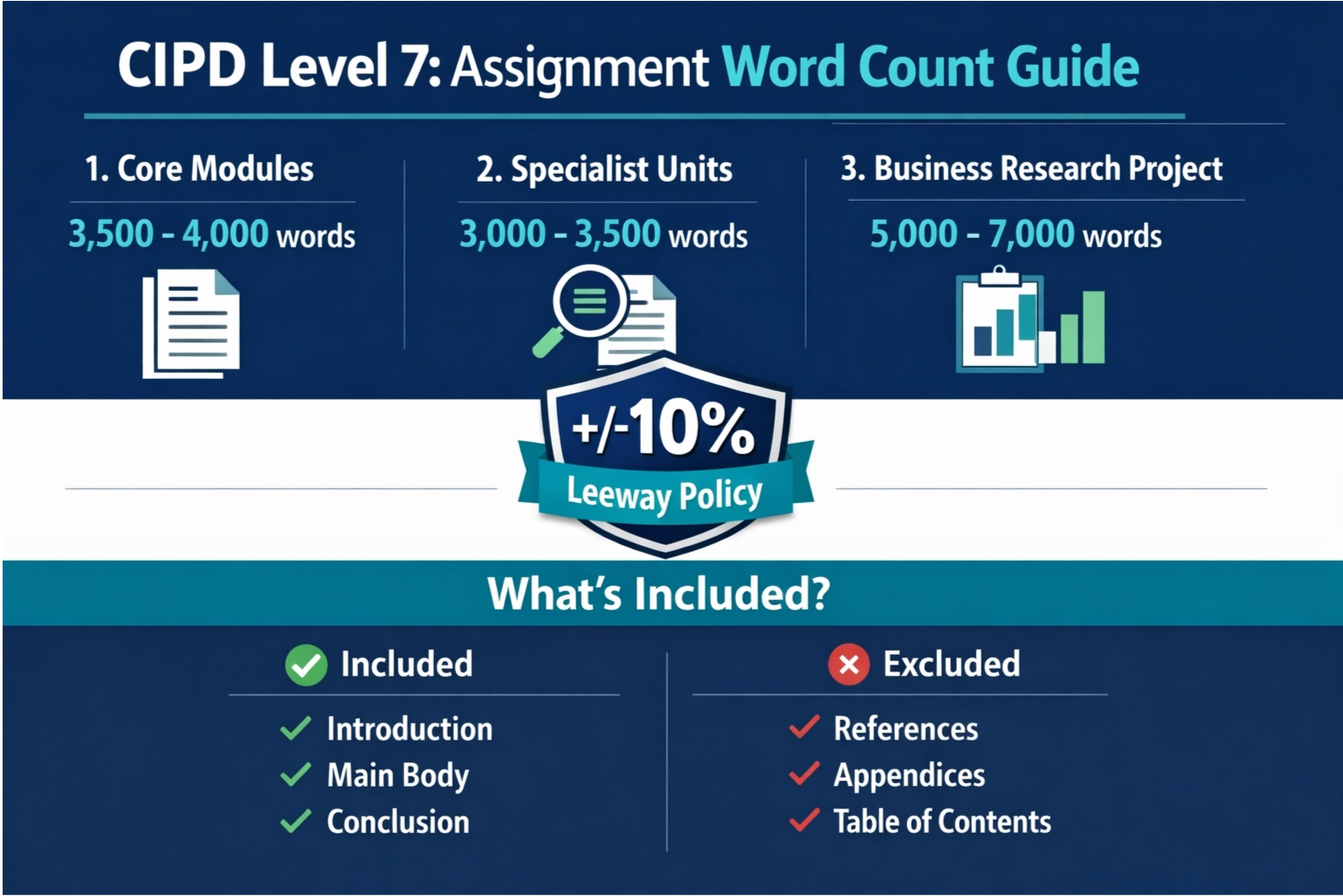
For the majority of units within the CIPD Level 7 Advanced Diploma in Strategic People Management or Strategic Learning and Development, the standard word count for a single assignment is 4,000 words. This figure is not a rigid limit but a target, which CIPD permits students to deviate from within a specific tolerance.
The standard CIPD policy allows for a plus or minus 10% ($\pm 10%$) tolerance on the stated word count. This means that for a 4,000-word assignment, the acceptable range for submission is between 3,600 words and 4,400 words. Students must declare their final word count on the assignment cover sheet.
This consistent word count applies to core units such as 7CO01 Work and working lives in a changing business environment, 7CO02 People management and development strategies for performance, 7CO03 Personal effectiveness, ethics and business acumen, and the 7CO04 Business Research in People Practice report, as well as the various optional units.
What Counts: Inclusions and Exclusions
Understanding precisely which parts of your submission contribute to the final word count is essential for effective planning. The CIPD policy is designed to ensure that the word count reflects the intellectual effort and critical content of the assignment.
The following table clarifies the standard inclusions and exclusions:
Category |
Included in Word Count |
Excluded from Word Count |
Rationale |
|
Main Text
|
All paragraphs, sentences, and main body content.
|
This is the core content being assessed.
|
|
|
Headings
|
All section and sub-section headings (e.g., 1.0 Introduction, 2.1 Analysis).
|
Headings are considered part of the structure and flow of the argument.
|
|
|
Citations
|
In-text citations (e.g., (CIPD, 2025) or (Smith, 2023, p. 45)).
|
Reference List / Bibliography.
|
In-text citations are integral to the academic argument, while the reference list is a separate administrative requirement.
|
|
Quotes
|
Direct quotations from sources.
|
Quotes are part of the main text and contribute to the overall argument.
|
|
|
Visual Aids
|
Captions, labels, and titles for figures and tables.
|
The content of tables, figures, diagrams, and charts themselves.
|
Visual aids are used to present data concisely and are not part of the narrative flow being assessed.
|
|
Front Matter
|
Title page, cover sheet, and table of contents.
|
These are administrative components of the assignment.
|
|
|
Appendices
|
All content placed in the Appendix section.
|
Appendices are for supplementary, non-essential evidence and are not directly assessed.
|
Note on In-Text Citations: A common point of confusion is the inclusion of in-text citations. Since they are part of the running text and structure the academic argument, they must be included in your final word count.
The Consequences of Word Count Mismanagement
Adhering to the word count is not merely about following instructions; it is a demonstration of professional discipline and effective communication. At Level 7, there are significant consequences for failing to manage the word count effectively:
Exceeding the Limit
If a submission exceeds the maximum word count (e.g., over 4,400 words for a 4,000-word assignment), the assessor is typically instructed to stop marking once the limit is reached. Any content beyond that point will not be considered, regardless of its quality or relevance to the assessment criteria. This can lead to a ‘Refer’ grade if critical assessment criteria are left unaddressed in the unmarked portion of the work.
Falling Below the Minimum
While technically acceptable down to the 10% minimum (3,600 words), submitting an assignment significantly under the target word count is highly discouraged. At Level 7, the assessment criteria demand critical evaluation, synthesis, and justification. It is exceptionally difficult to demonstrate the required depth of analysis, breadth of reading, and comprehensive application of theory in a significantly reduced word count. A submission that is too short often lacks the necessary critical edge and is likely to result in a lower grade or a ‘Refer’.
Word Count as a Tool for Criticality
The word count at Level 7 is intrinsically linked to the core academic requirement: moving from description to critical analysis.
- Description simply explains a theory, model, or concept (e.g., “Maslow’s Hierarchy of Needs has five levels…”). This is low-value content and consumes word count inefficiently.
- Critical Analysis evaluates the theory, compares it with alternatives, discusses its limitations in a specific context, and justifies its use or rejection (e.g., “While Maslow’s model provides a foundational framework, its linear, Western-centric assumptions are critically challenged by Alderfer’s ERG theory, which offers a more flexible, non-hierarchical application better suited to modern, diverse organizational structures.”).
The 4,000-word target forces the student to be ruthlessly efficient. Every sentence must contribute to the critical argument. If you find yourself struggling to stay within the word count, it is often a sign that too much space is being dedicated to low-value descriptive content, rather than high-value critical evaluation.
Practical Strategies for Word Count Success
To ensure your assignment meets the academic requirements while adhering to the word count, adopt the following strategies:
- Allocate Words by Assessment Criteria (AC): Before writing, break down the total word count (e.g., 4,000 words) across the specific Assessment Criteria (ACs) in the brief. Allocate more words to ACs that require deeper critical evaluation (e.g., “Critically evaluate…”) and fewer to those requiring simple explanation (e.g., “Explain…”).
- Utilise Exclusions Strategically: Make full use of the excluded sections to save words in the main body:
-
- Appendices: Place non-essential evidence, large data sets, full interview transcripts, or detailed policy documents here. Only refer to them in the main text (e.g., “See Appendix A for the full survey results”).
-
- Tables and Figures: Convert lengthy descriptive comparisons or statistical data into concise tables or figures. The content of the table itself does not count, allowing you to present complex information efficiently.
3. Edit for Conciseness: After completing a draft, engage in a rigorous editing process focused on removing wordiness. Replace phrases like “due to the fact that” with “because,” and eliminate redundant adjectives and adverbs. Every word saved is a word that can be used for a more critical point.
4.Focus on Action Verbs: Ensure your writing directly addresses the action verbs in the assignment brief (e.g., Critically Evaluate, Analyse, Justify, Synthesise). This naturally shifts your focus from description to analysis, making your writing more impactful and word-efficient.
The CIPD Level 7 assignment word count is a measure of your ability to communicate complex, strategic ideas with precision and critical depth. By understanding the 4,000-word target, the $\pm 10%$ tolerance, and the crucial difference between included and excluded content, you can transform the word count from a source of stress into a powerful tool for academic success. Plan strategically, write critically, and edit ruthlessly to ensure your submission is not only compliant but also demonstrates the high-level analytical skills expected of a strategic People Professional.